Chandra Wibowo
A groundbreaking working paper from the Federal Reserve Bank of Cleveland has offered a provocative explanation for the starkly different behavior of cryptocurrencies compared to traditional financial assets. The research suggests that individuals who invest in digital assets are not merely distinguished by demographics or risk tolerance, but rather by fundamentally divergent beliefs regarding the future returns of these nascent assets. This finding holds significant implications for understanding the persistent volatility inherent in the cryptocurrency market and the mechanisms that drive its cyclical rallies, potentially creating a self-reinforcing feedback loop where rising prices bolster bullish expectations and subsequently draw in a broader investor base.
The study, conducted by researchers Michael Weber, Bernardo Candia, Olivier Coibion, and Yuriy Gorodnichenko, utilized extensive survey data from as many as 25,000 U.S. households across multiple waves. Their analysis revealed that expectations about cryptocurrency returns were a far more potent predictor of ownership than a wide array of demographic characteristics. This suggests that the primary driver behind crypto adoption is not who people are, but what they believe crypto will become.
The paper, aptly titled "Do You Even Crypto, Bro? Cryptocurrencies in Household Finance," further bolstered its findings through a randomized information experiment. This experiment demonstrated that simply providing individuals with information about Bitcoin’s recent performance could significantly increase both their desired allocation to cryptocurrency and their subsequent purchasing behavior. This suggests a direct causal link between information dissemination, expectation formation, and market participation.
The Centrality of Expected Returns in Crypto Ownership
The research highlights a crucial departure from traditional asset classes. For established assets like stocks, bonds, or gold, observable characteristics such as age, income, and financial sophistication typically carry more weight in explaining investment decisions. However, in the realm of cryptocurrencies, the paper’s findings indicate a reversal of this dynamic. Expected returns emerge as the dominant explanatory factor, eclipsing conventional demographic and financial indicators.
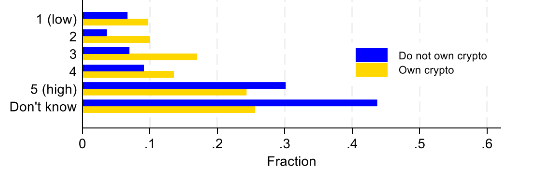
Specifically, the study found that crypto owners anticipated an average annual return of 22% over the subsequent year, a stark contrast to the 7% expected by non-owners. This divergence in return expectations was accompanied by a perception of lower risk among owners compared to non-owners. The quantitative impact of these expectations is substantial: a one-percentage-point increase in an individual’s expected crypto return was correlated with a 0.8-percentage-point rise in the probability of owning cryptocurrency. When combined with risk perceptions, these expectation-based factors explained a considerably larger portion of the variation in crypto ownership than traditional demographic variables.
A Distinctive Demographic Profile, Driven by Beliefs
Despite the primacy of expected returns, the demographic profile of crypto investors remains distinctive. The research indicates that individuals under 40 were approximately 13 percentage points more likely to own cryptocurrency than those over 60, even after accounting for other controlling factors. Men also exhibited a slightly higher propensity to own crypto, being about 4 percentage points more likely than women. Furthermore, households with higher incomes and greater wealth were more inclined to participate in the cryptocurrency market.
However, the paper’s most impactful finding for crypto markets may lie in its experimental evidence. In 2025, a randomized experiment exposed different households to information about Bitcoin’s performance, stocks, GameStop, or inflation. Participants who were shown Bitcoin’s 12-month trailing return subsequently increased their desired crypto portfolio allocation by approximately 2 percentage points. This represents a substantial 47% increase relative to the 4.3% desired allocation observed in the control group. Moreover, actual subsequent cryptocurrency purchases rose by about 2.5 percentage points.

The authors aptly describe this outcome as "providing information about recent Bitcoin returns induces some households to start buying cryptocurrency." This effect was particularly pronounced among individuals who had previously cited a lack of sufficient information as their reason for not owning crypto. Conversely, those who already held a negative view of crypto’s investment potential did not significantly alter their behavior in response to the information treatment.
The Speculative Bubble Mechanism and Consumption Patterns
The researchers posit that these findings illuminate a potential mechanism behind speculative bubbles in the cryptocurrency market. Past price appreciation can attract new investors, whose subsequent purchases drive prices even higher, thereby attracting further buyers. As the authors note, "Positive returns attract new participants, which raises the price further." This dynamic is particularly noteworthy given the widespread lack of understanding surrounding cryptocurrencies.
The paper references a 2021 survey where a striking 87% of non-crypto owners reported being unaware of expected returns over the following year. Even among existing crypto owners, 54% admitted to not knowing what return to anticipate. This knowledge gap, coupled with the strong influence of expected returns, creates fertile ground for speculative cycles.
The study also explored the impact of crypto wealth on household consumption. It found that a doubling of Bitcoin’s price led to a 1.4 percentage point increase in the likelihood of a household holding its entire financial portfolio in crypto to purchase a durable good. This effect is equivalent to roughly a 7% increase relative to the baseline probability of such a purchase. However, this elevated spending did not extend to ordinary consumption patterns, suggesting that the perceived nature of crypto gains might be different from a sustained increase in wealth.
Crypto Gains: "Gambling Income" or Permanent Wealth?
The researchers drew a stark comparison, suggesting that crypto gains are treated more like "gambling income" or lottery winnings rather than a permanent enhancement of wealth. This interpretation offers further insight into the ephemeral nature of some crypto-driven consumption booms and the potential for rapid reversals when prices decline.
The broader implications of this research are significant. It suggests that the inherent volatility of cryptocurrency markets may be rooted, at least in part, in widespread disagreement and ongoing learning among investors, rather than solely in the fundamental underpinnings of the assets themselves. The authors conclude that cryptocurrency stands out due to its relative newness, the lack of common understanding, the formation of sharply divergent investor beliefs about its future prospects, and the susceptibility of these beliefs and behaviors to new information about past returns.
The Future of Crypto Demand: Information and Expectations
The paper’s concluding remarks offer a potentially sobering outlook for the cryptocurrency market. "The absence of common information and beliefs about crypto across investors," the authors write, "suggests that price volatility will continue to be one of the most defining characteristics of this new asset for the foreseeable future." This implies that the next wave of retail demand might not be solely contingent on the absolute price of Bitcoin or other cryptocurrencies, but critically on what narratives and information are disseminated about their past price trajectories.
This suggests that the psychological and informational dynamics play an outsized role in shaping crypto market behavior. As the asset class matures, the focus on fundamental analysis may indeed grow, as suggested by other recent market observations. However, this research from the Federal Reserve Bank of Cleveland underscores that for a significant segment of the market, the narrative and the perceived potential for future gains, heavily influenced by recent performance, remain paramount drivers of participation.
The study’s methodology, combining large-scale household surveys with controlled experimental interventions, provides robust evidence for these conclusions. The randomized information experiment, in particular, offers a powerful tool for understanding causal relationships in financial decision-making, especially in a novel and often opaque asset class like cryptocurrency. The clear demonstration that information about past returns can directly influence investment decisions and actual purchases is a key takeaway, painting a picture of a market that is still in a formative stage, highly susceptible to informational inputs and the formation of divergent expectations.
Background Context and Chronology
The research draws upon data collected over a period that has seen significant fluctuations in the cryptocurrency market. The surveys were conducted in years characterized by both booming rallies and sharp corrections, providing a rich backdrop for analyzing investor behavior. For instance, the period around 2021 saw a surge in cryptocurrency adoption and prices, followed by a significant downturn in 2022. The researchers’ experimental design, including the 2025 experiment, aims to capture and dissect these dynamics across different market phases.
The underlying Federal Reserve’s Survey of Household Economics and Decisionmaking (SHED) has been a recurring source of data for U.S. economic policymakers since 2013, providing a consistent framework for understanding the financial well-being and decisions of American households. The inclusion of specific questions related to cryptocurrency ownership and expectations within this broader survey allows for a more integrated analysis of digital assets within the context of household finance.
The paper’s findings are particularly relevant in light of increasing institutional interest in cryptocurrencies, alongside continued retail participation. Understanding the motivations and belief systems of retail investors is crucial for regulators and market participants alike, as these factors can significantly influence market stability and price discovery. The Cleveland Fed’s contribution offers a data-driven perspective that moves beyond anecdotal observations to provide a more systematic understanding of why individuals choose to engage with this emerging asset class.
Implications for Market Stability and Future Research
The identification of a feedback loop where positive returns attract new buyers, further inflating prices, has direct implications for market stability. This mechanism can contribute to rapid price escalations and subsequent sharp declines, characteristic of speculative bubbles. The research suggests that interventions aimed at improving financial literacy and providing balanced information about the risks and potential returns of cryptocurrencies could play a role in mitigating such cycles.
Future research could delve deeper into the specific types of information that are most influential and explore the long-term impact of these belief formations on investor behavior. Further investigation into the relationship between crypto gains and consumption patterns, particularly distinguishing between durable and non-durable goods, could also yield valuable insights into how crypto wealth is integrated into household budgets. The paper’s findings serve as a crucial stepping stone in comprehending the complex interplay of information, expectations, and behavior in the dynamic world of cryptocurrency.