Sisilia Frederika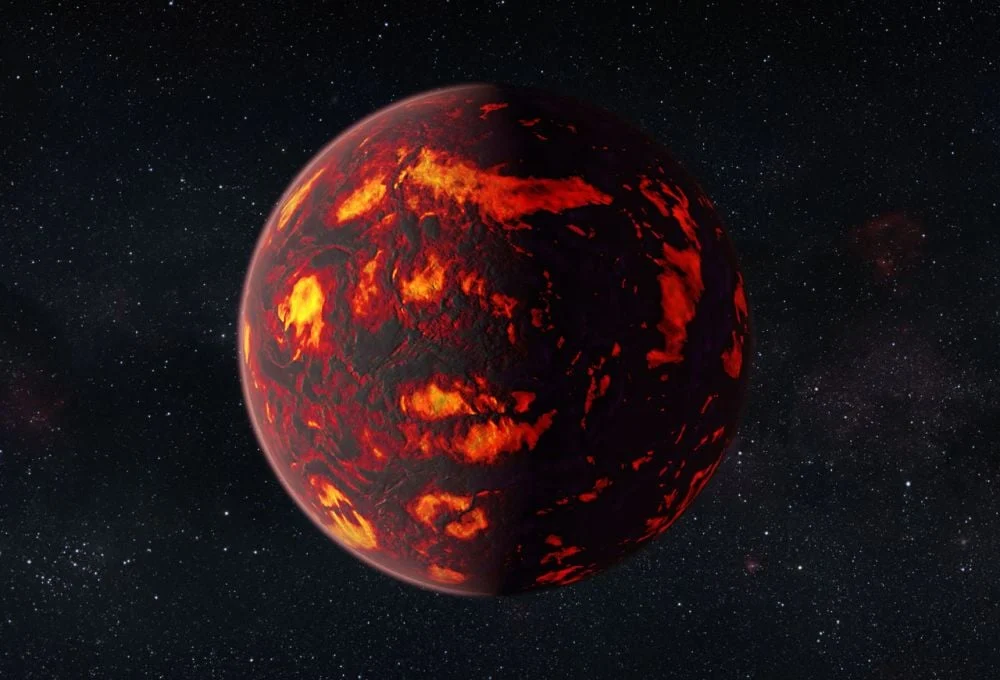
The scientific understanding of how planets retain or lose their atmospheres is undergoing a profound transformation as new data from the James Webb Space Telescope (JWST) challenges long-held assumptions about planetary evolution. For decades, the "cosmic shoreline" served as the primary empirical boundary used by planetary scientists to distinguish between worlds capable of maintaining an atmosphere and those destined to remain airless husks. However, recent research led by the Stanford Doerr School of Sustainability suggests that this boundary is far more complex than previously imagined. By introducing two new regimes—the "cosmic sandbar" and the "airless valley"—researchers are providing a more nuanced map of the cosmos, one that explains why some of the hottest known planets still possess thick atmospheres while cooler ones do not.
The Evolution of the Cosmic Shoreline Theory
In the realm of science, theories are not static edicts but adaptive frameworks that evolve alongside the arrival of new evidence. While foundational theories like Darwin’s Theory of Evolution or Einstein’s General Relativity have withstood a century of rigorous testing, they too began as radical propositions characterized by intense debate. The study of planetary atmospheres is currently in this "refinement" stage, accelerated by the unprecedented observational power of the JWST.
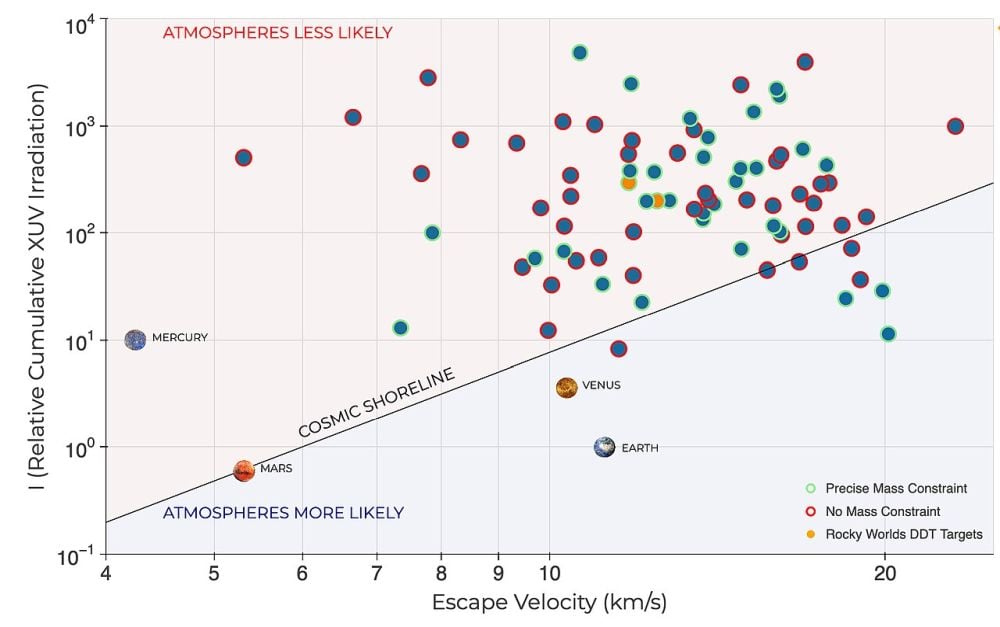
Traditionally, the cosmic shoreline was defined by a relatively simple relationship between two competing forces: stellar insolation and escape velocity. Insolation represents the amount of high-energy radiation a planet receives from its host star, which acts to strip away atmospheric gases. Escape velocity is the speed required for a molecule to break free from a planet’s gravitational pull; higher escape velocities, usually found on more massive planets, allow a world to "hold on" to its gases more effectively.
Under this binary model, worlds like Earth, Venus, and Saturn’s moon Titan fall on the "wet" side of the shoreline, possessing significant atmospheres. Conversely, Mercury and Earth’s Moon fall on the "dry" side, having lost their atmospheres to the vacuum of space. This model worked well for our solar system, but as astronomers began discovering thousands of exoplanets with wildly different characteristics, the shoreline began to show its limitations.
The JWST Disruption and the 55 Cancri e Paradox
The catalyst for the current theoretical shift was the observation of "lava worlds"—rocky exoplanets orbiting so close to their stars that their surfaces are perpetually molten. According to the traditional cosmic shoreline, these planets should be the most airless places in the universe. The extreme heat should have blasted away any trace of a volatile atmosphere eons ago.
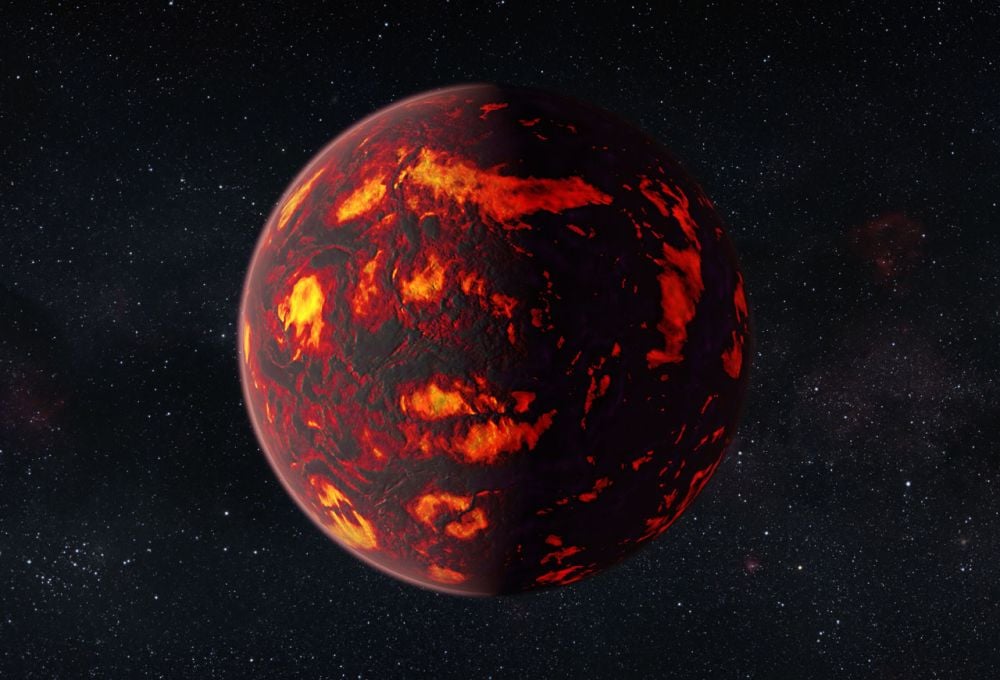
However, JWST observations of 55 Cancri e, a super-Earth located approximately 41 light-years away, contradicted this expectation. 55 Cancri e orbits its star at a distance of just 0.01544 AU, completing a full "year" in less than 18 hours. Despite being subjected to staggering levels of radiation, data published in 2024 indicated that the planet possesses a substantial atmosphere rich in carbon dioxide (CO2) or carbon monoxide (CO).
Initially, scientists hypothesized that these atmospheres might be composed of vaporized rock—a "mineral atmosphere" created by the boiling surface. But the JWST data pointed toward a "bona fide" volatile atmosphere. This discovery created a paradox: how could a planet so hot and so close to its star maintain an atmosphere that, by all existing rules of physics, should have vanished?
Introducing the Cosmic Sandbar and the Airless Valley
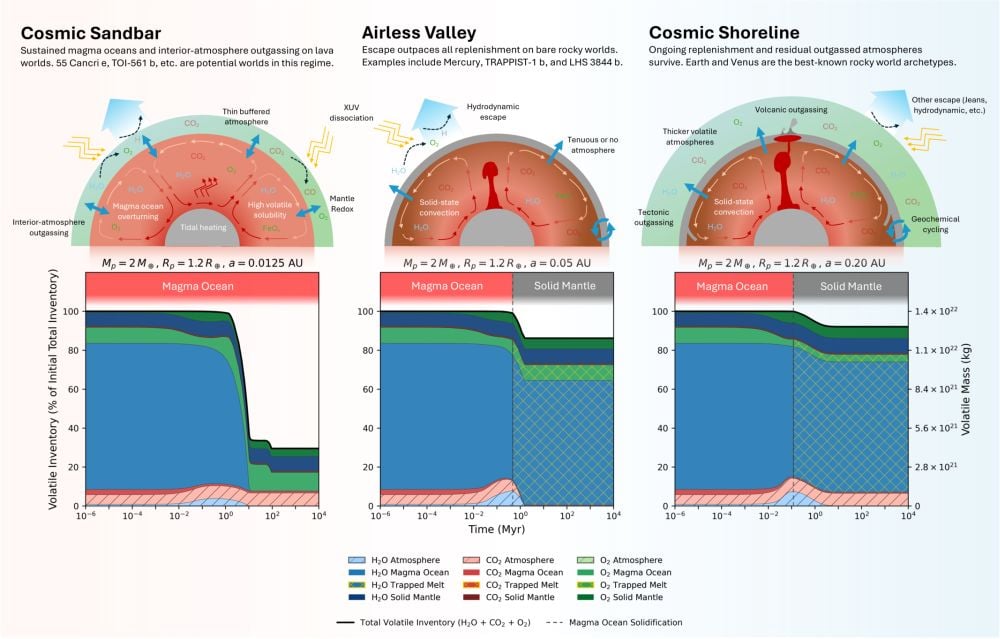
To resolve this discrepancy, lead author Barron Nguyen, a graduate student at the Stanford Doerr School of Sustainability, and senior author Laura Schaefer, an assistant professor of Earth and planetary sciences, developed a new coupled atmosphere-interior evolution model. Their findings, published in The Astrophysical Journal Letters, propose that the transition between airless worlds and atmospheric worlds is governed by three distinct regimes rather than a single line.
1. The Cosmic Sandbar (Outgassing-Regulated)
The "cosmic sandbar" is the most significant addition to the theory. This regime encompasses ultra-hot lava worlds like 55 Cancri e and TOI-561 b. In these environments, the planet’s surface is a global magma ocean. While the star’s radiation is constantly stripping the atmosphere away, the magma ocean acts as a massive reservoir of volatile gases. Through a process of continuous outgassing, the interior of the planet replenishes the atmosphere as quickly as it is lost.
"These lava worlds have pointed to something being wrong with the cosmic shoreline boundary, but we’ve found a way for them to preserve their atmospheres by proposing a new regime beyond it," Nguyen stated. The "sandbar" serves as a temporary but long-lived stronghold where the planet’s internal heat and molten state allow it to defy the erosive power of its star.
2. The Airless Valley (The Graveyard of Cores)
Between the hot sandbar and the cooler shoreline lies the "airless valley." This is a region where atmospheric escape outpaces any possible replenishment. It is often populated by planets that have had their thick hydrogen-helium envelopes stripped away, leaving behind bare rocky cores. These worlds, such as TRAPPIST-1b and Mercury, represent a "graveyard" of sorts.
In the airless valley, the planets have cooled enough for their surfaces to solidify, which effectively "locks" volatiles inside the mantle. Without a magma ocean to provide a steady supply of gas to the surface, the atmosphere cannot be replenished once it is lost to space.
3. The Cosmic Shoreline (Escape-Regulated)
The traditional cosmic shoreline remains, but it is now understood as the regime for cooler terrestrial planets. In this zone, the stellar radiation is low enough that outgassed atmospheres can survive for billions of years without being immediately blasted away. This is where Earth and Venus reside. Here, the primary factor for atmospheric retention is the planet’s ability to hold onto what it has, rather than its ability to constantly manufacture new air from a molten interior.
Technical Analysis: The Role of Magma Oceans and Tidal Heating
The researchers’ model highlights a critical and often overlooked factor in planetary evolution: the connection between a planet’s interior and its sky. The "sandbar" effect is specifically driven by long-lived magma oceans. These oceans are sustained not only by stellar heat but also by "tidal heating"—the internal friction caused by the gravitational tug-of-war in multi-planet systems.
On planets like 55 Cancri e, this tidal heating keeps the interior molten for much longer than would be expected by age alone. As long as the magma remains liquid, it can hold volatiles like CO2 and water in solution, releasing them slowly over time. This creates a feedback loop: the atmosphere provides a measure of insulation, and the magma ocean provides the atmosphere.
In contrast, planets in the "airless valley" undergo rapid solidification. Once the crust forms, the pathway for gases to reach the surface is restricted. If the planet is orbiting an M-dwarf (a red dwarf star), which is known for violent flaring and high X-ray/UV output, the atmosphere is stripped away faster than the solid planet can vent new gases through volcanic activity.
Implications for the Search for Habitable Worlds
The redefinition of the cosmic shoreline has profound implications for the search for life beyond our solar system. The primary goal of astrobiology is to identify planets with liquid surface water, but liquid water cannot exist without sufficient atmospheric pressure.
"Scientists have been interested in figuring out which planets have atmospheres and which do not, because that’s the first step of looking at planetary habitability," Nguyen noted. By understanding the "airless valley," astronomers can more accurately filter out planets that are unlikely to host life, even if they appear to be in a star’s "habitable zone" based on distance alone.
Furthermore, the discovery that lava worlds can maintain atmospheres changes how we categorize exoplanets. While 55 Cancri e is far too hot for life as we know it, the mechanisms that allow it to keep an atmosphere provide clues about the early histories of Earth and Venus, both of which likely transitioned through a magma ocean phase.
Conclusion: The Scientific Method in Real-Time
The transition from a single "cosmic shoreline" to a complex system of sandbars and valleys is a testament to the efficacy of the scientific method. As JWST continues to beam back data from the far reaches of the galaxy, it provides the "rational questioning" necessary to refine human understanding of the universe.
The work of Nguyen and his colleagues at Stanford demonstrates that the cosmic shoreline is not a "lost cause" or a failed theory, but rather a foundational idea that required expansion. As our instruments become more sensitive, our theories must become more sophisticated to match the diversity of the cosmos.
One day, this refined theory may lead us directly to a twin of Earth. For now, it provides a vital map for navigating the complex relationship between stars and the worlds that orbit them, proving that even in the most inhospitable corners of the universe—where rocks melt and the sun never sets—nature still follows a logic that we are just beginning to decode.