Clarissa Hana
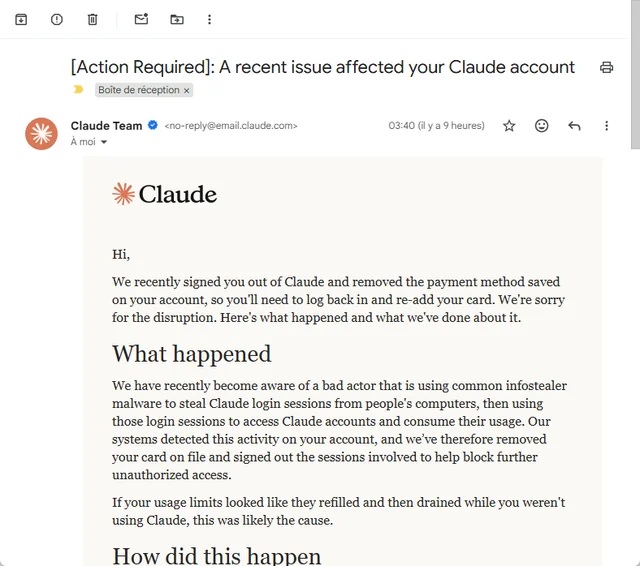
Anthropic, the artificial intelligence company behind the Claude large language model, is issuing urgent warnings to some of its users, alerting them to a sophisticated cyber threat that exploits infostealer malware present on their personal computers. This malware is reportedly stealing active Claude login sessions, enabling malicious actors to gain unauthorized access to user accounts and, consequently, consume their allocated usage without their knowledge or consent. The company has initiated a response to mitigate the damage, including signing affected users out of Claude, removing stored payment information, and processing refunds for any identified unauthorized charges.
The alarming discovery was detailed in an email sent by Anthropic to affected individuals, which was subsequently shared on a Reddit forum dedicated to Claude AI. The email stated, "We have recently become aware of a bad actor that is using common infostealer malware to steal Claude login sessions from people’s computers, then using those login sessions to access Claude accounts and consume their usage." This revelation paints a concerning picture of how sophisticated cybercriminals are leveraging readily available malware to target popular AI services. Anthropic further clarified that users might notice unusual activity, such as their usage limits appearing to reset and then rapidly deplete even when they are not actively using Claude, which would be a strong indicator of such a compromise.
Understanding the Threat: Infostealer Malware and Session Hijacking
Infostealer malware, a prevalent category of malicious software, is designed to covertly extract sensitive information from infected computers. This typically includes browser cookies, stored passwords, cryptocurrency wallet credentials, and other authentication tokens. The danger of these tools lies in their ability to capture active login sessions. When a user logs into a service like Claude, their browser stores session cookies that authenticate them for a period, eliminating the need to re-enter credentials. Infostealers can pilfer these cookies, allowing attackers to bypass traditional security measures such as multi-factor authentication (MFA) and directly impersonate the legitimate user.

Anthropic has explicitly stated that the malware is not intrinsically linked to Claude itself, nor is it believed to have been installed through any interaction with the Claude platform. Instead, the company emphasizes that the infection originates from the user’s local machine, often due to downloading compromised software, visiting malicious websites, or opening infected email attachments. The infostealer then harvests a wide array of data, with Claude’s authenticated sessions being just one of the many valuable pieces of information it collects. The attackers then selectively target these stolen Claude sessions from the compromised data pools.
Identifying the Culprits: A Spectrum of Malware
Anthropic’s investigation has identified a range of specific infostealer malware families associated with these attacks. On the Windows platform, the company has pointed to Vidar, LummaC2, StealC, RedLine, and Acreed as likely culprits. For macOS users, Atomic Stealer (AMOS) has been implicated in a smaller subset of incidents. These names represent well-known families of malware that are frequently updated and distributed through various illicit channels, often found on dark web marketplaces or bundled with pirated software.
The individual who shared Anthropic’s warning on Reddit confirmed that their system was likely compromised after downloading a pirated game, a common vector for malware infections. This anecdotal evidence aligns with Anthropic’s broader assessment of how these infections typically occur. The widespread availability and relative ease of use of these infostealer tools contribute to their persistent threat against individuals and organizations alike.
Anthropic’s Response and Mitigation Efforts

Upon detecting unauthorized activity, Anthropic has implemented several immediate protective measures for affected users. These include:
- Revoking Compromised Sessions: The primary action is to immediately sign the user out of all active Claude sessions. This effectively invalidates the stolen session cookies, preventing further unauthorized access.
- Removing Saved Payment Methods: To safeguard against fraudulent charges, Anthropic is automatically removing any payment methods previously saved within the user’s Claude account.
- Issuing Refunds: The company is committed to refunding any charges that are identified as unauthorized or resulting from the malicious consumption of usage.
However, Anthropic is also clear in its communication that these measures, while crucial for immediate security, do not resolve the underlying issue of malware infection on the user’s computer. "Signing you out of Claude stops the stolen sessions, but it doesn’t remove the malware," the company cautioned. "If it’s still on your computer, your next login session could be stolen the same way."
Recommendations for Affected Users
Anthropic strongly urges users who have received such warnings or suspect their accounts may be compromised to take proactive steps to secure their digital environment. These recommendations are standard best practices for cybersecurity and are essential for regaining control after an infection:
- Change Credentials: Users should immediately change their Claude account password to a strong, unique one. They should also consider changing passwords for other services, especially if they reuse passwords or if the infostealer may have had access to other credentials.
- Revoke Other Sessions: Where possible, users should review and revoke any unrecognized active sessions on other online services they use.
- Remove Malware: The most critical step is to thoroughly scan their computer for malware using reputable antivirus and anti-malware software. If malware is detected, it should be removed according to the software’s instructions. For persistent infections, professional IT assistance may be necessary.
- Enable Multi-Factor Authentication (MFA): While infostealers can bypass MFA by stealing session cookies, enabling MFA adds an extra layer of security that can deter less sophisticated attacks and provides an additional hurdle for attackers.
Broader Implications and the Evolving AI Security Landscape
The incident highlights a growing vulnerability at the intersection of AI services and endpoint security. As AI models like Claude become more integrated into daily workflows and personal lives, they represent increasingly attractive targets for cybercriminals. The ability of attackers to leverage common malware to bypass advanced AI security features underscores the need for a holistic approach to cybersecurity.
The reliance on session cookies, a fundamental web security mechanism, becomes a critical weak point when those cookies are exfiltrated. This incident serves as a stark reminder that even services with robust backend security can be compromised if the user’s own device is not adequately protected.
Data from cybersecurity reports consistently shows a significant gap between initial access prevention and the ability to block actions once an attacker has gained a foothold. For instance, a recent analysis revealed that when attackers possess valid credentials, only a mere 37% of their subsequent actions are successfully blocked. This statistic emphasizes that credential compromise, whether through phishing, brute force, or in this case, session hijacking, can dramatically reduce the effectiveness of preventative security measures.
The increasing sophistication of AI models also means that compromised accounts can lead to more significant consequences. Beyond the consumption of usage, attackers could potentially use stolen access to generate harmful content, engage in fraudulent activities under the user’s name, or even attempt to manipulate the AI’s outputs for malicious purposes, although Anthropic’s current findings focus primarily on usage consumption.
This event underscores the imperative for AI providers to continuously monitor for emerging threats and adapt their security protocols. Simultaneously, it places a greater responsibility on users to maintain vigilant cybersecurity hygiene, including keeping their operating systems and software updated, being cautious about downloads and links, and employing robust endpoint security solutions. The incident involving Claude and infostealer malware is likely a precursor to more sophisticated attacks targeting AI users as these technologies become even more pervasive. The challenge for both providers and users lies in staying ahead of evolving threats in this dynamic digital landscape.