Sisilia Frederika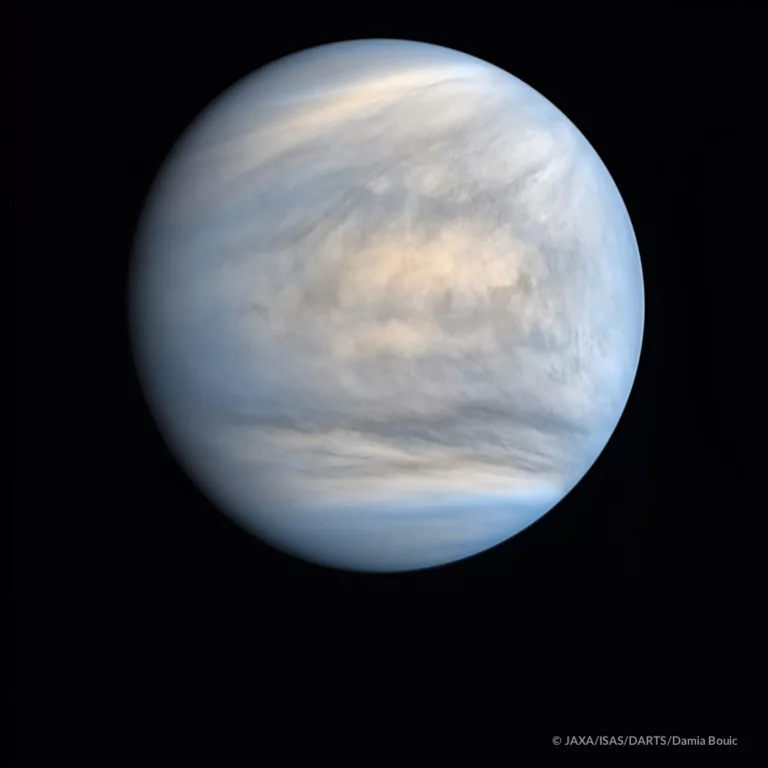
The second planet from the sun has long been characterized by its brilliant, uniform yellowish-white hue when viewed through traditional optical telescopes. To the amateur observer, Venus appears as a featureless, reflective orb, a result of its dense, global cover of sulfuric acid clouds. However, for planetary scientists operating in the ultraviolet (UV) spectrum, the planet reveals a much more chaotic and perplexing persona. In UV light, Venus is transformed into a high-contrast landscape of dark, swirling streaks and patches that circulate around the planet every four days, far outstripping the slow rotation of the solid planet beneath. For over a century, the identity of the substance responsible for these dark patterns—dubbed the "unknown UV absorber"—has remained one of the most significant mysteries in planetary science. A new study published in the journal Astrobiology by Jan Spacek and a team of international researchers provides a fresh perspective on this enigma by quantifying exactly how dark the Venusian clouds would appear if they were captured and measured in a laboratory setting.
The Enigma of the Ultraviolet Absorber
The phenomenon of Venusian UV absorption was first noted by ground-based observers in the early 20th century, but it was not until the arrival of spacecraft like Mariner 10 and the Pioneer Venus Orbiter that the scale of the mystery was fully realized. These missions showed that nearly half of the solar energy received by Venus is absorbed by these mysterious streaks in the upper cloud layers, located approximately 50 to 70 kilometers above the surface. This absorption plays a critical role in the planet’s thermal structure and atmospheric dynamics, driving the "super-rotation" of the atmosphere.
The research led by Jan Spacek addresses the fundamental question of the material’s physical properties. To determine the nature of the absorber, the team sought to calculate the "linear decadic absorption coefficient" of the cloud material. This value represents the inherent ability of a substance to absorb light at specific wavelengths, independent of how that light is scattered by the physical structure of the clouds. By determining how dark the clouds are in a "bulk" liquid state, scientists can narrow down the list of chemical candidates that could possibly exist within the harsh, acidic environment of the Venusian atmosphere.
Scattering vs. Absorption: The Physics of Cloud Coloration
To understand the challenge of identifying the UV absorber, one must distinguish between the processes of light scattering and light absorption. This distinction is vital in planetary meteorology. A common terrestrial analogy is found in a waterfall. While a deep river may appear dark because the water absorbs a small amount of light and allows the rest to penetrate deep or reflect away, the same water becomes brilliantly white when it goes over a cliff and is aerosolized into a fine spray. This is due to Mie scattering, a physical phenomenon where small particles—similar in size to the wavelength of light—reflect and redirect light in many directions.
On Venus, the clouds are composed of aerosolized droplets of concentrated sulfuric acid. These droplets are highly efficient at scattering visible light, which gives the planet its bright, reflective appearance. However, the dark streaks seen in UV light indicate that something within or between those droplets is actively absorbing photons rather than merely scattering them. The research team’s task was to strip away the "whitening" effect of Mie scattering to see the true "color" of the underlying material. By back-calculating from reflectance data, they were able to isolate the absorption characteristics of the mysterious chromophore (a light-absorbing molecule).
Methodology: Deciphering the Akatsuki Dataset
The study relied heavily on high-resolution data provided by the Japan Aerospace Exploration Agency’s (JAXA) Akatsuki spacecraft. Akatsuki, which entered orbit around Venus in 2015 after a dramatic five-year delay following an initial engine failure, is equipped with the Ultraviolet Imager (UVI). This instrument captures the planet at 283 nm and 365 nm, providing the most detailed look at the UV absorber to date.
Spacek and his colleagues analyzed the reflectance levels recorded by Akatsuki and applied complex atmospheric models to account for gas absorption and particle size distribution. Their findings revealed an absorption peak at approximately 375 nm. Crucially, the data showed a sharp, precipitous drop-off in absorption at wavelengths higher than 455 nm. This specific spectral "fingerprint" is the key to identifying the molecule. The researchers concluded that the absorber must be an incredibly efficient chromophore, meaning that even in low concentrations, it possesses a massive capacity to soak up ultraviolet light.
The Shortcomings of Inorganic Models
For decades, the leading candidates for the UV absorber have been inorganic compounds. Sulfur-related species, such as disulfur dioxide (S2O2) or ferric chloride (FeCl3), have been the favorites of atmospheric modelers. These substances are known to exist in volcanic environments and are chemically plausible within the context of Venus’s sulfur-rich atmosphere.
However, the new analysis presents a significant "reality check" for these inorganic theories. The researchers found that to match the extreme absorption levels observed by Akatsuki, these inorganic compounds would need to exist in concentrations that are physically impossible according to current aerosol models. For instance, if iron chloride were the culprit, the required amount would likely precipitate out of the droplets or alter the cloud chemistry in ways that have not been observed. This suggests that while inorganic chemistry is present on Venus, it may not be the primary driver of the high-contrast UV patterns.
The Organic Dilemma and the Red Oil Paradox
With inorganic candidates struggling to meet the quantitative requirements of the data, the focus has shifted toward organic molecules. Complex organics are known to be highly efficient light absorbers and could theoretically exist in the Venusian atmosphere, perhaps delivered by cometary impacts or synthesized through photochemical processes in the upper atmosphere.
However, the organic hypothesis faces its own chemical hurdle: the "red oil" problem. When simple organic molecules like glucose or formaldehyde are introduced to concentrated sulfuric acid—the primary constituent of Venus’s clouds—they undergo a process of dehydration and carbonization. This typically results in a dark, tar-like substance known as "red oil." While these oils are excellent absorbers of light, they are generally "flat" in their absorption spectrum, meaning they absorb light across the entire visible range.
The Akatsuki data, however, shows a very specific cutoff at 455 nm. If the clouds were filled with generic "red oils," the planet would likely appear much darker in visible light than it actually does. This implies that if organics are responsible for the UV absorption, they cannot be simple, degraded tars. Instead, they must be specific, stable molecular structures—perhaps complex, conjugated organic molecules—that maintain their integrity despite the acidic environment.
A Chronology of Venusian Atmospheric Observation
The search for the UV absorber has spanned over a century of scientific progress:
- 1920s: Ground-based observers first notice that Venus exhibits strange, dark markings when photographed through UV filters.
- 1960s: Astronomer Charles Boyer confirms the four-day rotation period of these UV markings, revealing the atmospheric "super-rotation."
- 1974: Mariner 10 provides the first close-up images of the UV streaks, showing complex, turbulent structures.
- 1978-1992: The Pioneer Venus mission and the Soviet Venera probes provide data on cloud composition, confirming the presence of sulfuric acid.
- 2006-2014: ESA’s Venus Express monitors the long-term variability of the UV absorber, finding that its abundance can change by as much as 50% over several years.
- 2015-Present: JAXA’s Akatsuki mission provides high-resolution, multi-wavelength data, allowing for the precise spectral analysis seen in the Spacek study.
Future Missions and the Search for Molecular Clarity
The debate between organic and inorganic origins is unlikely to be resolved through remote sensing alone. The next step in solving this puzzle requires in situ measurements—actually flying sensors through the clouds to sample the material directly.
Fortunately, several missions are on the horizon. NASA’s DAVINCI (Deep Atmosphere Venus Investigation of Noble gases, Chemistry, and Imaging) is scheduled to descend through the atmosphere in the early 2030s. More immediately, a private mission led by Rocket Lab, in collaboration with the Massachusetts Institute of Technology (MIT), aims to send a small probe to Venus. This mission will carry an Autofluorescence Nephelometer (AFN).
The AFN is designed to shine a 440 nm laser into the cloud droplets. If the droplets contain complex organic molecules with conjugated double bonds, they will "fluoresce"—emitting a characteristic glow. This would provide the first direct evidence of complex organics in the Venusian clouds. While fluorescence would not necessarily prove the existence of life, it would demonstrate that the clouds support a much more complex chemistry than previously thought and would likely identify the "unknown UV absorber" once and for all.
Broader Impact and Implications
The identification of the UV absorber has implications that reach far beyond the study of a single planet. Understanding how a planet can absorb such a vast amount of solar energy in its upper atmosphere is crucial for climate modeling, both for Earth and for exoplanets. If the absorber is indeed organic, it raises profound questions about the origins of such molecules in a seemingly hostile environment.
Furthermore, the "habitable zone" of Venus—the region between 50 and 60 kilometers where temperatures and pressures are remarkably Earth-like—remains a subject of intense astrobiological interest. If the UV absorber is linked to organic chemistry, it provides a potential framework for understanding how life, or at least the precursors to life, could survive in acidic aerosol environments.
As planetary science moves into a new era of Venusian exploration, the work of Jan Spacek and his team provides the quantitative constraints necessary to evaluate the data that will soon be returned from the clouds. Whether the answer lies in a rare inorganic compound or a resilient organic molecule, the resolution of this century-old mystery will fundamentally rewrite our understanding of Earth’s sister planet. For now, Venus remains a world of two faces: a brilliant, yellow gem in the night sky, and a dark, ultraviolet enigma that continues to challenge the limits of modern chemistry.