Sisilia Frederika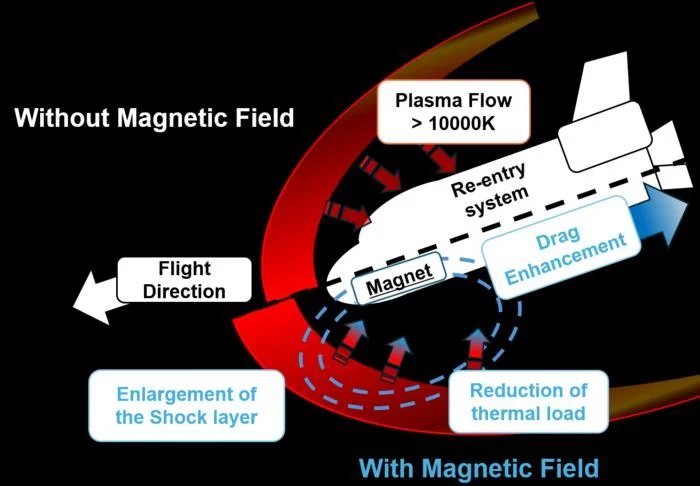
The pursuit of sustainable and efficient space travel has long been hindered by the physical limitations of atmospheric reentry. Traditionally, spacecraft have relied on ablative heat shields—sacrificial layers of material designed to char and disintegrate to dissipate the immense thermal energy generated during high-speed descent. While effective, this "by design" destruction presents significant challenges, including extensive refurbishment times and the burden of "dead weight" that reduces a vehicle’s payload capacity. However, a transformative solution is emerging from the field of magnetohydrodynamics (MHD). Researchers at Tokyo Metropolitan University (TMU) have recently unveiled a sophisticated test methodology that utilizes high-intensity magnetic fields to cushion spacecraft against the rigors of reentry, marking a pivotal step toward the next generation of reusable space vehicles.
The Physics of Reentry and the MHD Alternative
When a spacecraft enters a planetary atmosphere at orbital velocities—often exceeding 7.5 kilometers per second—the air in front of the vehicle is compressed so violently that it transforms into a weakly ionized plasma. This glowing shroud of superheated gas carries enough energy to melt or vaporize most known materials. To survive, current spacecraft utilize thermal protection systems (TPS) that either absorb heat (heat sinks) or carry it away through controlled erosion (ablation).
The MHD approach proposes a radical departure from these passive systems. By generating a powerful magnetic field from within the spacecraft, engineers can interact with the ionized plasma surrounding the vehicle. This interaction is governed by the Lorentz Force, a fundamental principle of electromagnetism where a moving charged particle—in this case, the ions in the plasma—experiences a force when passing through a magnetic field.
In a reentry scenario, the magnetic field acts as an invisible barrier, pushing the plasma away from the spacecraft’s surface. This "magnetic cushion" achieves two primary objectives: it significantly reduces the convective heat flux reaching the vehicle’s skin and increases aerodynamic drag. By effectively "embiggening" the aerodynamic profile of the craft without adding physical surface area, MHD braking allows for a more controlled and efficient deceleration.
Overcoming the Limitations of Permanent Magnets
Despite the theoretical promise of MHD braking, practical implementation has been stymied by hardware constraints. Early experimental designs relied on permanent neodymium magnets to generate the necessary fields. However, these magnets face a physical ceiling; their magnetic flux density typically peaks around 0.8 Tesla. In the hypersonic environment of reentry, where plasma pressures are extreme, 0.8 Tesla often lacks the "oomph" required to meaningfully displace the shock layer.
Furthermore, permanent magnets are heavy and rigid. Their fixed geometries make them difficult to integrate into the complex, curved architectures of modern spacecraft. This lack of adaptability means that for many mission profiles, the mass of the magnets outweighs the benefits provided by the reduction in heat shield thickness. To solve this, the TMU research team, led by T. Muramatsu, turned to an advanced electrical architecture known as a Pulse Forming Network (PFN).
The Pulse Forming Network: High Power Without the Weight
The Pulse Forming Network is an electrical circuit comprised of alternating capacitors and inductors. Its primary function is to store electrical energy over a relatively long period and then discharge it in a massive, controlled burst lasting only microseconds. This capability is uniquely suited for reentry testing and potentially for actual flight operations.
Because the PFN operates in extremely short pulses, it can generate magnetic fields far exceeding the limits of permanent magnets without requiring the massive cooling systems that would be necessary for a continuous-duty electromagnet. In the TMU experiments, the PFN was used to power a coil that generated a quasi-steady magnetic field during the critical moments of simulated reentry.
The researchers developed two distinct test modules to evaluate the PFN’s effectiveness across different geometries:
- Model 1: A blunt cylinder with a gentle nose curve, designed to simulate generalized reentry capsules. This model produced a magnetic flux density of 1.24 Tesla, representing a 50% increase over standard neodymium capabilities.
- Model 2: A design based on the MUSES-C (Hayabusa) asteroid sample return spacecraft. This model utilized a similar coil configuration to achieve a magnetic field of 1.58 Tesla.
Experimental Rigor: The MX-6.0 Expansion Tube
To validate these models, the Tokyo Metropolitan University team utilized their MX-6.0 expansion tube facility. This 8-meter-long aerodynamic testbed is designed to simulate the exact conditions of hypersonic flight. By firing shockwaves at speeds of up to 7.7 kilometers per second, the MX-6.0 replicates the atmospheric chemistry and kinetic energy of a vehicle returning from low Earth orbit or deep space.
A critical challenge in high-speed wind tunnel testing is synchronization. The window of time in which the hypersonic flow is stable is incredibly brief. The TMU team successfully synchronized the PFN discharge with the arrival of the shockwave, creating a standing magnetic field that lasted between 110 and 148 microseconds. While this duration seems infinitesimal, it was more than double the effective test time required to gather accurate data on the plasma-magnetic interaction.
Quantifying the "Magnetic Cushion"
The results of the study, published in the Journal of Spacecraft and Rockets, provided empirical evidence of the MHD effect. High-speed imaging and spectroscopic analysis revealed that the magnetic field successfully pushed the shock layer away from the models.
For Model 1, the thickness of the glowing shock emission region—the area where the plasma is most concentrated—increased by 15.7%. Model 2 saw an even more significant growth of 16.2%. In the context of aerospace engineering, these percentages are substantial. An increase in shock layer thickness directly correlates to a reduction in the temperature of the gas in immediate contact with the spacecraft’s surface. Furthermore, the expansion of the shock layer increases the effective "drag area" of the vehicle, allowing it to shed velocity higher in the atmosphere where the air is thinner and less thermally taxing.
Chronology of Reentry Innovation
The TMU research sits at the intersection of decades of aerospace evolution. To understand its significance, one must look at the timeline of reentry technology:
- 1950s: The "Blunt Body Theory" is developed by H. Julian Allen, showing that a rounded shape creates a shockwave that carries heat away from the vehicle.
- 1960s-1970s: The Apollo and Soyuz programs perfect ablative shielding using materials like AVCOAT.
- 1981: The Space Shuttle introduces reusable ceramic tiles, though they remain fragile and require intense maintenance.
- 2000s: Early MHD experiments in Russia and the US explore plasma actuators, but power constraints remain a barrier.
- 2010s: The rise of SpaceX and Blue Origin shifts the focus toward rapid reusability, making the "disposable" nature of ablative shields a primary economic bottleneck.
- 2024: The TMU study demonstrates that PFN-driven MHD can provide the necessary field strength for practical aerobraking without the weight penalties of previous systems.
Broader Implications for the Aerospace Industry
The implications of successful MHD braking extend far beyond the laboratory. For commercial space companies like SpaceX, the ability to reduce the mass of the thermal protection system on vehicles like Starship could translate into tons of additional payload capacity. In the space industry, where every kilogram launched costs thousands of dollars, such efficiencies are transformative.
Moreover, MHD technology offers a solution for missions to planets with thin atmospheres, such as Mars. Landing heavy payloads on the Red Planet is notoriously difficult because the atmosphere is thick enough to generate heat but too thin to provide sufficient drag for traditional parachutes. An MHD system could allow a Mars lander to "tune" its magnetic field to maximize drag, providing a controlled descent that is currently impossible with static heat shields.
Industry analysts suggest that if this technology can be scaled from 20mm test modules to full-sized spacecraft, it could lead to the development of "maintenance-free" reentry systems. This would drastically shorten the turnaround time between flights, moving the industry closer to the goal of airline-like space operations.
Future Research and Scaling Challenges
While the TMU pilot program was a resounding success, the researchers emphasize that the current setup was designed specifically for wind tunnel validation. Moving from a microsecond pulse in a test chamber to a multi-minute burn during an actual reentry sequence remains a significant engineering hurdle.
Future research will likely focus on:
- Superconducting Magnets: Exploring the use of high-temperature superconductors to maintain high-strength fields for longer durations with minimal power draw.
- Power Integration: Developing onboard power systems, perhaps utilizing the energy of the plasma itself (MHD generation), to power the braking magnets.
- Dynamic Control: Creating sensors that can adjust the magnetic field in real-time to respond to atmospheric turbulence or changes in the angle of attack.
The work at Tokyo Metropolitan University provides the foundational "ruler" by which these future systems will be measured. By creating a reliable, high-strength testing environment, they have given designers the tools to move MHD braking from the realm of science fiction into the blueprint of future spacecraft. As the global space race accelerates, the "invisible cushion" of magnetohydrodynamics may soon become the standard for every vehicle returning to Earth.