Evan Lee Salim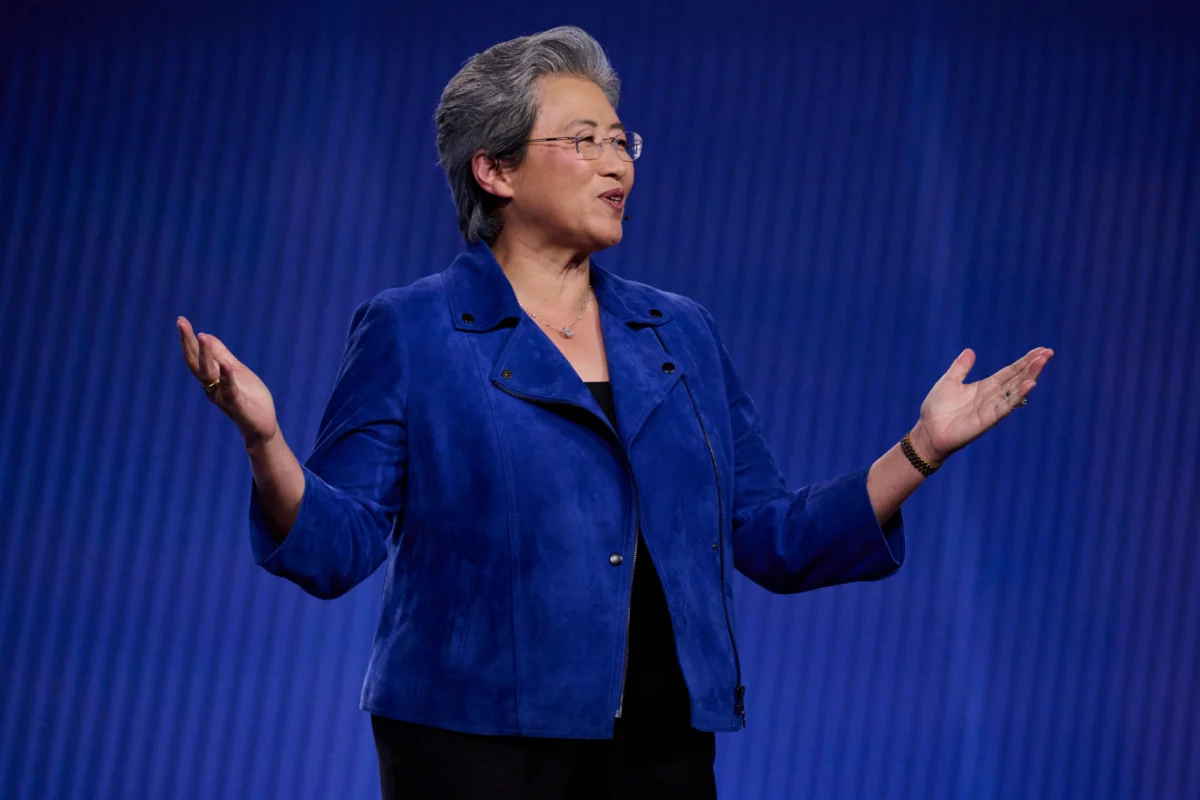
Advanced Micro Devices (AMD) has intensified its strategic offensive in the burgeoning artificial intelligence sector, officially unveiling its cutting-edge Helios rack-scale system, a formidable computing architecture designed to power the most demanding AI research and deployment needs of the world’s leading laboratories and enterprises. This aggressive move, showcased prominently at the company’s Advancing AI conference in San Francisco, directly targets Nvidia’s long-held supremacy in the high-performance AI accelerator market, promising unparalleled performance metrics and a rapidly expanding customer base that includes industry giants like Microsoft and Anthropic. AMD’s Chair and CEO, Dr. Lisa Su, positioned Helios not merely as a product launch but as a pivotal moment in the accelerating race to define the future of AI infrastructure, projecting a staggering $1.4 trillion market for AI accelerators by 2030.
AMD’s Bold Challenge: The Helios System Takes Center Stage
The announcement of the Helios AI rack system marks a significant escalation in AMD’s efforts to carve out a substantial share of the lucrative AI hardware market. Historically, Nvidia has commanded this domain, largely due to its early mover advantage, robust GPU architectures, and the pervasive CUDA software ecosystem. However, AMD’s introduction of Helios, first revealed in 2025 and given a public preview at CES 2026 in January, signals a determined push to disrupt this status quo. The system, engineered for massive-scale AI training and inference, integrates a multitude of processors into a single, high-powered unit, purpose-built for the intensive computational demands of modern data centers. Dr. Su lauded Helios as the tech industry’s "highest-performance AI rack," asserting its capability to "train and run the most demanding frontier models in the world at massive scale." Early reports from publications like The Register suggest Helios is already demonstrating performance metrics that rival, and in some cases surpass, Nvidia’s formidable Vera Rubin and Grace Blackwell rack-scale systems, setting the stage for an intense competitive battle.
The core philosophy behind Helios is to provide a complete, integrated solution for large-scale AI workloads. Rack systems are the backbone of contemporary AI development, acting as the fundamental building blocks for training increasingly complex neural networks and deploying sophisticated AI models. These units consolidate processing power, memory, and networking capabilities, optimized for parallel computing tasks characteristic of deep learning. AMD’s ambition with Helios extends beyond raw compute; it represents a full-stack approach, encompassing not just the hardware but also the necessary software and interconnects to facilitate seamless operation at unprecedented scales. The company has articulated plans for Helios to be deployed by leading AI companies at "gigawatt-scale," a term that underscores the immense power consumption and computational capacity required for the next generation of AI development, particularly for foundation models and the emerging field of agentic AI.
A Growing Ecosystem: Key Partnerships and Deployments Underline Confidence
A critical indicator of Helios’s potential impact is the rapidly growing roster of high-profile customers already committed to its deployment. Among these are some of the most influential entities in the AI landscape: OpenAI, Meta, Oracle, Anthropic, and Microsoft. These commitments provide significant validation for AMD’s technology and strategic direction. Microsoft, a long-standing partner and a major player in cloud computing and AI development, has been particularly vocal in its support. Microsoft CEO Satya Nadella confirmed earlier in the week that the company plans to significantly expand its Azure infrastructure with Helios, indicating a deep integration of AMD’s new system into one of the world’s largest cloud platforms. This partnership is crucial, as it provides Helios with immediate access to a vast enterprise customer base and validates its suitability for mission-critical cloud-based AI services.
Further bolstering AMD’s position, a strategic partnership between AMD and Anthropic was announced, detailing plans for Anthropic to deploy up to two gigawatts of AMD Instinct MI450 series GPUs via the new rack system. Anthropic, a leading AI safety and research company known for its Claude family of large language models, represents a cutting-edge customer whose demanding workloads will push Helios to its limits, simultaneously serving as a powerful testament to its capabilities. These partnerships are not just about hardware sales; they are about co-development, optimization, and the creation of a robust ecosystem that can effectively compete with Nvidia’s established CUDA platform. The collaboration with these AI pioneers suggests that AMD is not just selling chips, but actively participating in shaping the future of AI development through close technological alliances.
Beyond Helios: AMD’s Broader AI Portfolio and Strategic Vision
While Helios captured the spotlight, AMD’s Advancing AI conference also served as a platform to showcase other integral components of its comprehensive AI strategy. The company introduced its Venice-X CPU, slated for launch in 2027. This CPU is specifically engineered for data centers and designed to handle high-computing workloads, complementing the GPU-centric approach of Helios. The Venice-X is expected to feature an impressive 1152 MB of 3D V-Cache, 96 cores, and a boost clock of 5.15 GHz, based on the Zen 6 architecture. This dual-pronged strategy—high-performance GPUs for parallel AI workloads and powerful CPUs for general-purpose high-performance computing and data management—underscores AMD’s commitment to offering a full-spectrum solution for modern data centers. The interplay between these advanced CPUs and GPUs is critical for optimizing end-to-end AI workflows, from data pre-processing and model training to inference and deployment.
AMD’s strategic vision extends beyond individual hardware components. The company is actively investing in its software stack, recognizing that hardware performance alone is insufficient without a robust and user-friendly software ecosystem. Efforts to enhance ROCm (Radeon Open Compute platform), AMD’s open-source software platform for GPU computing, are crucial for attracting developers and enabling seamless migration of AI workloads from other platforms. This focus on both hardware innovation and software accessibility is essential for AMD to sustain its challenge against Nvidia, whose CUDA platform has long been a significant competitive moat due due to its extensive libraries, tools, and developer community.
The Agentic AI Era: Driving Unprecedented Compute Demand
Dr. Lisa Su’s keynote remarks provided a compelling long-term outlook on the trajectory of the chip industry, particularly concerning the profound impact of artificial intelligence. She asserted that by 2030, chips dedicated to powering AI will constitute a massive, perhaps even dominant, segment of the overall computing market. This dramatic shift is primarily driven by what she termed a "step change in compute demand," largely fueled by the emergence of "agentic AI."
Agentic AI refers to a new paradigm where AI systems are designed to autonomously reason, plan, and execute multi-step tasks to achieve a specific goal. Unlike traditional AI models that primarily perform pattern recognition or generate responses based on single prompts, agentic AI involves a continuous loop of reasoning, tool utilization, data access, and iterative problem-solving. As Dr. Su explained, "When you ask the agent to do something, it actually has dozens of steps, and it has to reason, and it has to call tools, and it has to access data, and it has to keep doing it over and over until it solves the problem, and so you need lots of GPUs to do all that." This inherent iterative and complex nature of agentic AI necessitates an exponential increase in computational power, far beyond what current generative AI models demand.
This exponential growth in demand underpins Dr. Su’s ambitious market projection: "We’re now expecting that by 2030, the AI accelerator market is going to reach about $1.4 trillion." To put this into perspective, she added, "What that means is, by the end of the decade, the AI accelerator market is going to approach the size of the entire semiconductor market today." This forecast highlights the extraordinary scale of the opportunity AMD is pursuing. Furthermore, she emphasized that GPUs are expected to constitute "the vast majority of that market" because "the algorithms are still very much in their infancy, and we’re still continuing to see the workloads change, and that favors programmability in the overall silicon ecosystem." The flexibility and parallel processing capabilities of GPUs make them uniquely suited to adapt to the rapidly evolving nature of AI algorithms, cementing their role as the primary workhorses of the AI revolution.
Future Outlook: Implications for the Semiconductor and AI Industries
The emergence of AMD’s Helios system and its aggressive market strategy carries profound implications for both the semiconductor industry and the broader landscape of AI development. For the semiconductor industry, increased competition in the high-end AI accelerator space could lead to faster innovation cycles, more diverse product offerings, and potentially more competitive pricing. Nvidia, while dominant, has faced increasing scrutiny over its market control and pricing power. A robust challenger like AMD could foster a healthier, more dynamic market, benefiting end-users and accelerating the pace of AI research globally.
For AI development, the availability of multiple high-performance hardware options from different vendors could democratize access to advanced computing resources. While the "gigawatt-scale" deployments are currently the domain of large enterprises and research labs, the underlying technological advancements will inevitably trickle down, making powerful AI infrastructure more accessible to a wider range of developers and organizations. This increased accessibility could spur further innovation, enabling smaller entities to contribute to the advancement of AI.
Moreover, the strategic partnerships forged by AMD with leading AI companies like Microsoft and Anthropic are indicative of a broader industry trend towards co-innovation. As AI models become more complex and resource-intensive, the lines between hardware providers, cloud service providers, and AI developers are blurring. These collaborations are crucial for optimizing hardware for specific AI workloads and for ensuring that the next generation of computing infrastructure is purpose-built to meet the evolving demands of AI.
In conclusion, AMD’s launch of the Helios rack-scale system represents a calculated and significant challenge to Nvidia’s long-standing dominance in the AI accelerator market. Backed by compelling performance claims, strategic customer commitments, and a comprehensive long-term vision articulated by Dr. Lisa Su, AMD is positioning itself as a formidable contender in a market projected to reach unprecedented scales. The battle for AI infrastructure supremacy is intensifying, and with Helios, AMD has fired a powerful salvo, setting the stage for a period of accelerated innovation and fierce competition that will ultimately shape the future of artificial intelligence.