admin
admin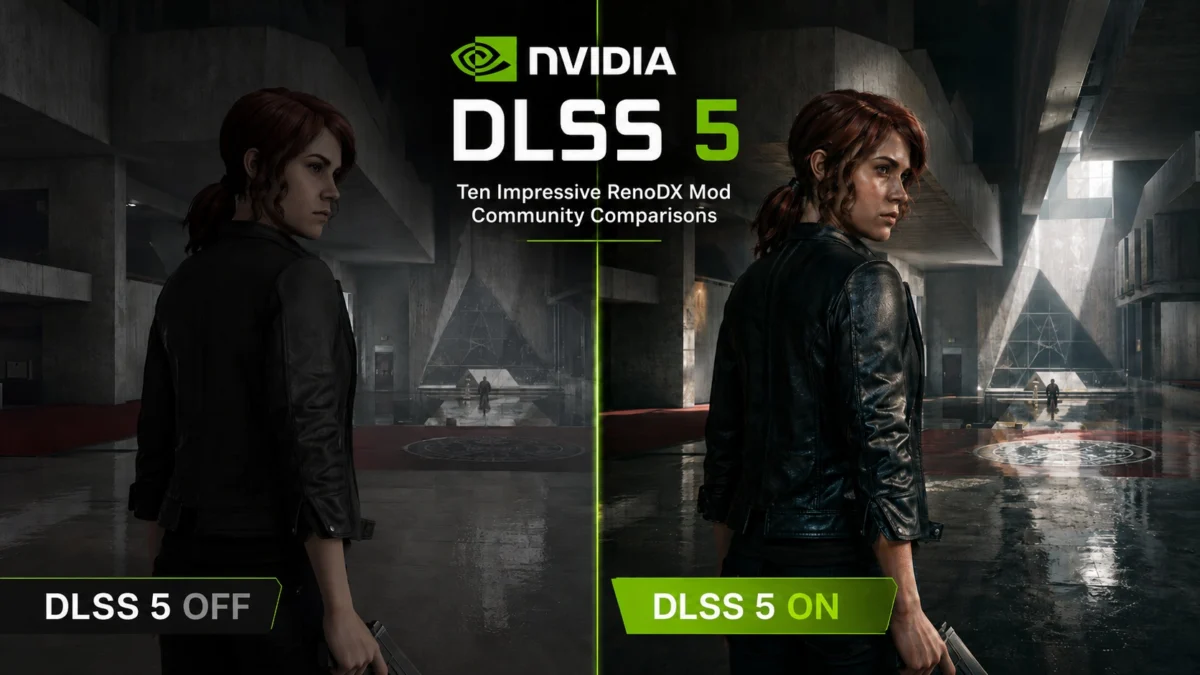
NVIDIA’s Deep Learning Super Sampling (DLSS) technology has undergone a fundamental evolution with the emergence of DLSS 5, a version that shifts the focus from image reconstruction and frame interpolation toward a more complex process known as Neural Rendering. This technology, designed to enhance lighting, materials, and character features such as skin and hair in real time, is being positioned by the company as a critical milestone in the pursuit of photorealistic gaming. While DLSS 5 has yet to see an official commercial release integrated into a retail title, the PC gaming community has successfully bypassed these barriers. By utilizing a leaked runtime library found in an early access build of NBA 2K27, enthusiasts and modders have begun testing the experimental functionality across a wide array of modern and legacy titles, providing a first look at the future of AI-driven graphics.

The Technical Foundation of DLSS 5 Neural Rendering
DLSS 5 represents the fifth major iteration of NVIDIA’s AI-powered graphics suite. Unlike its predecessors—DLSS 2, which focused on temporal upscaling, and DLSS 3, which introduced Frame Generation—DLSS 5 leverages a sophisticated neural rendering model. According to technical documentation provided by NVIDIA, the system functions by ingesting a game engine’s existing color buffers and motion vectors for every frame. These inputs are fed into a real-time neural model trained to recognize and reinterpret specific visual elements.

The primary objective of DLSS 5 is to bridge the gap between real-time rasterized or ray-traced graphics and the physical accuracy of offline cinematic rendering. The AI model is specifically trained on high-fidelity datasets involving human anatomy (skin pores, subsurface scattering), follicle dynamics (hair and fur), and complex material interactions (fabric sheen, translucency, and light refraction). By analyzing the scene, the neural network enhances these elements while attempting to remain "anchored" to the original 3D geometry and the developer’s artistic intent. This ensures that the AI does not hallucinate entirely new objects, but rather refines the existing ones to look more lifelike.

Chronology of the DLSS 5 Discovery and Modding Breakthrough
The public’s introduction to DLSS 5 did not come through a formal NVIDIA keynote, but rather through an accidental leak. In early 2026, a pre-release build of NBA 2K27 for PC was found to contain a specific file: "nvngx_dlssnr.dll." This file, the Neural Rendering runtime, was quickly identified by members of the RenoDX Discord server, a community dedicated to high-dynamic-range (HDR) and visual modding.

Initial attempts to run the library were met with hardware compatibility barriers. The leaked runtime utilized CUDA binaries specifically compiled for NVIDIA’s "Blackwell" architecture, the foundation of the GeForce RTX 50 Series GPUs. Consequently, the technology was initially inaccessible to the vast majority of PC gamers. However, the timeline of the mod’s development accelerated when a prominent modder known as Uncle Burrito successfully swapped the Blackwell-specific binaries with those compatible with the "Ada Lovelace" architecture. This breakthrough allowed the experimental DLSS 5 implementation to run on GeForce RTX 40 Series hardware, though NVIDIA has not yet confirmed whether official support will eventually extend to these older cards.

Using the RenoDX framework and the ReShade post-processing tool, the community developed a method to inject the Neural Rendering pass into DirectX 12 games. This process involves forcing the game to pipe its visual data through the experimental DLSS 5 model before the final image is output to the display.

Visual Analysis Across Diverse Gaming Environments
The application of DLSS 5 through unofficial mods has yielded a spectrum of results, ranging from transformative photorealism to visual inconsistencies that highlight the need for professional tuning.

Modern High-Fidelity Titles: Cyberpunk 2077 and STALKER 2
In Cyberpunk 2077, a title already renowned for its path-tracing capabilities, DLSS 5 serves as a refinement layer rather than a replacement for lighting. Analysts noted that the neural model significantly improved material response in Night City, particularly on wet surfaces and character clothing. However, without developer-led "masking," the AI occasionally over-sharpened faces, creating a "haloing" effect that conflicted with the game’s original atmospheric lighting.

Similarly, in S.T.A.L.K.E.R. 2: Heart of Chornobyl, which utilizes Unreal Engine 5, the neural rendering pass added immense detail to the rugged materials of the Zone. The interaction of light with fabrics and the weathered skin of characters became more pronounced. Nevertheless, the experimental nature of the mod often resulted in aggressive local contrast, suggesting that the model requires fine-tuning to avoid making environments look unnaturally harsh.

Stylized and Character-Driven Games: Final Fantasy VII Rebirth and Stellar Blade
Testing in Final Fantasy VII Rebirth and Stellar Blade revealed the potential "uncanny valley" risks associated with DLSS 5. In these titles, where character designs are highly stylized, the neural model’s tendency to add realistic skin pores and hair detail sometimes clashed with the "anime-adjacent" aesthetic. In Final Fantasy VII Rebirth, users found that a "natural" configuration—applying the effect with lower intensity—was far superior to the "cinematic" or "default" presets, which tended to alter the characters’ recognizable facial structures too drastically.

Legacy Titles and Remasters: GTA V and The Witcher 3
Perhaps the most dramatic visual shifts were observed in older titles. In Grand Theft Auto V, a game with a decade-old foundation, DLSS 5 managed to reinterpret character models to a degree that they resembled modern current-gen assets. Skin shading and facial depth were vastly improved. However, the lack of professional artist control meant that the AI sometimes misinterpreted lighting cues, leading to characters looking like AI-generated deepfakes rather than enhanced versions of Rockstar’s original models.

Performance Metrics and Hardware Demands
The most significant takeaway from the community’s testing is the massive computational cost associated with Neural Rendering. Unlike DLSS Super Resolution, which is designed to increase performance, the current iteration of DLSS 5 is a heavy post-processing overhead.

Data from multiple testing sources, including the YouTube channel Testing Games and various Reddit contributors, indicate a consistent performance penalty of 50% or more. For example:

- RTX 5090 in Control: Toggling DLSS 5 on resulted in the framerate being cut by more than half.
- RTX 5080 in Cyberpunk 2077: Performance dropped from approximately 71 FPS with Path Tracing enabled to 45 FPS when the DLSS 5 mod was layered on top.
- RTX 5090 in Stellar Blade: Framerates plummeted from a range of 155–250 FPS down to 118–125 FPS.
These figures suggest that DLSS 5 is not intended to be a "free" upgrade. The VRAM usage also spiked significantly during testing, leading to reports of memory leaks and stability issues when the technology was repeatedly toggled. Industry analysts suggest that for DLSS 5 to become a standard feature, it will likely need to be paired with further advancements in AI hardware acceleration found in future GPU architectures, or it must be heavily optimized through official integration.

Broader Implications and the Role of Developer Control
NVIDIA has consistently emphasized that DLSS 5 is intended to be a tool for developers, not a "one-size-fits-all" filter for end-users. The company’s documentation highlights the importance of intensity sliders, color-grading tools, and masking functionality. Masking is particularly crucial; it allows developers to tell the AI where to apply neural rendering (such as on a hero character’s face) and where to ignore it (such as on stylized UI elements or background environments that must maintain a specific look).

The unofficial experiments conducted via RenoDX lack these developer-side controls. This explains why the visual results, while often impressive, are frequently inconsistent. The "uncanny valley" effect—where a character looks almost human but "off" enough to cause revulsion—is a major hurdle for DLSS 5. If the AI adds hyper-realistic skin texture to a character with stiff, 2015-era animations, the contrast can be jarring.

Future Outlook: The Path to Photorealism
The emergence of DLSS 5 marks a pivot in how the industry views graphics rendering. We are moving away from a world where every pixel is calculated based on geometry and light rays, and toward a hybrid world where AI "imagines" the final details of a scene based on those calculations.

For NVIDIA, DLSS 5 is the logical conclusion of their investment in Tensor cores. While the current performance cost is prohibitive for most, history suggests that NVIDIA will find ways to optimize the technology, possibly through specialized hardware blocks or by combining it with more efficient versions of Frame Generation.

The community-led "Technical Preview" of DLSS 5 has provided invaluable data. It has proven that the technology can indeed make games look significantly more lifelike, but it has also served as a cautionary tale regarding the loss of artistic vision when AI is given too much autonomy. As official implementations begin to surface in titles like the rumored Oblivion Remastered and Assassin’s Creed Shadows, the industry will be watching to see if professional artists can harness this neural power without losing the "soul" of their games. For now, DLSS 5 remains a glimpse into a high-fidelity future that requires top-tier hardware and a delicate human touch to truly succeed.