Sisilia Frederika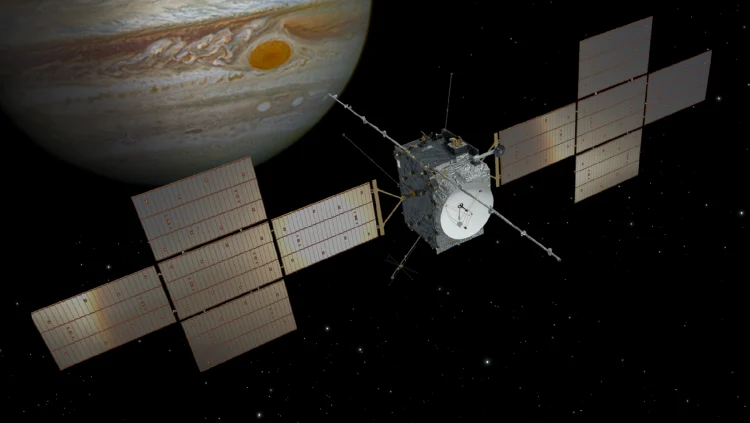
The international scientific community has turned its focus toward one of the smallest and most elusive members of the Jovian system, the moon Kallichore, as new research provides the precise data necessary for a high-stakes deep-space encounter. An international team of researchers, utilizing a sophisticated array of space-based and ground-based observational tools, has successfully characterized the physical properties and orbital dynamics of this tiny, irregular moon. The findings, recently published in the journal Nature, represent a critical milestone for the European Space Agency’s (ESA) Jupiter Icy Moons Explorer (JUICE) mission, which is currently traversing the inner solar system on its way to the gas giant. By significantly reducing the uncertainties surrounding Kallichore’s position, the study ensures that JUICE can maximize its scientific output during a planned flyby scheduled for late 2031.
Jupiter is often described as a "miniature solar system" due to its immense gravitational influence and its staggering collection of natural satellites. While the four Galilean moons—Io, Europa, Ganymede, and Callisto—command the majority of scientific and public attention, they represent only a fraction of the Jovian population. Jupiter hosts nearly 100 known moons, the vast majority of which are classified as "irregular." Unlike the Galilean moons, which possess nearly circular orbits and reside in the planet’s equatorial plane, irregular moons like Kallichore follow highly elliptical, inclined, and often retrograde paths. These small bodies are believed to be captured objects, likely asteroids or remnants of protoplanetary material trapped by Jupiter’s gravity billions of years ago. Because they have remained geologically inert since their capture, they serve as pristine "time capsules" of the early solar system’s chemical and physical conditions.
Physical Characteristics and the Dark Surface of Kallichore
The research team, drawing on data from NASA’s Hubble Space Telescope and the Gran Telescopio de Canarias (GTC) in Spain, has provided the most detailed portrait of Kallichore to date. One of the primary challenges in studying such a small object—with an average diameter of just 3.8 kilometers (approximately 2.4 miles)—is its extreme distance and lack of brightness. For comparison, Europa, the smallest of the Galilean moons, is roughly 3,122 kilometers (1,940 miles) in diameter, making Kallichore nearly a thousand times smaller.
The study’s analysis of Kallichore’s geometric albedo revealed a value of approximately 0.037, or 3.7 percent. In the context of planetary science, albedo measures the reflectivity of a surface on a scale from 0 (perfectly black) to 1 (perfectly reflective). An albedo of 0.037 indicates that Kallichore is an exceptionally dark object, reflecting less light than fresh asphalt or charcoal. This low reflectivity is characteristic of C-type (carbonaceous) asteroids, which are rich in organic compounds and hydrated minerals. The discovery supports the hypothesis that Kallichore and other members of the "Carme group"—a cluster of irregular moons with similar orbital characteristics—are fragments of a larger D-type or C-type progenitor that was shattered during a catastrophic collision after being captured by Jupiter.
Navigational Precision and the JUICE Mission Flyby
Beyond physical characterization, the primary motivation for the study was the refinement of Kallichore’s orbital parameters. Precision is the cornerstone of deep-space navigation, particularly when a spacecraft traveling at several kilometers per second attempts to intercept an object only a few kilometers wide. Prior to this research, the margin of error regarding Kallichore’s predicted position in 2031 was approximately 272 kilometers (169 miles). For a mission like JUICE, which relies on pre-programmed sequences to point its high-resolution cameras and spectrometers, such a margin was unacceptably large.
The new measurements provided by the international team have reduced this error margin by 80 percent. Mission planners now have a much tighter constraint on where the moon will be during the encounter. To guarantee a successful science return, the JUICE team aims for a margin of error of approximately 30 kilometers (19 miles). Achieving this level of precision allows the JANUS (Jovis, Amorum ac Natorum Undique Scrutator) camera system on JUICE to lock onto the target and capture high-resolution imagery that would otherwise be impossible if the moon were outside the instrument’s narrow field of view. The flyby is currently projected to occur in October 2031, just months after the spacecraft’s arrival in the Jovian system.
The JUICE Mission: A Decade of Discovery
The ESA’s JUICE mission represents one of the most ambitious robotic explorations ever attempted. Launched in April 2023 from Europe’s Spaceport in Kourou, French Guiana, the spacecraft is currently executing a series of complex gravity-assist maneuvers. These include a first-of-its-kind Earth-Moon flyby in 2024 and a Venus flyby in 2025, designed to "slingshot" the probe toward the outer solar system.
JUICE is scheduled to arrive at Jupiter in July 2031. Its primary mission is to explore the habitability of the icy moons Europa, Ganymede, and Callisto, all of which are suspected to harbor vast liquid water oceans beneath their frozen shells. However, the mission’s secondary objectives—including the study of the Jovian magnetosphere, the atmosphere of the gas giant, and the population of irregular moons—are equally vital for a holistic understanding of the system.
In December 2034, JUICE is slated to make history by entering orbit around Ganymede, the largest moon in the solar system. This will mark the first time a human-made spacecraft has orbited a moon other than Earth’s own. By studying Kallichore during its initial tour of the system, JUICE will provide comparative data that helps scientists understand the difference between the "native" moons of Jupiter and the "captured" residents of the outer reaches.
The Scientific Imperative of Irregular Moons
While the search for life often leads scientists to geologically active worlds like Europa, irregular moons offer a different kind of scientific treasure. Because moons like Europa have active volcanoes (in the case of Io) or shifting ice crusts and subsurface plumes, their surfaces are constantly being recycled. This geological activity erases the record of the moon’s earliest history.
In contrast, irregular moons are essentially frozen in time. They have no internal heat engines and no atmospheres to cause erosion. A crater on Kallichore might be billions of years old, providing a record of the impact history of the outer solar system. Furthermore, by analyzing the mineral composition of Kallichore’s surface, scientists can determine where in the solar nebula these objects originally formed. If Kallichore is found to be rich in volatiles and organic molecules, it could suggest that these small bodies played a role in delivering the building blocks of life to the inner planets, including Earth, during the "Late Heavy Bombardment" period.
Collaborative Research and Future Implications
The success of the Kallichore study highlights the necessity of international cooperation in modern astronomy. The Gran Telescopio de Canarias, located at the Roque de los Muchachos Observatory on the island of La Palma, is one of the world’s largest and most advanced optical-infrared telescopes. Its ability to resolve extremely faint objects, combined with the "top-down" view provided by the Hubble Space Telescope, allowed the researchers to cross-reference data and eliminate observational biases.
The implications of this study extend beyond the JUICE mission. As NASA prepares its own mission to the Jovian system—the Europa Clipper, set to launch in late 2024—the data gathered on the irregular moon population will assist in broader efforts to map the Jovian environment. Understanding the distribution and composition of these moons helps scientists model the gravitational dynamics of the early solar system, particularly the migration of the giant planets.
As the JUICE spacecraft continues its long trek across the vacuum of space, the work performed by astronomers on Earth ensures that when the probe finally reaches its destination, it will not be flying blind. The refinement of Kallichore’s orbit is a testament to the precision of modern celestial mechanics and the enduring curiosity of the human species.
In the coming decade, the data returned from the October 2031 flyby will likely answer long-standing questions about the origin of Jupiter’s irregular satellites. For now, Kallichore remains a silent, dark speck in the vastness of the Jovian suburbs, waiting for its first close-up encounter with a visitor from Earth. The success of this study ensures that when that moment arrives, science will be ready to unlock the secrets held within its ancient, shadowed craters.