Sisilia Frederika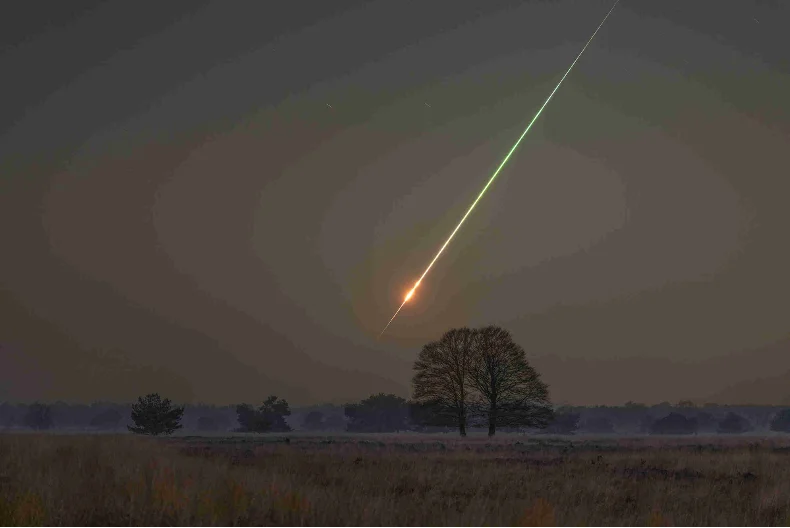
A collaborative team of researchers from the SETI Institute and NASA Ames Research Center has published a comprehensive study detailing the complex physical transformations space rocks undergo as they penetrate Earth’s atmosphere. The findings, recently featured in the journal Meteoritics & Planetary Science, provide a granular, step-by-step analysis of the transition from a high-speed bolide to a terrestrial meteorite. This research addresses a critical knowledge gap in planetary science, specifically regarding how the internal composition and structural integrity of a space rock dictate its behavior during the violent process of atmospheric entry. By analyzing 75 documented meteorite falls, the team has introduced a standardized seven-stage framework that describes the life cycle of these objects from the moment they encounter the upper atmosphere to their eventual impact on the ground.
The primary motivation for this extensive data synthesis was the need to better understand the mechanics of mid-air explosions, or airbursts. Such events, exemplified by the 2013 Chelyabinsk incident in Russia, pose significant risks to populated areas. Understanding the physics of how these rocks fragment is essential for the development of planetary defense strategies. Dr. Peter Jenniskens, a meteor astronomer at the SETI Institute and NASA Ames Research Center and the study’s lead author, noted that the research fundamentally shifts the scientific understanding of mass loss in space rocks. Historically, it was believed that the intense heat and light generated during entry caused the rock to evaporate entirely. However, the new data suggests that a combination of melting and mechanical fragmentation is the dominant force in how a bolide sheds its mass.
The Seven-Phase Evolution of Atmospheric Entry
The researchers utilized video and photographic evidence from 75 specific meteorite events to categorize the entry process into seven distinct phases. These phases are not uniform across all objects; rather, the altitude at which each phase occurs is heavily dependent on the rock’s velocity, entry angle, and mineralogical composition.
Phase 1: Atmospheric Entry. This initial stage occurs as the object first encounters the thin gases of the upper atmosphere. At this point, the rock is traveling at speeds ranging from 11 to 72 kilometers per second. While the friction is present, it has not yet generated enough heat to produce visible light.
Phase 2: Onset of Luminosity. As the atmospheric density increases, the kinetic energy of the rock begins to convert into thermal energy. The surrounding air becomes ionized, and a faint glow becomes visible to ground-based observers and satellite sensors.
Phase 3: Fireball Formation. The brightness of the object increases exponentially. The rock is now a "fireball" or "bolide." A shockwave forms in front of the object, compressing the air and raising temperatures to thousands of degrees Celsius.
Phase 4: Thermal Equilibrium and Initial Melting. The brightness maintains a steady peak as the exterior of the rock begins to melt. This creates a thin layer of molten material, known as a melt-mantle, which is continuously stripped away by the high-velocity airflow in a process called ablation.
Phase 5: Frontal Fragmentation. The immense pressure exerted on the leading face of the rock causes the primary structure to fail. The front of the rock begins to break apart into smaller fragments, significantly increasing the total surface area exposed to the atmosphere and often resulting in a visible flare of light.
Phase 6: Rear Fragmentation. Following the failure of the leading edge, the trailing sections of the rock succumb to the vacuum-like forces and turbulence in the wake of the object. This causes the remaining core to shatter into a "fragmentation cloud."
Phase 7: Dark Flight and Crust Formation. The final stage occurs when the fragments have decelerated to the point where they no longer generate enough heat to glow. This is known as "dark flight." During this time, the molten exterior cools rapidly, forming a thin, glassy "fusion crust." The wind then discards the smaller crusted pieces as they tumble toward the surface.
Data-Driven Insights and Methodology
To reach these conclusions, the SETI and NASA team meticulously analyzed a database of 75 meteorite falls where the trajectory and fragmentation could be visually verified. This dataset included various types of space rocks, ranging from common stony chondrites to rare metallic irons. By examining attributes such as entry angle, spin rate, and mass loss, the researchers were able to create a predictive model for how different materials react under thermal stress.
One of the most significant findings was the role of the rock’s "spin rate." A rapidly spinning rock distributes heat more evenly across its surface, potentially delaying fragmentation. Conversely, a rock with a slow spin or a fixed orientation may experience extreme thermal gradients, leading to premature structural failure. The study also highlighted that the angle of entry is a deciding factor in the severity of an airburst. A shallow entry angle results in a longer duration in the upper atmosphere, allowing for more gradual ablation, whereas a steep entry angle forces the rock into dense air much faster, increasing the likelihood of a catastrophic explosion.
Historical Precedents: Chelyabinsk and Tunguska
The practical implications of this study are best understood through the lens of historical events. The 2013 Chelyabinsk event serves as a modern benchmark for the dangers of mid-air fragmentation. On February 15, 2013, a 20-meter asteroid entered the atmosphere over Russia at approximately 19 kilometers per second. It exploded at an altitude of 30 kilometers with an energy release equivalent to 500 kilotons of TNT—roughly 30 times the yield of the Hiroshima bomb.
The resulting shockwave shattered windows across six cities and injured approximately 1,500 people. The SETI study explains why this occurred: the rock’s composition and entry speed caused it to skip Phase 4 and move rapidly into Phase 5 and 6, resulting in a massive release of energy at a high altitude. If the rock had been more metallic or had a different spin rate, the fragmentation might have occurred lower, potentially causing even more localized ground damage, or higher, where the shockwave would have dissipated.
Even more extreme was the 1908 Tunguska event. While no crater was ever found, a space rock estimated to be between 50 and 100 meters in diameter exploded at an altitude of 5 to 10 kilometers. The blast was 1,000 times more powerful than the atomic bomb dropped on Hiroshima, leveling 80 million trees across 2,150 square kilometers of Siberian forest. The new seven-phase model suggests that the Tunguska object likely underwent an extremely rapid Phase 5 and 6 transition, where the entire mass fragmented nearly simultaneously due to internal structural weaknesses, creating a "pancake" effect of compressed air that hit the ground with devastating force.
Implications for Planetary Defense
The findings published by Dr. Jenniskens and his team are of paramount importance to the NASA Planetary Defense Coordination Office (PDCO). By understanding the specific altitudes at which different types of asteroids are likely to fragment, scientists can better predict the "footprint" of an impending airburst.
If an asteroid is detected on a collision course with Earth, its spectral signature can tell astronomers about its composition (e.g., whether it is an S-type stony asteroid or an M-type metallic one). Using the seven-stage framework, defense experts can now estimate whether that specific rock will burn up harmlessly in the upper atmosphere, explode with a dangerous shockwave at mid-altitudes, or survive as a solid mass until ground impact. This allows for more accurate evacuation orders and disaster preparedness strategies.
Furthermore, the study clarifies that "mass loss" is not a simple linear process of melting. Because fragmentation (Phases 5 and 6) accounts for the majority of mass loss in larger bolides, the research suggests that we must focus on the internal "toughness" or fracture toughness of asteroids, rather than just their melting points.
Clarifying Astronomical Terminology
In addition to the physical mechanics of entry, the study emphasizes the importance of using precise terminology to describe these celestial phenomena. The general public often uses terms like "shooting star" or "comet" interchangeably, but in a scientific and legal context, the distinctions are vital:
- Meteoroid: A small rocky or metallic body in outer space, ranging in size from a grain of dust to objects one meter wide.
- Asteroid: A rocky body in space that is larger than one meter in diameter.
- Meteor: The visible streak of light (the "shooting star") produced when a meteoroid or asteroid enters the atmosphere and becomes incandescent due to friction.
- Bolide: A scientific term for an exceptionally bright meteor, especially one that explodes in the atmosphere.
- Meteorite: Any portion of a meteoroid or asteroid that survives the passage through the atmosphere and strikes the ground.
By standardizing these definitions alongside the seven-phase entry process, the SETI Institute and NASA hope to streamline communication between researchers, government agencies, and the public.
Conclusion and Future Research
The introduction of the seven-stage process of atmospheric entry represents a significant milestone in meteoritics. It moves the field away from generalized assumptions about "space rocks" and toward a nuanced, physics-based understanding of bolide behavior. As global monitoring networks—such as the All-Sky Fireball Network and various satellite-based infrared sensors—continue to capture more high-resolution data on meteorite falls, this model will be further refined.
Future research will likely focus on the role of "porosity" in the fragmentation process. Many asteroids are "rubble piles"—loose collections of rocks held together by gravity rather than solid blocks of stone. Applying the seven-phase framework to these porous objects will be the next step in ensuring that Earth is prepared for the next significant visitor from the cosmos. For now, the work of the SETI Institute and NASA Ames provides a vital roadmap for understanding the brief, violent, and brilliant journey of a space rock as it becomes a part of our world.