Clarissa Hana
Every click of an "Allow" button on an OAuth consent screen by an employee establishes a trust relationship between applications, often without deep consideration of the underlying security implications. This seemingly innocuous action grants third-party tools access to sensitive corporate data, ranging from calendars and communication platforms like Slack to critical code repositories. While the act of granting permission takes mere seconds, a thorough review and understanding of these permissions can consume significantly more time. For IT and security departments, the challenge is no longer preventing employees from connecting apps to corporate resources, but rather managing the vast and often invisible landscape of existing grants, identifying genuine risks, and revoking unnecessary access without succumbing to an overwhelming manual review process. This is the complex problem that Nudge Security aims to address.
The Perilous Nature of OAuth Grants: A Misunderstood Protocol
A fundamental misunderstanding surrounding OAuth grants is the assumption that they inherit the robust access controls established for user identities. This is a critical misconception. OAuth operates as a protocol entirely separate from authentication mechanisms. While Single Sign-On (SSO) verifies a user’s identity, and Multi-Factor Authentication (MFA) adds layers of security to that verification, an OAuth grant is neither. These grants possess an independent lifespan that often outlasts the credentials of the individuals who authorized them. Consequently, disabling a user account within platforms like Google Workspace or Microsoft 365 only suspends grants originating from those specific platforms. Grants issued by third-party applications, however, remain active and functional, creating persistent security gaps.
Furthermore, many OAuth grants lie dormant for extended periods, failing to generate any logged activity. Despite their inactivity, these grants retain their full authorization and can be exploited at any moment. Threat actors are acutely aware of this vulnerability. A stark example of this threat manifested in the recent Vercel breach. The root cause was identified as a compromised OAuth token originating from Context.ai, a third-party AI tool that an employee had previously connected to their enterprise Google Workspace account. This single point of consent, granted months prior, was sufficient for attackers to gain unauthorized access.
The sheer scale of these potential entry points underscores the persistent nature of the problem. Consider a company with 1,000 employees. If each employee connects an average of 88 third-party applications, this results in an astonishing 88,000 distinct access paths. Alarmingly, it’s estimated that approximately 31,000 of these paths could offer a direct line to sensitive corporate data, highlighting the immense attack surface created by unmanaged OAuth grants.
The Impracticality of Manual Reviews: A Bottleneck for Security Teams
The process of thoroughly reviewing a single OAuth grant is remarkably time-consuming and complex. It typically involves a multi-faceted evaluation:
- Grantor Identification: Determining who issued the grant.
- Grantee Assessment: Identifying the application receiving the access.
- Scope Analysis: Examining the specific permissions granted (e.g., read-only access to calendars, full control over documents).
- Data Sensitivity Evaluation: Assessing the type and sensitivity of the data the grant can access.
- Vendor Risk Profile: Investigating the security posture and reputation of the third-party vendor.
- User Context Review: Understanding why the specific employee granted the access and if it aligns with their role.
- Activity Monitoring: Checking for any recent or historical activity associated with the grant.
- Policy Compliance: Verifying adherence to internal security policies.
- Revocation Rationale: Determining if the grant should be revoked based on the above factors.
Executing this detailed review for a single grant can easily consume 45 minutes to an hour to reach a definitive verdict. While this timeframe might be justifiable for one grant, it becomes an insurmountable obstacle when faced with tens of thousands of such permissions. The sheer volume makes manual oversight impractical, regardless of the expertise of the security team. The limited headcount within most security departments further exacerbates this challenge, making it impossible to maintain adequate oversight of the ever-expanding OAuth grant landscape. This is precisely why advanced capabilities, particularly those leveraging AI, are not merely beneficial but essential for effectively managing OAuth grant risk and covering the actual attack surface of an organization.
Nudge Security: Bridging the Visibility and Governance Gap
Nudge Security is designed to tackle this pervasive challenge by providing comprehensive visibility into OAuth grants and app-to-app integrations across an organization’s entire Software-as-a-Service (SaaS) ecosystem. Its discovery capabilities are not reliant on activity logs, ensuring that even dormant grants and "Sign in with Google" type permissions, which often lack direct activity, are identified alongside active ones. Beyond OAuth grants, Nudge Security also surfaces critical programmatic access points such as API keys, service accounts, and remote managed code processing (MCP) server connections that power AI tools and agents, offering a holistic view of data access.
For every identified grant, Nudge Security provides a detailed inventory, including:
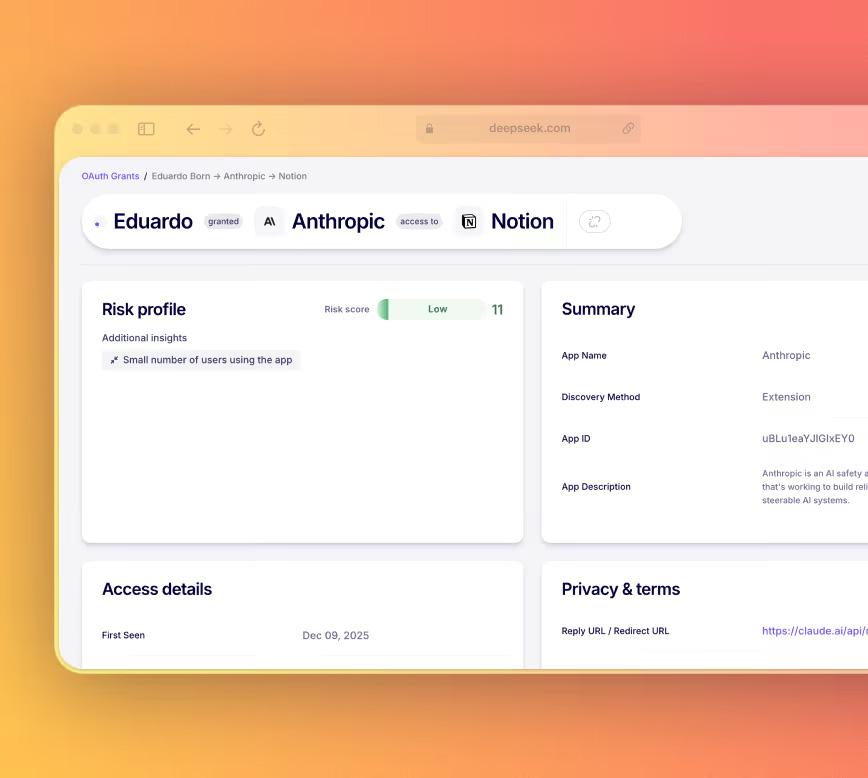
- Grantor: The identity provider that issued the grant.
- Grantee: The third-party application or service.
- User: The employee who authorized the grant.
- Permissions: A precise listing of the access granted.
- Creation Date: When the grant was initially established.
- Last Activity: The timestamp of the most recent interaction (if any).
- Risk Score: An automated assessment of the potential security risk.
Assessing Risk: Pinpointing Critical Vulnerabilities
A simple list of grants is insufficient for effective security management. Nudge Security elevates this by automatically classifying and assigning risk scores to every integration. This scoring is based on a sophisticated analysis of multiple factors, including:
- Scope of Permissions: The breadth and depth of access granted.
- Vendor Reputation: The security posture and trustworthiness of the third-party provider.
- Grantor Authority: The source of the grant and its inherent security levels.
- Organizational Usage: How widely the application is used within the company.
- Data Sensitivity: The criticality and confidentiality of the data accessible.
These risk insights actively flag critical security concerns, such as:
- Excessive Permissions: Grants that provide far more access than necessary for the application’s function.
- High-Risk Vendors: Connections to companies with known security vulnerabilities or a history of breaches.
- Dormant Grants: Permissions that have not been used recently but remain active and pose a potential risk.
- Unapproved Applications: Integrations that have not gone through the official vetting process.
Conversely, Nudge Security also highlights positive signals, such as the widespread adoption of certain applications or the presence of verified publishers. This allows security teams to quickly differentiate between routine, low-risk integrations and those that warrant immediate attention.
Analyzing Verdicts: AI-Driven Security Assessments
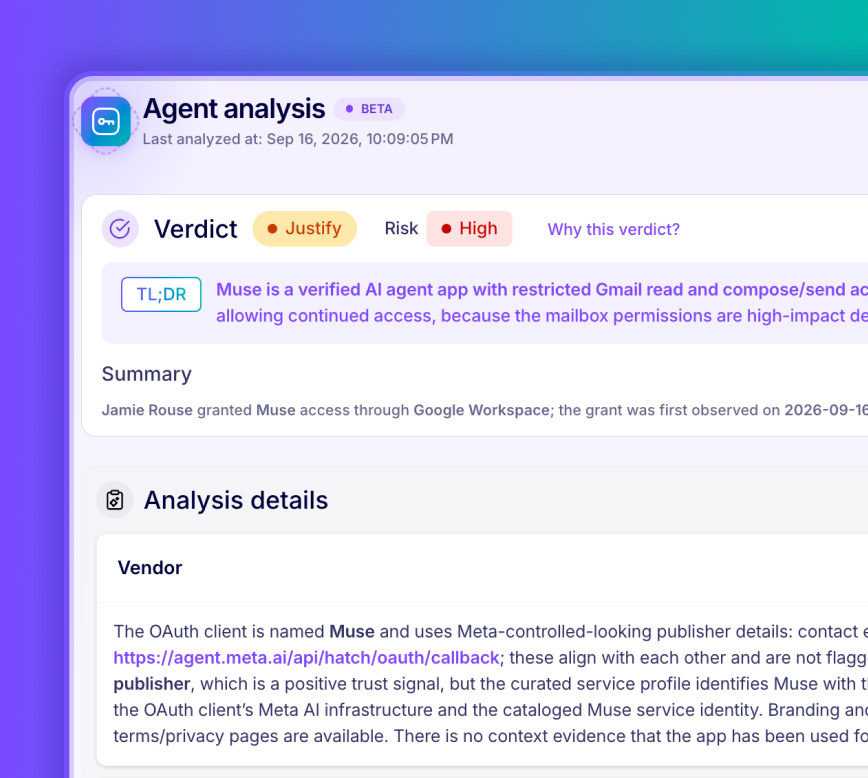
While risk scores serve as an initial indicator, the true power of Nudge Security lies in its OAuth Grant Risk Analyst agent. This AI-powered agent performs the actual in-depth analysis of each OAuth grant. As new grants appear, the agent continuously reviews them, leveraging Nudge Security’s comprehensive discovery context across browsers, inboxes, identity providers, and connected applications. It also draws upon threat intelligence from an extensive database of over 240,000 vendor security profiles.
The agent meticulously evaluates the same factors that an experienced human analyst would consider:
- Permission Scope: Does the granted access align with the application’s stated purpose?
- Vendor Trustworthiness: Is the vendor a reputable and secure entity?
- User Role and Context: Is the grant appropriate for the employee’s job function?
- Data Access Patterns: Is the application accessing data it shouldn’t be?
- Potential for Abuse: Could this grant be exploited for malicious purposes?
Crucially, the agent’s analysis extends beyond the technical capabilities of the grant itself. By examining who created the grant, it can identify potential risks that a simple risk score might miss. For instance, a grant created by a newly hired employee with access to sensitive development tools might be flagged as high-risk, even if the tool itself is generally considered safe.
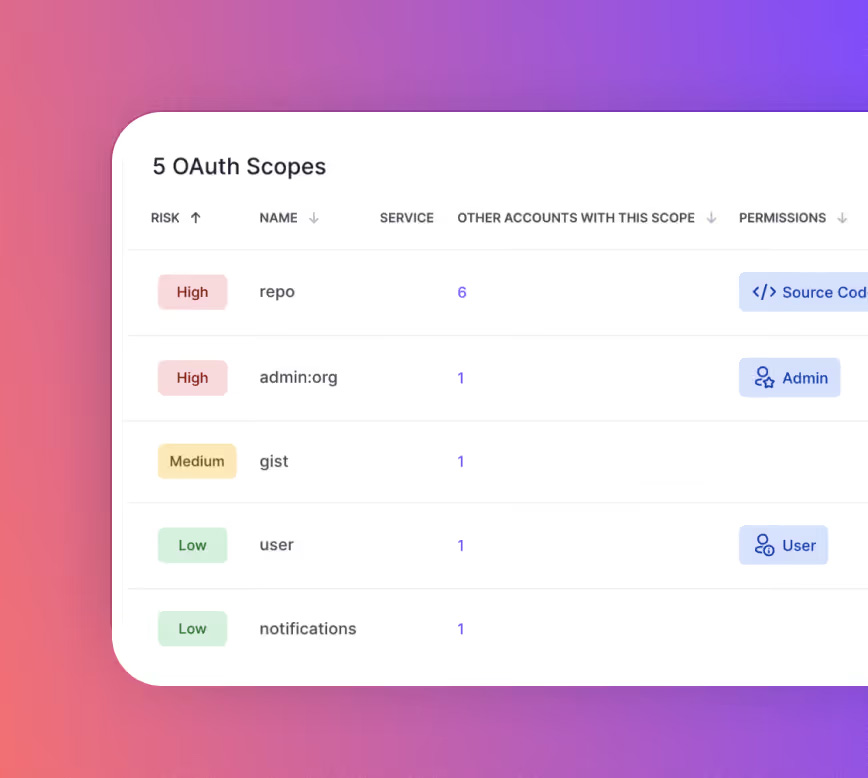
Each analysis concludes with a clear, plain-language risk evaluation, a concise "TL;DR" summary, detailed reasoning, identification of any evidence gaps, and one of three definitive verdicts:
- Approve: The grant poses minimal risk and can remain active.
- Review: The grant warrants further investigation or requires additional context.
- Revoke: The grant presents an unacceptable security risk and should be immediately deactivated.
The efficiency of this AI agent is remarkable. What would take a human analyst 45 minutes to assess, the agent can typically process and deliver a verdict within 15 seconds, drastically reducing the time to remediation.
Governing Access: Empowering Human Oversight with AI Efficiency
The speed and accuracy of the AI agent are only truly valuable when integrated into a trusted governance framework. Nudge Security ensures that the security team remains in control by presenting the agent’s recommendations for review before any action is taken. The agent suggests the appropriate next step, and your team reviews the verdict and the supporting evidence. Upon authorization, the agent orchestrates the necessary actions, whether it’s revoking the grant or initiating a request for the grantor to justify the access. Every action is meticulously logged, providing a complete audit trail of what was done, when, and why.
Beyond the automated analysis, Nudge Security offers robust controls to maintain ongoing oversight of OAuth risk:
- Automated Remediation: For approved actions, the agent can automatically revoke grants or trigger workflows for user re-authentication.
- Policy Enforcement: The system can be configured to automatically flag or revoke grants that violate predefined security policies.
- Continuous Monitoring: Nudge Security continuously monitors for new grants and changes in existing ones, ensuring that risk is managed proactively.
- Reporting and Dashboards: Comprehensive reports and intuitive dashboards provide visibility into the overall OAuth grant landscape and risk posture.
This integrated approach transforms a lengthy, manual review process into a swift, data-driven decision-making exercise for the security team, allowing them to manage risk in seconds without relinquishing control.
The Path Forward: Embracing Proactive SaaS Security
The reality is that employees will continue to connect applications to enhance their productivity, and this trend is unlikely to abate. The responsibility of security teams is to ensure that every such connection is visible, thoroughly understood, and judiciously managed, with access revoked when the associated risks outweigh the organizational benefits.
Nudge Security offers OAuth risk management as an integral component of a comprehensive SaaS and AI security governance solution. It provides an exhaustive inventory of OAuth grants, the contextual intelligence necessary to understand their associated risks, and an AI agent capable of delivering clear, actionable verdicts at scale. Crucially, it empowers security teams to retain full control over every critical decision.
For organizations seeking to regain control over the pervasive threat of risky OAuth grants and establish a robust posture for SaaS and AI security, Nudge Security presents a compelling solution. By leveraging AI-driven analysis and maintaining human oversight, businesses can navigate the complex landscape of application integrations with confidence, safeguarding sensitive data and mitigating potential security breaches.
Ready to gain control over risky OAuth grants? Start a free 14-day trial of Nudge Security today.