Clarissa Hana
The Cronos blockchain network has successfully resumed its trading activities and block production following a significant security incident involving the Tectonic cryptocurrency lending platform. The exploit, which leveraged price manipulation of Tectonic’s native TONIC token, allowed an attacker to illicitly borrow approximately $74 million, prompting a swift network-wide halt by Cronos validators. While the initial perceived value of the borrowed assets was substantial, the actual financial loss for the attacker has been significantly curtailed, with only around $6 million in Ethereum successfully siphoned off, according to blockchain security firm PeckShield. The incident underscores the inherent risks within decentralized finance (DeFi) ecosystems and the critical role of network-level interventions in mitigating widespread damage.
Genesis of the Exploit: Price Manipulation and Leverage
The security breach unfolded rapidly on the Cronos network, a blockchain platform closely associated with the cryptocurrency exchange Crypto.com. At the heart of the exploit was Tectonic, a prominent decentralized lending protocol operating on Cronos. Tectonic allows users to deposit various cryptocurrencies as collateral and then borrow other assets against these deposits. This mechanism, common in DeFi, is susceptible to sophisticated attack vectors, particularly those involving price oracles and market manipulation.
Reports indicate that the threat actor executed a carefully orchestrated plan to artificially inflate the price of Tectonic’s native token, TONIC. This price surge, described as a 100-fold increase, was achieved within a remarkably short timeframe of approximately 20 minutes. Such rapid price appreciation is often a red flag in financial markets and can be indicative of manipulative practices, especially in less liquid cryptocurrency markets.

Once the TONIC token’s value was artificially inflated, the attacker proceeded to utilize this inflated collateral to borrow other, more stable cryptocurrencies from the Tectonic protocol. The sheer volume of TONIC, now perceived as highly valuable due to the manipulated price, enabled the attacker to secure a large loan. The total value of assets borrowed reached an estimated $74 million.
The Aftermath: Network Halt and Partial Recovery
The immediate aftermath of the exploit saw the Cronos network take decisive action to contain the damage. Recognizing the systemic risk posed by the ongoing attack, Cronos validators initiated an "emergency action" to halt the blockchain’s operations. This drastic measure involved freezing all in-progress transactions, effectively pausing the network to prevent further illicit borrowing or asset transfers stemming from the exploit. The decision to halt the network, while disruptive to legitimate users, was presented as a necessary step to safeguard the ecosystem from escalating losses.
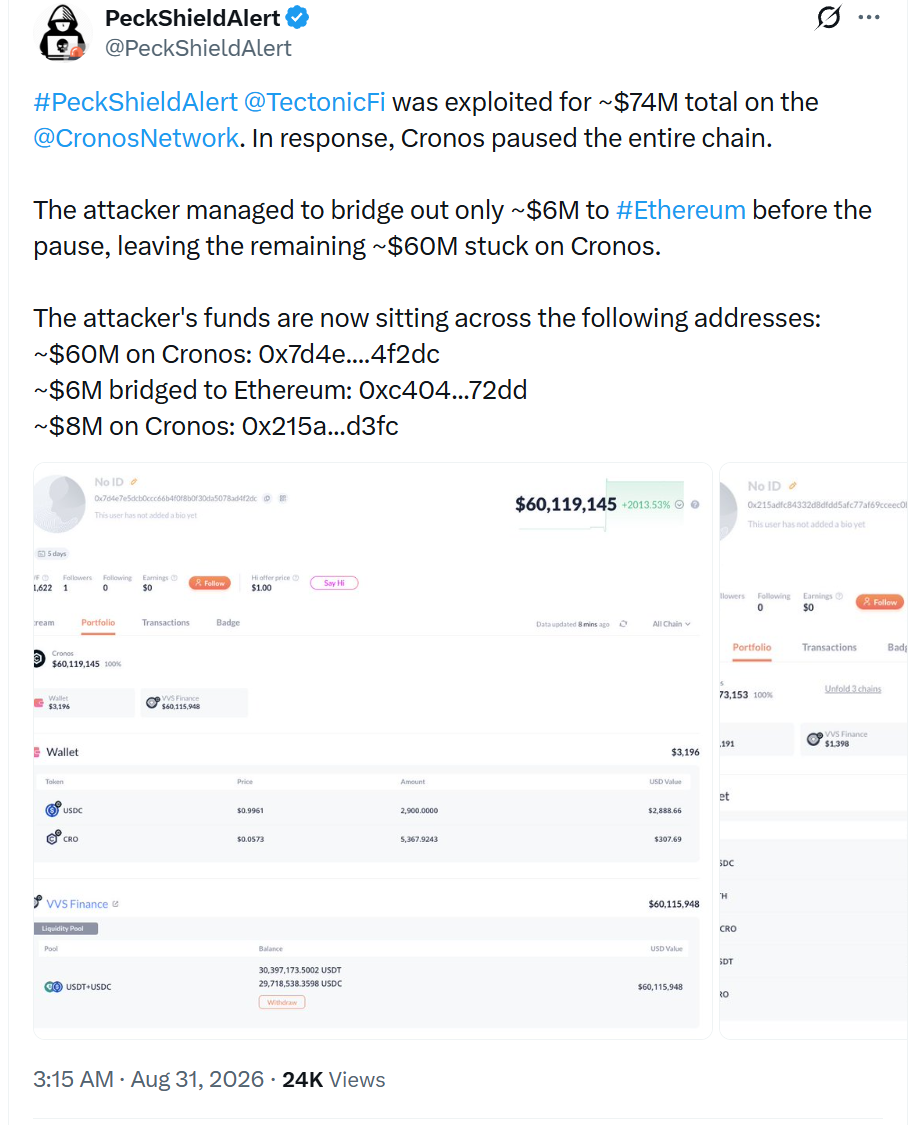
PeckShield, a leading blockchain security and data analytics company, provided crucial insights into the financial ramifications of the exploit. While the attacker managed to borrow $74 million worth of assets, the actual amount successfully extracted from the Tectonic protocol and the wider Cronos ecosystem was significantly less. PeckShield’s analysis revealed that approximately $6 million in Ethereum was stolen, with the remaining borrowed funds effectively becoming "stuck" within the Cronos network due to the subsequent halt and the nature of the exploited mechanics. This distinction is critical, as it highlights the difference between the notional value of borrowed assets and the actual realized profit for the attacker.
Timeline of Events: A Rapid Unfolding Crisis
The incident unfolded over a compressed period, demanding swift responses from all involved parties.

- Initial Price Inflation: Within a 20-minute window, the attacker artificially inflated the price of Tectonic’s TONIC token by an estimated 100 times.
- Exploitation of Lending Protocol: The attacker leveraged the inflated TONIC as collateral to borrow a substantial amount of assets from the Tectonic lending platform.
- Detection and Halt: The Cronos network, alerted to the suspicious activity, swiftly implemented a full network halt to prevent further exploitation. This occurred on August 30, 2026, at approximately 23:49:01 UTC.
- Investigation and Communication: Tectonic, the affected lending protocol, acknowledged the incident and advised users to refrain from interacting with the platform pending further investigation and confirmation of safety.
- Network Resumption: Following the implementation of necessary measures and an assessment of the network’s stability, Cronos announced the resumption of block production and trading activities. The network officially restarted, producing blocks again from block number 90,896,189.
- Post-Mortem Planned: Cronos indicated its intention to release a detailed post-mortem report to provide further insights into the exploit and the mitigation strategies employed.
Background and Context: Cronos and Tectonic Ecosystems
To understand the implications of this exploit, it is essential to contextualize the entities involved. Cronos is a prominent blockchain network designed for decentralized applications (dApps) and is often referred to as an "Ethereum-like" blockchain due to its compatibility with the Ethereum Virtual Machine (EVM). Its close association with Crypto.com, a major cryptocurrency exchange, has contributed to its adoption and the development of its ecosystem.
Tectonic, prior to this incident, was a significant player within the Cronos DeFi landscape. As one of Cronos’s largest lending protocols, it held a considerable amount of Total Value Locked (TVL), reportedly $122 million before the exploit. TVL is a key metric in DeFi, representing the total value of assets deposited into a protocol. The substantial TVL indicated Tectonic’s importance and the trust placed in it by the Cronos user base. The incident has dramatically impacted this metric, with DeFiLlama data showing the TVL dropping to just under $3 million following the exploit.
Official Statements and Responses
The swift actions and communications from both Cronos and Tectonic were crucial in managing the crisis.
Cronos Network’s Statement:
Cronos explicitly stated that the network halt was a "validator-consensus emergency action to protect users from an exploit on the Tectonic protocol." They further clarified that the chain state was "restored to before the Tectonic exploit," indicating a rollback to a point before the malicious activity could cause further irreversible damage. The network’s official communication confirmed the restart: "Cronos is producing blocks again as of 2026-08-30 23:49:01 UTC, starting from block 90,896,189." They also assured the community that the blockchain was under close monitoring for stability and protocol compatibility.
Tectonic’s Announcement:
Tectonic, in its initial communication, acknowledged the ongoing investigation into the incident. The protocol advised its users: "We are investigating an incident. Please refrain from interacting with the protocol until we confirm it is safe to do so." This cautious approach aimed to prevent further user losses while the situation was being assessed.
Analysis of Implications: Trust, Security, and Future of DeFi
The Cronos-Tectonic exploit, while ultimately contained in terms of financial loss for the broader ecosystem, has several significant implications for the DeFi space:
- Vulnerability of Price Oracles: The incident highlights the persistent vulnerability of DeFi protocols to price manipulation, particularly when relying on price feeds that can be influenced by trading activity within the same ecosystem. Sophisticated attackers can exploit these weaknesses to create artificial collateral value.
- Effectiveness of Network-Level Interventions: The decision by Cronos to halt the network, though a blunt instrument, proved effective in preventing the attacker from realizing the full $74 million in borrowed assets. This demonstrates the potential power of core network-level interventions in crisis management within blockchain ecosystems. However, such actions can also raise questions about decentralization and censorship.
- Impact on User Confidence: Despite the swift response and the limited actual loss, such events can erode user confidence in DeFi protocols and the underlying blockchain networks. The perception of security is paramount in attracting and retaining users and capital. The significant drop in Tectonic’s TVL is a direct indicator of this impact.
- Importance of Audits and Risk Management: The exploit underscores the critical need for rigorous smart contract audits, comprehensive risk assessments, and robust security practices for all DeFi protocols. Developers must anticipate and actively defend against potential attack vectors, including price manipulation and reentrancy attacks.
- The Role of Blockchain Security Firms: The swift analysis and reporting by firms like PeckShield are invaluable in understanding the mechanics of these exploits and in providing transparency to the community. Their role in forensic analysis and threat intelligence is becoming increasingly vital.
- Future of Lending Protocols: This event may prompt a re-evaluation of how lending protocols manage collateral, especially for tokens with volatile price action. Mechanisms for more resilient price discovery and stricter collateralization ratios might be explored.
The Cronos network’s resilience in recovering from this incident, coupled with the detailed post-mortem planned, will be crucial in rebuilding trust. The DeFi landscape is characterized by constant innovation, but also by persistent security challenges. Events like the Tectonic exploit serve as stark reminders of the ongoing arms race between attackers and defenders in the decentralized finance arena. The ability of networks and protocols to learn from these incidents, implement stronger security measures, and maintain transparency will be key to their long-term sustainability and growth.