Clarissa Hana
A critical vulnerability within GitLab, a popular platform for software development and version control, has been brought to light, revealing that private email addresses intended for submitting issues and tasks can be exploited to push code, steal sensitive information, and compromise private repositories. These specially crafted email addresses, designed to streamline bug reporting and task creation, inadvertently act as credentials, allowing any internet-connected entity to interact with a GitLab project as if they were the legitimate token owner. Researchers at application security firm Aikido have identified numerous instances where these sensitive addresses are publicly exposed in project documentation, posing a significant risk to the integrity and security of software supply chains, particularly for widely used open-source projects.
The vulnerability stems from a built-in GitLab feature that allows users to email work items directly into a project. Each project can generate a unique email address, typically formatted to accept incoming messages for issue creation. Crucially, these addresses contain a long-lived, embedded token, intrinsically linked to the account that generated it. This token serves as an authentication mechanism, enabling GitLab to parse incoming emails and translate them into actionable project items like issues or merge requests. The problem arises because these tokens, when exposed, grant attackers the ability to impersonate legitimate users, bypassing standard security protocols.
The Mechanism of Exploitation: A Subtle Suffix Swap
Aikido’s research details a disturbingly simple exploitation method. The private email addresses generated for work items follow a specific pattern. If an attacker obtains such an address, they can modify a key component: the suffix. By changing the "-issue" suffix to "-merge-request," the GitLab system can be tricked into accepting the email as a request to create a merge request, rather than just an issue. This seemingly minor alteration transforms a bug reporting channel into a potential code injection vector.
"In principle, checking the sending address matches the token owner’s email would add a layer of defense, but GitLab doesn’t do this," stated Aikido researchers in their initial findings, highlighting a significant oversight in the platform’s email processing logic. This means that any email sent to an exposed address is processed and attributed to the owner of the embedded token, regardless of the sender’s actual identity or origin. Further testing by Aikido confirmed that this attack vector also bypasses IP address restrictions, a common security measure designed to limit access to authorized networks.
The potential impact of such an exploit is far-reaching. An attacker who successfully leverages these exposed email addresses could:
- Push Malicious Code: By creating merge requests, attackers could inject harmful code into protected branches of private repositories. This could lead to the widespread distribution of malware or the disruption of critical software functionalities.
- Steal Source Code: Access to private repositories grants attackers the ability to exfiltrate proprietary source code, leading to intellectual property theft and competitive disadvantage for organizations.
- Exfiltrate Secrets and Credentials: CI/CD (Continuous Integration/Continuous Deployment) pipelines often store sensitive information, such as API keys, passwords, and access tokens, as environment variables. Attackers gaining access via these compromised email addresses could potentially access and steal these secrets, leading to further breaches.
- Access Confidential Issues: Private repositories often contain sensitive discussions and details about ongoing development, including confidential issues and project plans. Attackers could gain access to this information, compromising business strategies and internal operations.
Timeline of Discovery and Disclosure
The revelation of this vulnerability did not occur overnight. Aikido researchers, dedicated to uncovering security flaws in development platforms, embarked on an investigation that led to the discovery of these exposed GitLab email addresses. The process of identifying these vulnerabilities involved systematically scanning public GitLab repositories and their associated documentation.
In what researchers described as "one afternoon," Aikido uncovered "a dozen live GitLab incoming email addresses in public READMEs, contributing guides, and support pages." These addresses were not accidentally leaked but were deliberately included by project maintainers with the intention of facilitating bug reporting and community contributions. This practice, while well-intentioned, created an unintended attack surface.
Aikido’s initial report of the issue to GitLab was submitted through HackerOne, a bug bounty platform, in May. However, the initial response from GitLab was to classify the vulnerability as "intended behavior." This classification suggested that GitLab did not perceive the exposure of these email addresses as a security risk, or at least not one that required immediate mitigation beyond existing user guidance.
Undeterred, Aikido followed up with a second notification in June. This persistent engagement prompted GitLab to re-evaluate the situation. Following this second report, GitLab implemented several changes:
- UI Updates: The GitLab user interface was updated to explicitly mention the potential for merge requests to be created via email, thereby increasing user awareness.
- Clarification on Token Data Access: Statements that may have been misleading regarding token data access were removed or clarified.
- Documentation Enhancement: GitLab’s official documentation was updated to explicitly state that incoming email processing bypasses IP address restrictions, providing a clearer understanding of the feature’s security implications.
Despite these improvements, the core issue of how these email addresses are generated and the inherent risk associated with their exposure, particularly in public-facing documentation, remains a significant concern for the security community.
The Broader Impact on Software Supply Chains
The implications of this vulnerability extend beyond individual projects. Many popular open-source projects rely on GitLab for their development and collaboration. When these projects have their email tokens exposed, it creates a significant risk for the entire software supply chain. Organizations that depend on these open-source components could be indirectly affected by attacks originating from compromised GitLab projects.
"A few belonged to very popular open source projects," Aikido researchers noted, underscoring the widespread potential for supply-chain attacks. The compromise of a widely used library or framework could have cascading effects, impacting countless downstream applications and services. This highlights the interconnected nature of modern software development and the critical importance of securing every link in the supply chain.
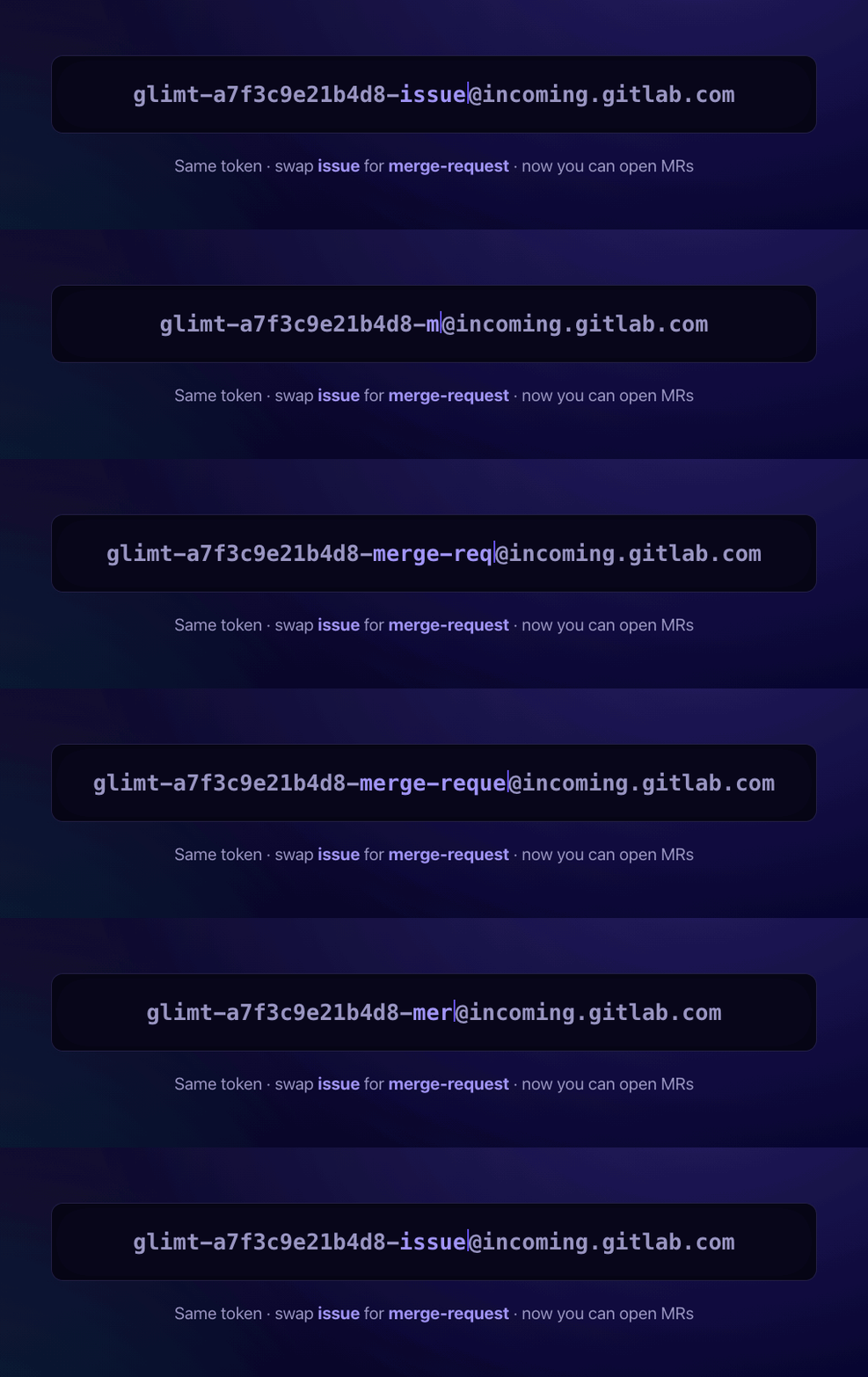
GitLab’s own documentation has long warned about the security implications of exposing these addresses. The platform states that these email addresses are "private" and "generated just for you." The warning continues: "Keep it to yourself, because anyone who knows it can create issues or merge requests as if they were you. If you suspect this private email address was leaked, reset the token immediately." This clearly indicates that GitLab is aware of the potential for misuse, yet the platform’s design and the discoverability of these addresses in public documentation created the vulnerability.
Analysis of Implications and Future Mitigation
The discovery by Aikido serves as a stark reminder of the ongoing challenges in securing complex software development platforms. While GitLab has made some improvements in response to the reports, the fundamental design of the "Email work item to this project" feature, where a token is embedded directly into a discoverable email address, presents an inherent risk.
The researchers’ observation that GitLab does not verify the sender’s email address against the token owner’s email is a critical security gap. Implementing such a check would significantly mitigate the risk of impersonation. The fact that GitLab is now "considering" this change, as noted by Aikido, indicates a shift in their approach but also suggests that the immediate threat mitigation might not be as robust as desired by security professionals.
Furthermore, the ability to brute-force project IDs in private repositories, although requiring the project path to be leaked separately, adds another layer of complexity to the attack. This means that even for private projects, a determined attacker could potentially gain access if other information is inadvertently exposed.
The responsibility now falls on both GitLab and project maintainers to ensure better security practices. For project maintainers, it is imperative to:
- Cease Public Exposure: Stop voluntarily including these sensitive email addresses in public documentation such as README files, contributing guides, or support pages.
- Reset Compromised Tokens: For any projects where these addresses may have been exposed in the past, maintainers should proactively reset the associated tokens to revoke access for any potentially compromised addresses.
For GitLab, continued development should focus on:
- Strengthening Email Token Security: Implementing robust sender verification and exploring alternative, more secure methods for email-based work item creation.
- Enhanced Documentation and Warnings: Providing clearer, more prominent warnings to users about the security implications of these features and the importance of safeguarding generated email addresses.
- Proactive Security Audits: Regularly conducting security audits to identify and address potential vulnerabilities before they are exploited by malicious actors.
The exposure of these private GitLab email addresses underscores a broader trend in cybersecurity: the unintended consequences of feature design and the critical need for constant vigilance. As software development platforms become more integrated and feature-rich, the potential for subtle vulnerabilities to have significant impacts grows. The lessons learned from this incident should serve as a catalyst for improved security practices across the entire software development ecosystem, ensuring the integrity and trustworthiness of the code that powers our digital world.