Clarissa Hana
Authorities in Germany and the United States have successfully dismantled the central infrastructure of Kratos, a sophisticated phishing-as-a-service (PhaaS) platform that operated on a global scale. In a coordinated international effort, law enforcement agencies also announced the arrest of the platform’s primary developer in Indonesia. The operation, dubbed "Operation Olympus Blade," has effectively rendered the Kratos service inoperable, marking a significant victory in the fight against cybercrime.
The joint operation saw law enforcement officials seize more than 200 servers that formed the backbone of the Kratos platform. This decisive action has crippled the service’s ability to function and distribute its malicious tools to cybercriminals worldwide. The investigation was spearheaded by the Frankfurt General Prosecutor’s Office (ZIT) and Germany’s Federal Criminal Police Office (BKA), with crucial collaboration from various U.S. law enforcement agencies.
Kratos: A Widespread Criminal Enterprise
The BKA has characterized Kratos as "one of the world’s most widely used criminal phishing services," highlighting its extensive reach and impact. Investigations have confirmed that Kratos was utilized by threat actors to target victims in at least 35 countries, with a significant concentration of attacks observed in Europe and the United States.
According to official statements from the BKA, it is estimated that over 1,800 criminal customers subscribed to the Kratos service. These individuals leveraged the platform to launch approximately 15,000 phishing campaigns on a monthly basis. The sheer volume of these campaigns underscores the significant threat Kratos posed to individuals and organizations globally. The BKA further elaborated that each individual campaign had the potential to impact several thousand recipients worldwide, emphasizing the platform’s broad destructive capability.

The Mechanics of the Kratos Phishing Toolkit
At its core, Kratos provided a comprehensive phishing toolkit that enabled cybercriminals to easily create and manage deceptive Microsoft authentication pages. These fake login pages were meticulously designed to mimic legitimate Microsoft interfaces, making them highly convincing to unsuspecting users. The primary objective of these fake pages was to trick victims into divulging their email addresses and passwords.
Once credentials were compromised, attackers gained unauthorized access to Microsoft accounts. This access served as a gateway for a cascade of further criminal activities. The BKA indicated that these compromised accounts were frequently exploited to "commit further crimes." This often included sophisticated attacks such as Business Email Compromise (BEC) scams, where attackers impersonate executives to defraud companies; widespread data theft; outright account takeovers for illicit purposes; and further phishing attacks targeting the compromised user’s network of contacts, perpetuating the cycle of deception.
Financial Gains and Operational Disruption
The illicit operations of the Kratos platform generated substantial profits for its owner. Authorities estimate that the individual arrested in Indonesia, believed to be the technical administrator and likely owner of the service, amassed at least €300,000 (approximately $342,000) since the beginning of 2024 through subscription fees for the Kratos platform. This significant financial gain highlights the lucrative nature of phishing-as-a-service models for cybercriminals.
With the arrest of the technical administrator and the successful shutdown of key components of its operational infrastructure, the BKA confidently stated that these ongoing phishing campaigns can no longer continue. The disruption of the platform’s core functionality is expected to significantly reduce the number of Kratos-driven phishing attacks globally.
Operation Olympus Blade: A Global Collaboration
The success of Operation Olympus Blade is a testament to the power of international law enforcement cooperation. The Frankfurt General Prosecutor’s Office and the BKA played pivotal roles in coordinating the investigation and operational aspects within Germany. Their U.S. counterparts provided essential support, facilitating the dismantling of infrastructure and contributing to the arrest of the key suspect.

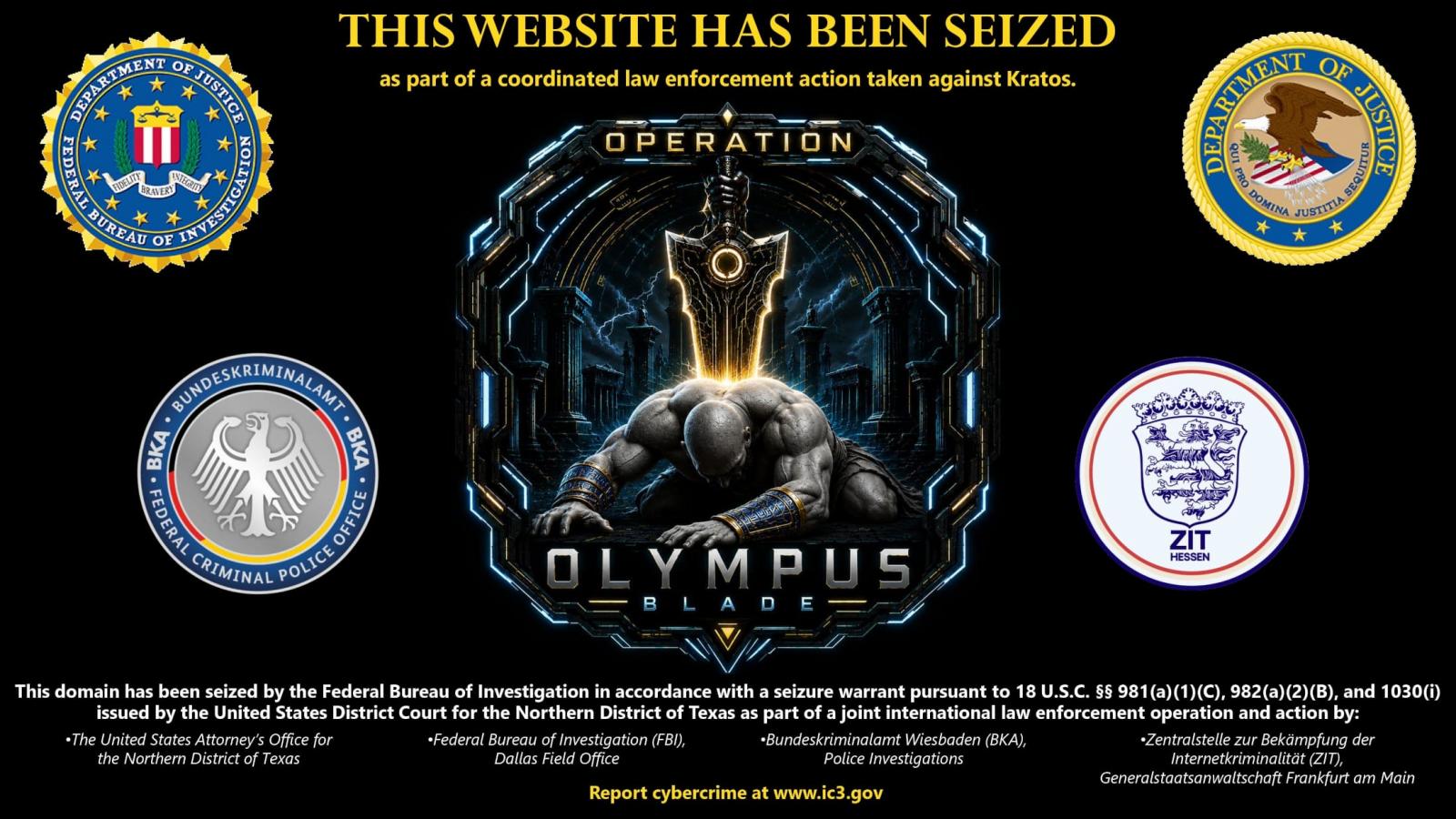
A stark seizure banner was prominently displayed on the Kratos service’s website, serving as a clear message to cybercriminals and the public alike. The banner officially declared the action as part of Operation Olympus Blade and, crucially, announced that domain ownership had been transferred to the Federal Bureau of Investigation (FBI). This symbolic act signifies the transition of control and the commitment of law enforcement to disrupt and dismantle such criminal enterprises.
Future Investigations and Forensic Evidence
The seizure of the Kratos servers is not merely an endpoint but a crucial step in an ongoing investigation. Law enforcement agencies anticipate that the forensic evidence extracted from these servers will be invaluable in identifying the Kratos platform’s customers. This could lead to further arrests and prosecutions of individuals who utilized the service to conduct their illicit activities. The detailed logs and data stored on these servers can provide a roadmap to understanding the scope of the criminal network and identifying other actors involved in the phishing ecosystem.
The investigation also aims to uncover the full extent of the damage caused by Kratos and its users. By analyzing the data, authorities can better understand the techniques, tactics, and procedures (TTPs) employed by these threat actors, which can inform future defensive strategies. The information gathered will also be vital in assisting victims and potentially recovering stolen assets.
Broader Implications for Cybersecurity
The dismantling of Kratos represents a significant blow to the phishing-as-a-service model. These platforms lower the barrier to entry for aspiring cybercriminals, providing them with ready-made tools and infrastructure to launch attacks without needing advanced technical expertise. By taking down Kratos, law enforcement has disrupted a major supply chain for cybercrime.
However, the nature of cybercrime, particularly the PhaaS model, means that the threat is unlikely to be entirely eradicated. As one platform is shut down, others may emerge, or existing ones may adapt. This ongoing cat-and-mouse game necessitates continuous vigilance and adaptation from cybersecurity professionals and law enforcement agencies.
The incident also highlights the critical importance of robust cybersecurity measures for individuals and organizations. The reliance on Microsoft accounts for a vast array of services means that the security of these accounts is paramount. This includes practicing good password hygiene, enabling multi-factor authentication (MFA) wherever possible, and remaining educated about common phishing tactics.
A Chronology of the Operation (Inferred)
While a precise timeline of the operation has not been publicly detailed, the typical progression of such international cybercrime investigations can be inferred:
- Initial Intelligence Gathering: Law enforcement agencies likely spent an extended period gathering intelligence on the Kratos platform, identifying its infrastructure, operational methods, and key personnel. This would involve monitoring dark web forums, analyzing network traffic, and potentially employing undercover tactics.
- International Collaboration and Coordination: Once sufficient evidence was gathered, international partnerships were forged. Germany’s ZIT and BKA initiated discussions and joint planning with their U.S. counterparts, establishing the framework for a coordinated takedown.
- Infrastructure Identification and Seizure: The crucial phase involved pinpointing the physical and virtual locations of the Kratos servers. This likely led to coordinated raids and digital seizures across various jurisdictions. The seizure of over 200 servers suggests a complex and distributed infrastructure.
- Developer Apprehension: Simultaneously or in close succession, efforts focused on identifying and locating the platform’s developer. The arrest in Indonesia indicates a successful international effort to apprehend key individuals.
- Public Announcement and Seizure Banner: Following the successful operational phase, authorities released public statements and deployed seizure banners on the compromised platforms to inform the public and deter further illicit activity.
- Ongoing Forensic Analysis: The seized servers are now undergoing detailed forensic examination to extract evidence for further investigations and potential prosecutions.
Expert Reactions and Future Outlook
While specific reactions from cybersecurity firms have not been cited in the original report, such takedowns typically elicit statements emphasizing the importance of such efforts. Cybersecurity analysts often point out that while these operations are critical for disrupting criminal enterprises, they also serve as a reminder of the persistent and evolving nature of cyber threats.
The success of Operation Olympus Blade is expected to have a chilling effect on the broader phishing-as-a-service market, at least temporarily. It demonstrates that law enforcement agencies are increasingly capable of dismantling sophisticated criminal operations that operate across borders. This could lead to a more cautious approach by other PhaaS providers and their customers.
However, the underlying demand for stolen credentials and the profitability of such activities mean that the threat of phishing will persist. Organizations and individuals must remain proactive in their cybersecurity efforts, adopting a layered defense strategy that includes technical controls, employee training, and robust incident response plans. The continued collaboration between international law enforcement and the cybersecurity community will be essential in staying ahead of evolving cyber threats. The Kratos takedown serves as a significant milestone, but the fight against cybercrime is an ongoing battle that requires sustained commitment and innovation.