George Chandra Eka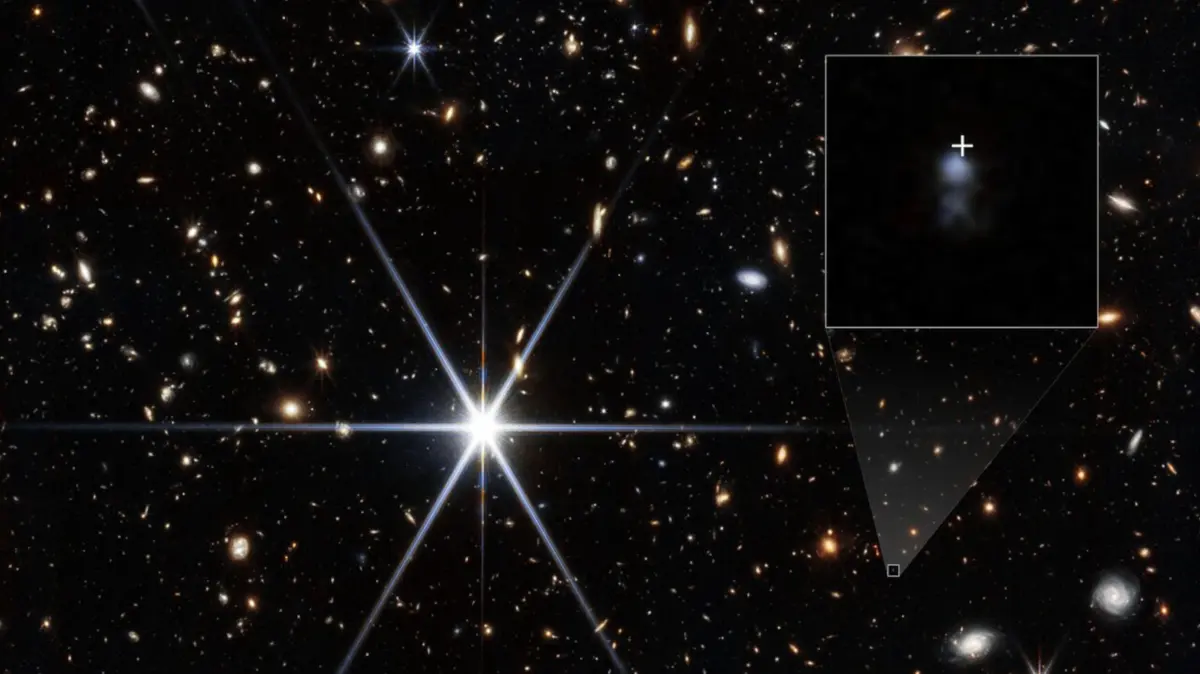
The James Webb Space Telescope (JWST) has successfully pinpointed the precise cosmic origin of the most distant Fast Radio Burst (FRB) ever detected, an extraordinary event initially observed in 2024 by the MeerKAT ground telescope array. This groundbreaking localization has provided invaluable data that profoundly enriches our understanding of these enigmatic, ultra-fast radio waves and, crucially, sheds new light on the conditions and processes prevalent in the universe’s infancy. The data suggests that this particular FRB emanated from a surprisingly small galaxy existing merely 3 billion years after the Big Bang, challenging some prevailing theories about FRB generation and offering strong support for the hypothesis linking them to magnetars formed from the collapse of massive stars.
Unveiling a Cosmic Beacon: The Discovery of FRB 20220610A
Fast Radio Bursts are among the most perplexing phenomena in modern astrophysics. These fleeting, yet incredibly powerful, bursts of radio waves last for mere milliseconds but unleash as much energy as the Sun emits over several days. First discovered serendipitously in 2007 by Duncan Lorimer and his team while sifting through archival data from the Parkes Observatory, the "Lorimer Burst" (FRB 010724) opened a new frontier in transient astronomy. Since then, hundreds of FRBs have been detected, both one-off events and repeating bursts, originating from across the cosmos. However, pinpointing their exact galactic homes has remained a significant challenge due to their brevity and the vast distances involved.
The FRB in question, designated FRB 20220610A, was first identified in 2024 by the MeerKAT radio telescope array in South Africa. MeerKAT, a precursor to the Square Kilometre Array (SKA), is renowned for its exceptional sensitivity and wide field of view, making it an ideal instrument for detecting such transient events. Its ability to capture highly dispersed signals from deep space allowed astronomers to register FRB 20220610A as the most distant burst to date, based on its dispersion measure – a metric indicating how much the radio signal has been slowed down and spread out by ionized gas along its path from source to observer. A higher dispersion measure typically implies a greater distance. While MeerKAT provided the initial detection and distance estimate, the precise localization of the host galaxy required the unparalleled infrared vision of the James Webb Space Telescope.
The James Webb Space Telescope’s Crucial Role
The James Webb Space Telescope, a collaboration between NASA, ESA, and CSA, represents the pinnacle of infrared astronomy. Its primary mirror, nearly 6.5 meters in diameter, and its suite of highly sensitive instruments – including the Near-Infrared Camera (NIRCam) and the Near-Infrared Spectrograph (NIRSpec) – are designed to observe the universe in wavelengths that are largely invisible to ground-based telescopes due to atmospheric absorption. Crucially, JWST’s capabilities allow it to detect light that has been significantly redshifted, meaning light from very distant objects that has been stretched to longer, redder wavelengths as the universe expands. This makes JWST uniquely suited to peer back in time to the earliest epochs of cosmic history.
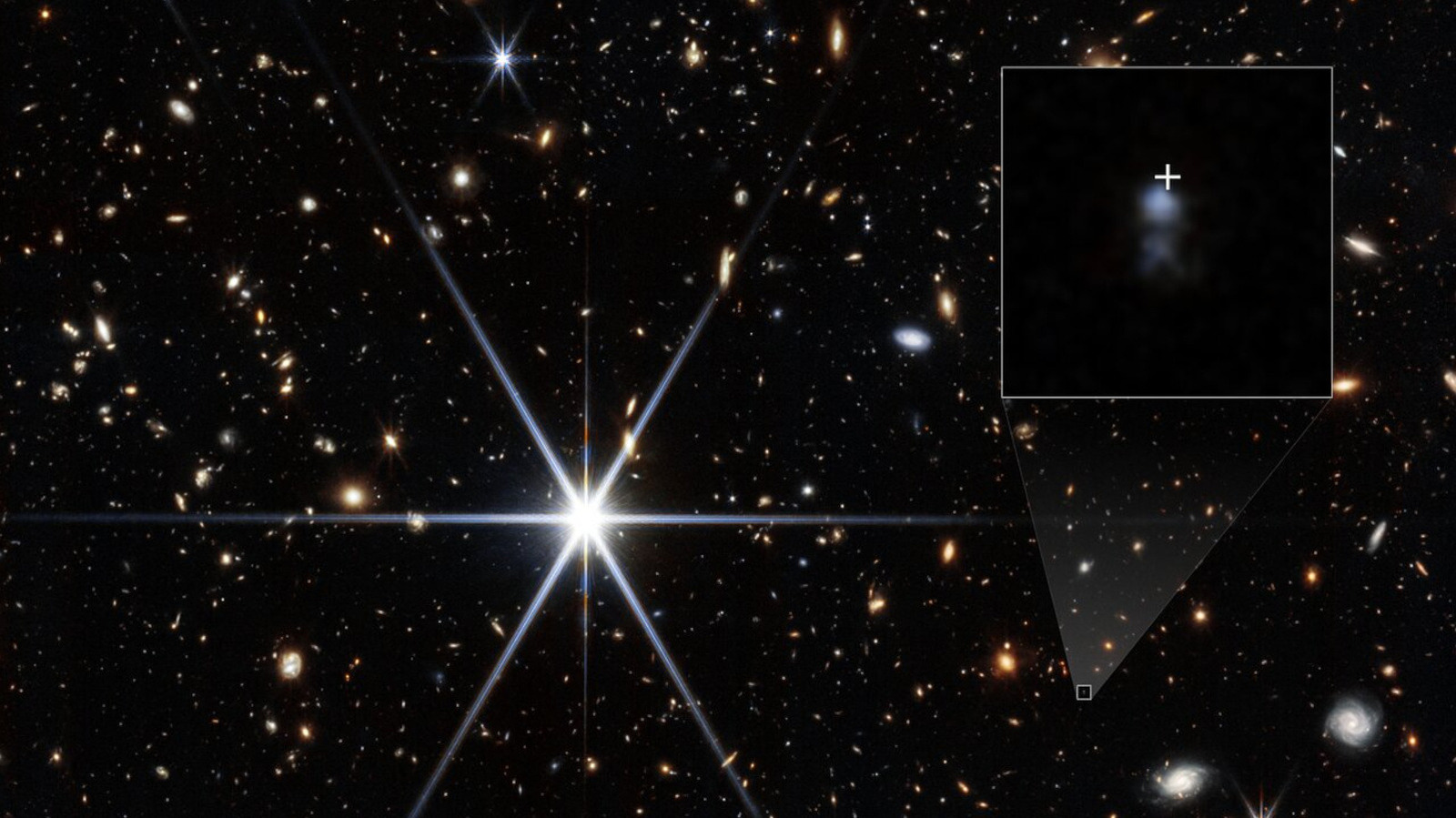
Following the MeerKAT detection and initial localization of FRB 20220610A to a general region of the sky, astronomers leveraged JWST to conduct follow-up observations. Using its near-infrared instruments, JWST was able to penetrate the cosmic dust and gas that might obscure a distant galaxy in visible light, identifying a faint, distant galaxy precisely at the coordinates from which the FRB originated. This multi-wavelength approach, combining the radio detection capabilities of MeerKAT with the infrared imaging and spectroscopic power of JWST, exemplifies the collaborative and complementary nature of modern astronomical research. The ability of JWST to resolve the faint host galaxy allowed researchers to gather crucial spectroscopic data, measuring the galaxy’s redshift with unprecedented accuracy. This redshift measurement, a direct indicator of cosmic distance and look-back time, was essential for placing the FRB event within the broader cosmological timeline.
A Glimpse into the Early Universe: The Host Galaxy’s Profile
The spectroscopic measurements from JWST revealed that the host galaxy of FRB 20220610A is located at a redshift corresponding to an epoch approximately 3 billion years after the Big Bang. This places the burst squarely within a pivotal period of cosmic evolution often referred to as "cosmic noon," when the rate of star formation across the universe was at its absolute peak. During this era, galaxies were rapidly assembling and producing stars at rates far exceeding those observed in the present-day universe. The detection of an FRB from such an early epoch is itself remarkable, providing a rare probe into the extreme conditions of the young universe.
What proved even more surprising was the nature of the host galaxy itself. Contrary to expectations based on observations of other FRB host galaxies, which have typically been massive, vigorously star-forming systems in the more recent universe, the galaxy responsible for FRB 20220610A was found to be remarkably small – estimated to be around 1,000 times less massive than the Milky Way galaxy. This unexpected characteristic adds a critical piece of information to the puzzle of FRB origins. Previous FRBs detected in the relatively nearby universe (billions of years later than FRB 20220610A) have largely been associated with much larger, more evolved galaxies. The discovery of an FRB originating from a dwarf galaxy in the early universe suggests a broader range of progenitor environments than previously considered or, alternatively, points towards a specific progenitor mechanism that thrives in such conditions.
The properties of this dwarf galaxy—its high star-formation rate relative to its size and its early cosmic epoch—provide a unique laboratory for testing theories of FRB generation. Such galaxies, while small, are known to be efficient sites of massive star formation, which are key ingredients in some FRB progenitor models.
Deciphering the Enigma: Theories of Fast Radio Burst Origins
The precise mechanisms responsible for generating FRBs remain one of the most significant unsolved mysteries in astrophysics. Over the years, numerous theories have been proposed, often categorizing FRBs into those arising from extreme astrophysical phenomena involving neutron stars. Two leading theories have dominated the scientific discourse, each with distinct implications for the type and age of the host galaxy.
Theory 1: Neutron Star Mergers
One prominent hypothesis suggests that FRBs are produced during the cataclysmic merger of two neutron stars. Neutron stars are the super-dense, collapsed cores of massive stars that have undergone supernova explosions. With masses comparable to the Sun but diameters only about 20 kilometers, they possess extreme gravitational fields. When two neutron stars in a binary system spiral inward and eventually merge, they are known to produce powerful gravitational waves (as detected by LIGO/Virgo) and are thought to be progenitors of short-duration gamma-ray bursts. The energy released during such an event is colossal, making it a plausible candidate for the immense power of an FRB.
However, the neutron star merger theory faces a significant challenge when considering FRBs from the early universe. The formation of a binary neutron star system and the subsequent orbital decay that leads to a merger typically takes billions of years. This long timescale implies that FRBs originating from such mergers should predominantly be found in older, more evolved galaxies, where multiple generations of stars have lived and died, allowing sufficient time for these binary systems to form and coalesce. The detection of FRB 20220610A from a galaxy existing only 3 billion years after the Big Bang, an epoch when the universe itself was relatively young and few stars had completed their full evolutionary cycle to form binary neutron star systems, significantly reduces the likelihood of a merger being its progenitor.
Theory 2: Magnetars from Supernovae
The alternative leading theory posits that FRBs are generated by magnetars, a rare and exceptionally extreme type of neutron star. Magnetars are characterized by their extraordinarily powerful magnetic fields, billions of times stronger than any magnet created on Earth and thousands of times stronger than those of typical neutron stars. These intense magnetic fields can undergo sudden rearrangements and "starquakes," releasing colossal amounts of energy in the form of electromagnetic radiation, including radio waves.
Magnetars are believed to form from the supernova explosions of particularly massive stars. These massive stars have relatively short lifespans, evolving rapidly and collapsing into neutron stars or black holes within millions of years of their birth. This rapid evolutionary path makes the magnetar hypothesis particularly appealing for explaining FRBs originating from the early universe. In an epoch like "cosmic noon," characterized by prolific massive star formation, the universe would have been teeming with young, massive stars destined to become magnetars. The high star-formation rate in the dwarf galaxy hosting FRB 20220610A further strengthens this connection. The extreme environment of a young, rapidly star-forming galaxy could also contribute to the conditions necessary for magnetars to produce powerful FRBs. Observations of FRBs originating from magnetars within our own galaxy have provided direct evidence for this connection, bolstering the theory.
Scientific Consensus and Implications of the New Data
The detailed analysis of FRB 20220610A and its host galaxy, published in the prestigious journal Science, provides compelling evidence that significantly favors the magnetar hypothesis for this specific event. Dr. Manisha Caleb from the University of Sydney, Australia, who served as the lead author on the study, remarked, "Our work suggests that it’s very unlikely that this [fast radio burst] was produced by a merger." This statement encapsulates the profound shift in understanding brought about by the JWST’s findings.
The discovery implies that at least some, if not many, FRBs detected from the early universe are likely the result of the intense activity of nascent magnetars formed in the aftermath of massive stellar collapses. This doesn’t necessarily rule out neutron star mergers as progenitors for all FRBs; the scientific community generally acknowledges that FRBs may have multiple distinct origins, with different mechanisms dominating at different cosmic epochs or in different galactic environments. However, for the most distant and earliest FRBs, the magnetar model appears to be a far more consistent explanation.
This research has sparked considerable excitement within the astrophysical community. It validates the immense power of combining observations from different types of telescopes across the electromagnetic spectrum. It also underscores the importance of JWST’s ability to peer into the universe’s past, providing direct observational constraints on theoretical models of extreme cosmic phenomena. The findings will undoubtedly lead to refined models of magnetar formation and behavior, particularly in the extreme conditions of the early universe.
The Broader Impact: Understanding Cosmic Evolution
Beyond elucidating the origins of FRBs, this discovery has broader implications for our understanding of cosmic evolution. FRBs are not just interesting phenomena in their own right; they also serve as powerful cosmological probes. As these radio waves travel across vast intergalactic distances, they interact with the tenuous plasma and matter distributed throughout the universe. The dispersion measure of an FRB, for example, can be used to map the distribution of ionized gas, offering insights into the structure of the intergalactic medium and potentially even the elusive baryonic matter that makes up only a fraction of the universe’s total mass.
By locating FRBs at various redshifts, astronomers can build a cosmic distance ladder that also tracks the evolution of matter distribution over time. This new distant FRB provides a valuable data point from an earlier epoch, allowing scientists to test models of cosmic reionization and the formation of large-scale structures. It also offers a unique way to study the environments of star formation in the early universe, confirming that even small galaxies were capable of hosting the massive, rapidly evolving stars necessary to produce magnetars.
The collaborative success of MeerKAT and JWST highlights the synergy required to unlock the universe’s deepest secrets. Future research will undoubtedly focus on identifying more FRB host galaxies, particularly at high redshifts, using JWST and other upcoming telescopes. By accumulating a larger sample of localized FRBs across cosmic time, astronomers hope to definitively unravel the full spectrum of FRB progenitors and leverage these powerful cosmic flashes to paint an ever-clearer picture of the universe’s history and evolution.
Looking Ahead: The Future of FRB Research
The localization of FRB 20220610A represents a significant leap forward, but it is merely one step in a long and exciting journey. The next generation of radio telescopes, such as the full Square Kilometre Array (SKA), will detect FRBs with even greater frequency and precision, offering unprecedented opportunities for localization. Combined with the continued operation of JWST and the launch of future space telescopes, astronomers will be better equipped to conduct rapid follow-up observations, characterizing host galaxies and their environments with even finer detail.
As our understanding of FRBs grows, these cosmic bursts may evolve from mere puzzles into indispensable tools for cosmology. They hold the potential to probe the dark matter distribution, measure the Hubble constant independently, and even constrain models of fundamental physics under extreme conditions. Each new localized FRB adds another piece to this complex cosmic mosaic, bringing us closer to a comprehensive understanding of the most powerful and mysterious radio signals emanating from the depths of space and time. The universe continues to reveal its secrets, one fleeting burst at a time, and the James Webb Space Telescope is proving to be an unparalleled guide in this grand exploration.