Clarissa Hana

In a dramatic escalation of a sophisticated cyberattack, the GMO Group, a major Japanese technology conglomerate, issued an urgent directive to its customers, imploring them to immediately disconnect their personal computers from the internet and power them down. This drastic measure came as a threat actor, who had previously breached the company’s Onamae Desktop Cloud service, threatened to unleash a widespread ransomware attack and subsequently published stolen data online. The incident has sent ripples of concern throughout Japan’s digital infrastructure and highlighted the persistent vulnerabilities faced by cloud service providers.
The cyberattack specifically targeted Onamae Desktop Cloud, a widely utilized Virtual Private Server (VPS) provider in Japan operated by GMO Internet, a prominent member of the GMO Internet Group and one of the nation’s largest domain registrars. The breach, initially detected by the company on October 20th, is believed to have potentially allowed the intrusion of malware onto as many as 26,739 customer servers. In response to the early detection of this intrusion, GMO took immediate steps to mitigate potential damage by shutting down affected servers and curtailing service availability while initiating a thorough investigation into the security incident.
Timeline of the Cyberattack and Response
The unfolding crisis for GMO and its customers can be traced through a series of critical events:
- October 20, 2026: GMO Internet detects a security breach on its Onamae Desktop Cloud service. The company’s initial assessment suggests that malware may have been installed on a significant number of customer servers.
- Following Detection (October 20-25, 2026): In a precautionary move, GMO shuts down affected servers, leading to a reduction in service availability. The company begins an internal investigation into the scope and nature of the breach.
- Late October 2026 (Specific Date Unspecified in Original Report): GMO confirms that data has been exfiltrated by the attackers. The threat actor demands a ransom of ¥8 billion (approximately $50 million USD) for the return of the data and to prevent its public release. GMO publicly states its refusal to pay the ransom. As a gesture of goodwill and to acknowledge the inconvenience caused, the company announces it will compensate each affected customer ¥5,000 (approximately $30 USD).
- October 26, 2026: GMO issues a public warning, alerting customers and the media that the threat actors intend to leak stolen customer information online. Furthermore, the company reveals that the attackers have planted a ransomware payload on customer servers, with the intention of activating it.
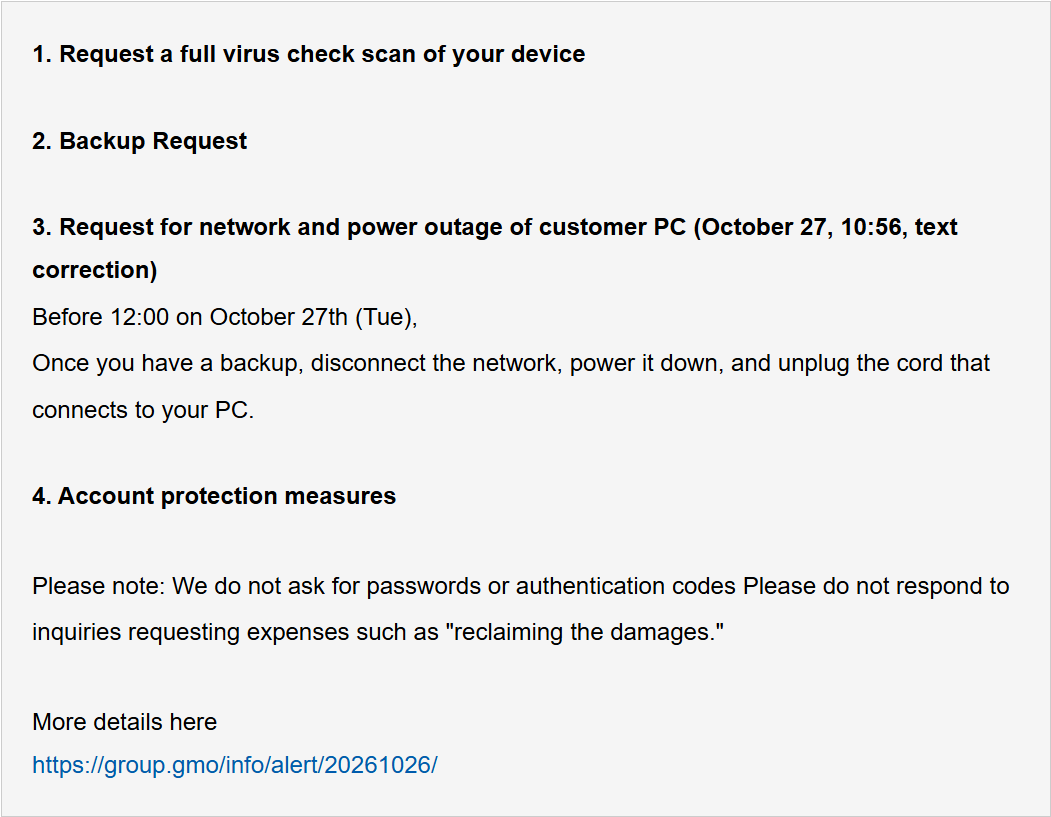
- October 27, 2026 (Morning): In an unprecedented and urgent advisory, GMO instructs its customers to physically disconnect their personal computers from the internet, shut them down, and unplug all connecting cables before noon on this day. This severe recommendation is made to prevent the potential activation of the ransomware. The company states it is working in collaboration with cybersecurity firm Trend Micro to remediate the situation.
- October 27, 2026 (Later Report): GMO confirms that the threat actor has indeed published company and customer data online. Efforts are underway to verify the authenticity of the leaked information. The company reiterates its stance against paying the ransom and announces that it will consider additional financial compensation for customers whose data was exposed. Crucially, the report notes that the attacker did not appear to activate the ransomware on customer machines, despite the threat.
- October 27, 2026 (Further Advisory): GMO issues a stern warning to both the public and the media against disseminating the exposed information. The company declares its intention to pursue legal action against any individuals or entities that spread the leaked data.
Scope of the Breach and Data Compromise

The initial intrusion vector is believed to have compromised the Onamae Desktop Cloud service, affecting a substantial number of servers. While GMO assured customers that their payment information remained secure and was not exposed, the situation took a more serious turn with the confirmation of data theft. Critically, credentials and trading account details for MetaTrader 4 (MT4) and MetaTrader 5 (MT5) platforms, widely used for financial trading, were identified as potentially exposed or compromised. This has necessitated urgent password resets and the termination of active trading sessions for affected users to prevent unauthorized access to their financial accounts.
The subsequent data leak confirmed that the attacker had made good on their threat to publish sensitive information. The exact nature and volume of the published data are still under verification, but it is understood to include information pertaining to both GMO and its customers. This development significantly amplifies the impact of the breach, moving beyond a potential ransomware threat to an actual data exfiltration and public disclosure.
GMO’s Response and Mitigation Efforts
GMO’s response has been characterized by a series of escalating advisories and actions. The company’s decision to shut down servers and limit service availability was a direct attempt to contain the breach. The refusal to pay the ¥8 billion ransom highlights a policy often adopted by cybersecurity-conscious organizations, aiming to avoid incentivizing further criminal activity. The offer of ¥5,000 compensation to each affected customer, while a gesture of goodwill, is a fraction of the potential financial and reputational damage incurred.
The directive for customers to physically disconnect their PCs represents an extreme measure, underscoring the perceived severity of the ransomware threat. This recommendation, "Once you have a backup, disconnect the network, power it down, and unplug the cord that connects to your PC," aimed to create an air gap, physically isolating machines from any potential network-based ransomware activation. The company also committed to scanning customer systems for any lingering malware and offered to provide equivalent PC replacements for those who suffered damage from a ransomware attack, although this scenario appears to have been averted.
The Unfulfilled Ransomware Threat and Data Leak
Despite the explicit threat of a ransomware payload being activated, reports indicate that the attacker ultimately did not trigger the ransomware on customer machines. This could be attributed to various factors, including the swift actions taken by GMO and its customers, potential technical limitations, or a strategic shift in the attacker’s objective from widespread disruption to data leverage. However, the publication of stolen data represents a significant success for the threat actor, providing them with valuable information that can be used for further attacks, sale on the dark web, or other malicious purposes.
Broader Implications and Analysis
This incident carries significant implications for the cybersecurity landscape, particularly within Japan’s digital economy.
- Vulnerability of Cloud Infrastructure: The breach of Onamae Desktop Cloud, a critical component of Japan’s digital infrastructure, underscores the inherent vulnerabilities associated with cloud service providers. The sheer volume of affected servers (up to 26,739) highlights the cascading impact a single breach can have on a vast number of businesses and individuals.
- Ransomware Evolution: While the ransomware attack itself did not materialize as threatened, the incident demonstrates the evolving tactics of cybercriminals. The dual threat of ransomware and data exfiltration (double extortion) is a common and highly effective strategy, designed to pressure victims into compliance through the fear of both system disruption and reputational damage.
- Customer Trust and Data Protection: The exposure of customer data, including sensitive trading credentials, erodes trust between service providers and their users. The onus is now on GMO to demonstrate robust data protection measures and to reassure its customer base that such an incident will not be repeated. The company’s commitment to further financial compensation for exposed data victims reflects the gravity of this aspect.
- The Challenge of Ransom Payment Decisions: GMO’s firm stance against paying the ransom, while ethically commendable and strategically sound in the long term, places the immediate burden of recovery and mitigation squarely on the company and its customers. This decision is often a complex one, balancing the immediate costs of recovery against the long-term implications of funding criminal enterprises.
- Legal and Reputational Ramifications: The decision by GMO to pursue legal action against those who disseminate the leaked information indicates a strong commitment to mitigating further harm. However, the reputational damage from such a high-profile breach can be long-lasting, impacting customer acquisition and retention.
The incident serves as a stark reminder for all organizations to continuously assess and strengthen their cybersecurity postures, implement robust incident response plans, and educate their users about the evolving threats in the digital realm. The actions taken by GMO, while drastic, reflect the challenging decisions faced by organizations when confronted with sophisticated cyberattacks that threaten both operational continuity and data integrity. The ultimate impact on GMO and its customers will depend on the thoroughness of the ongoing investigations, the effectiveness of remediation efforts, and the company’s ability to rebuild and maintain trust in the wake of this significant security event. The global cybersecurity community will undoubtedly be observing the aftermath and the lessons learned from this substantial breach in Japan’s digital sector.