Sisilia Frederika
The quest to identify a truly Earth-like world orbiting a distant star has long been considered the "Holy Grail" of modern astronomy. Since the landmark discovery of the first exoplanet orbiting a sun-like star in 1995, the field of exoplanetary science has undergone a radical transformation. Driven by rapid technological advancements in both ground-based and space-based observatories, humanity has moved from questioning whether other planets exist to cataloging thousands of them. However, despite the success of missions like Kepler, TESS, and the revolutionary James Webb Space Telescope (JWST), the ability to directly image a terrestrial, habitable-zone planet remains one of the most significant hurdles in space science. To bridge this gap, NASA and its global partners are currently laying the groundwork for the Habitable Worlds Observatory (HWO), a next-generation flagship mission designed specifically to photograph and analyze worlds that could harbor life.
While the HWO is not expected to launch until the 2040s, the engineering and conceptual foundations are being laid today. A pivotal study published in June 2026 in the Journal of Astronomical Telescopes, Instruments, and Systems has provided a comprehensive look into the early architecture concepts that will define this mission. This research, spearheaded by NASA’s Systems Engineering Team (SET), introduces a series of Exploratory Analytic Cases (EACs) that balance the ambitious scientific requirements of the mission with the practical limitations of modern aerospace engineering. These designs represent a critical step in transitioning the HWO from a theoretical concept into a tangible spacecraft capable of answering the fundamental question: Are we alone in the universe?
The Evolution of Exoplanet Detection and the Need for Direct Imaging
For decades, the primary methods of detecting exoplanets have been indirect. The transit method, utilized most famously by the Kepler Space Telescope, involves measuring the slight dip in a star’s brightness as a planet passes in front of it. The radial velocity method, on the other hand, detects the "wobble" of a star caused by the gravitational pull of an orbiting planet. While these methods have been incredibly productive, they provide limited information regarding the planet’s atmosphere or surface conditions.
Direct imaging—actually capturing the light reflecting off a planet’s surface or being emitted by its atmosphere—is the next frontier. This task is extraordinarily difficult because planets are billions of times fainter than the stars they orbit. To an observer light-years away, an Earth-like planet is a tiny speck of light lost in the overwhelming glare of its host sun. The James Webb Space Telescope has begun to perform direct imaging of large, young, gaseous exoplanets, but imaging a small, rocky planet in the habitable zone requires a level of precision and light-suppression technology that does not yet exist in a flight-ready capacity. The Habitable Worlds Observatory is being designed specifically to solve this "contrast" problem.
Technical Architectures: The Exploratory Analytic Cases
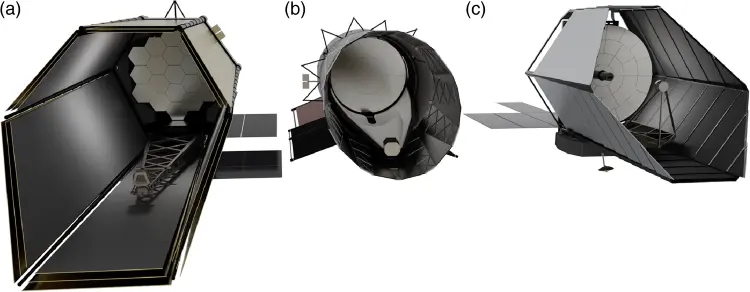
The recent study by the SET, which includes experts from various NASA centers and the Jet Propulsion Laboratory (JPL), focused on three primary Exploratory Analytic Cases (EACs). These cases serve as blueprints for the telescope’s physical structure, specifically addressing mirror size, shape, and the optical path of incoming light.
EAC1: The Off-Axis Segmented Design
The first concept, EAC1, proposes a telescope with a 6-meter inscribed and 7.2-meter circumscribed diameter. This design utilizes an "off-axis" configuration. In a traditional "on-axis" telescope, the secondary mirror and its support structures sit directly in front of the primary mirror, obstructing a portion of the incoming light and creating diffraction patterns that can interfere with sensitive measurements. An off-axis design moves these components out of the light path, providing an unobstructed view. The study highlights EAC1 as a strong contender because its off-axis nature is particularly beneficial for high-contrast imaging, which is essential for seeing faint planets near bright stars.
EAC2: The Round Off-Axis Design
EAC2 explores a 6-meter round, off-axis design. While similar to EAC1 in its off-axis benefits, the round aperture offers different advantages in terms of the Point Spread Function (PSF)—the way the telescope focuses light. A perfectly round aperture can simplify some aspects of the wavefront sensing and control systems, which are the "active optics" that keep the telescope in perfect focus despite temperature changes or mechanical vibrations.
EAC3: The Large On-Axis Design
The third case, EAC3, investigates a larger 8-meter outer diameter on-axis design. While this design suffers from the obstructions inherent in on-axis systems, the larger mirror provides a significantly greater light-collecting area. In astronomy, "aperture is king." A larger mirror allows the telescope to see deeper into space and resolve smaller details. However, the study suggests that the benefits of the off-axis designs in EAC1 and EAC2—specifically their ability to work more efficiently with a coronagraph—may outweigh the raw size advantage of EAC3.
The Role of the Coronagraph and Thermal Stability
Central to the success of the HWO is the coronagraph instrument (CI). A coronagraph is an internal optical device designed to block out the overwhelming light of a star so that the much fainter planets orbiting it can be seen. For the HWO to achieve its goal of imaging 25 habitable-zone planets, the coronagraph must be able to suppress starlight by a factor of 10 billion to one.
The study emphasizes that the telescope’s architecture is inextricably linked to the coronagraph’s performance. Beyond the physical shape of the mirrors, the thermal properties of the observatory are a major factor. Even miniscule changes in temperature can cause the telescope’s mirrors to warp by a few picometers (a trillionth of a meter), which is enough to ruin the high-contrast imaging required for exoplanet research. Consequently, the SET is leveraging "model-driven practices" based on the heritage of the JWST and the upcoming Nancy Grace Roman Space Telescope to ensure the HWO remains thermally and mechanically stable.
A Timeline of Development and Inter-Agency Collaboration
The HWO was born out of the 2020 Decadal Survey on Astronomy and Astrophysics (Astro2020), which recommended that NASA develop a large infrared/optical/ultraviolet space telescope to follow the JWST and the Roman Space Telescope. The mission is currently in its pre-formulation phase, a period dedicated to "technology maturation."
According to the study, the SET has successfully shared its architectural models with industry partners. This collaborative approach allows private aerospace companies to begin developing the specialized components—such as ultra-stable mirrors and advanced sensors—well before the mission enters its formal design phase. This strategy is intended to reduce the risk of cost overruns and schedule delays, which have historically affected large-scale "Great Observatory" missions.
The projected timeline for the HWO includes:
- 2020s: Concept maturation and technology development.
- Early 2030s: Formal mission adoption and start of construction.
- 2040s: Launch and commencement of the primary science mission.
Broader Implications: The Search for Life
The scientific stakes for the Habitable Worlds Observatory could not be higher. By directly imaging Earth-like planets, the HWO will be able to perform spectroscopy—analyzing the light filtered through or reflected by a planet’s atmosphere. This process allows scientists to identify "biosignatures," such as the presence of oxygen, methane, water vapor, and carbon dioxide. Finding a combination of these gases could provide the first definitive evidence of biological activity on another world.
Furthermore, the HWO will serve as a general-purpose observatory, much like Hubble and JWST. While its primary mission is exoplanet imaging, its massive aperture and sensitive instruments will be used to study the evolution of galaxies, the birth of stars, and the dynamics of our own solar system.
The study’s findings suggest a preference for off-axis designs and larger aperture sizes to maximize light-gathering efficiency. By establishing these engineering requirements now, NASA is ensuring that the HWO will be equipped with the most effective tools possible when it finally begins its journey into deep space.
Conclusion: A Multi-Decadal Vision
The development of the Habitable Worlds Observatory represents a multi-decadal commitment to expanding the boundaries of human knowledge. The recent architectural studies are more than just engineering exercises; they are the first blueprints for a machine that may eventually tell us that our "pale blue dot" is not unique.
As the SET continues to refine the EACs and move toward a final design, the integration of lessons learned from previous missions like the JWST will be vital. The transition from detecting planets to imaging them marks a new era in astronomy—one where the focus shifts from finding "where" planets are to discovering "what" they are. While the 2040s may seem distant, the rigorous scientific and engineering work being performed today ensures that when the HWO finally reaches its orbit, it will be ready to look at the stars and find a reflection of our own world.