Clarissa Hana
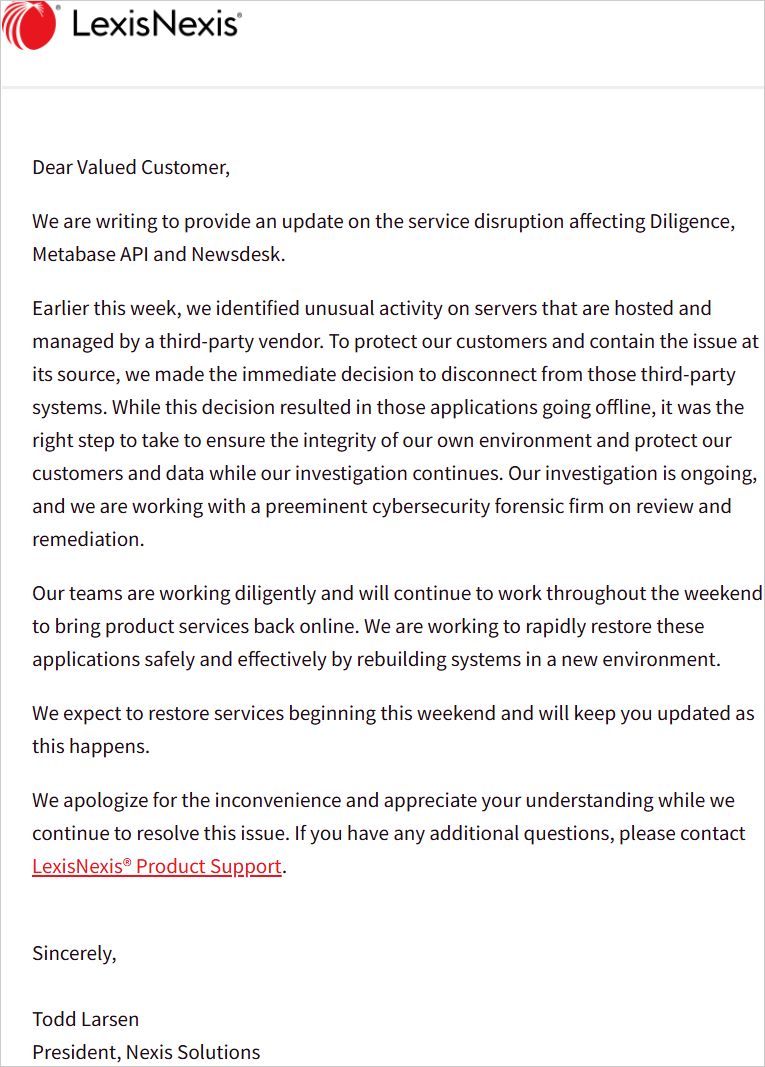
LexisNexis, a global leader in legal, business, and risk information services, has taken several of its critical platforms offline as a precautionary measure following the identification of unusual activity on servers managed by an undisclosed third-party vendor. The affected services include Nexis Diligence, the Metabase API, and Newsdesk. The company confirmed that a comprehensive investigation is underway, involving a leading cybersecurity forensic firm, to ascertain the full scope of the incident and to rebuild the compromised systems in a secure environment before resuming normal operations. This latest disruption adds to a series of cybersecurity challenges faced by the data analytics giant in recent years, raising concerns among its extensive client base across various industries.
Immediate Response and Service Disruption
The decision to disconnect from the affected third-party systems was made swiftly upon the discovery of "unusual activity" earlier this week, as communicated to customers in a notification. This proactive stance underscores the company’s commitment to safeguarding its clients’ data and operational integrity. The specific nature of the "unusual activity" has not been disclosed, but the immediate shutdown of key services indicates a potentially serious security concern.
Nexis Diligence, a vital platform for compliance professionals, facilitates in-depth due diligence and risk research. Its unavailability impacts the ability of numerous organizations to conduct essential background checks and risk assessments, which are crucial for regulatory compliance and informed decision-making in fields like finance, law, and corporate governance.
The Nexis Metabase API, a data feed providing news and media intelligence for integration into enterprise systems, is also offline. This service is critical for businesses that rely on real-time information for market analysis, competitive intelligence, and strategic planning. Its disruption can lead to gaps in essential data streams, potentially affecting ongoing research and analytical processes.
Furthermore, the Nexis Newsdesk service, a sophisticated media monitoring and analytics tool, has been temporarily suspended. This platform is indispensable for communications, public relations, and marketing departments that depend on it to track brand reputation, monitor industry trends, and gauge public sentiment. The loss of this service can leave organizations blind to critical developments in their media landscape.
Investigation and Remediation Efforts
Todd Larsen, President of the Global Nexis Solutions division at LexisNexis, provided a brief but definitive confirmation to BleepingComputer regarding the cause of the service outages. He stated, "Our investigation is ongoing, and we are working with a preeminent cybersecurity forensic firm on review and remediation." This collaboration with an external, specialized firm signals the seriousness with which LexisNexis is treating the incident and its commitment to a thorough and independent assessment.
The company’s strategy involves not only investigating the root cause of the suspicious activity but also rebuilding the affected systems within a new, isolated environment. This approach aims to ensure that any potential vulnerabilities or residual threats from the compromised infrastructure are completely eradicated before the services are brought back online. The process of rebuilding and re-establishing these complex systems is expected to take time, and a definitive timeline for service restoration has not yet been provided.
Clarification on Metabase Cloud Vulnerability
Recent reports highlighted a critical zero-day SQL injection vulnerability affecting Metabase Cloud’s hosting service, which led to data-theft attacks. However, LexisNexis has clarified that its Nexis Metabase API product is entirely separate from Metabase Cloud and was not impacted by this specific vulnerability. Larsen explicitly stated, "Nexis Solutions is not a Metabase Cloud customer, and the Nexis Metabase API product has no connection to Metabase Cloud or the reported vulnerability." This distinction is important to avoid misattribution of the current incident to the previously reported Metabase Cloud security flaw. The current disruption stems from activity on servers managed by a different, unnamed third-party vendor.
Background of Third-Party Vendor Reliance
The incident underscores the inherent risks associated with relying on third-party vendors for hosting and managing critical infrastructure. While outsourcing can offer cost efficiencies and specialized expertise, it also introduces a new layer of potential vulnerability. A security breach or operational issue at a vendor’s facility can have cascading effects on their clients’ services and data. The unnamed status of the vendor in this case prevents a broader assessment of their security posture but highlights the importance of rigorous vendor risk management and due diligence for all organizations.
The global LexisNexis network is vast, encompassing extensive data repositories and sophisticated analytical tools. The company serves a wide array of clients, including:
- Law Firms: Relying on LexisNexis for legal research, case precedents, and statutory information.
- Corporations: Utilizing the platforms for due diligence, risk management, market intelligence, and competitive analysis.
- Financial Institutions: Employing services for regulatory compliance, anti-money laundering checks, and fraud detection.
- Government Agencies: Accessing public records, regulatory information, and intelligence data.
- Consultants and Researchers: Leveraging the extensive databases for in-depth analysis and reporting.
The disruption of services like Nexis Diligence directly impacts the operational efficiency and compliance efforts of these diverse sectors. For instance, a law firm unable to conduct immediate due diligence on a potential client or investment could face delays in critical transactions. Similarly, a financial institution might experience challenges in fulfilling Know Your Customer (KYC) requirements if its risk assessment tools are unavailable.

Historical Cybersecurity Incidents at LexisNexis
This latest event is not the first time LexisNexis has encountered cybersecurity challenges. The company has faced significant breaches in the past, which may inform the cautious approach taken in the current situation.
-
May 2025 Data Breach: LexisNexis disclosed a significant data breach that compromised the personal information of approximately 364,000 individuals. This incident occurred after unauthorized access was gained to the company’s private GitHub repositories, highlighting vulnerabilities in code management and development environments. The nature of the data stolen in this breach would have had direct implications for the individuals whose personal details were exposed, including potential risks of identity theft and fraud. The company’s response at the time involved notifying affected individuals and implementing enhanced security measures for its development platforms.
-
March 2025 "React2Shell" Exploitation: Earlier in March, LexisNexis confirmed another security incident where hackers exploited a vulnerability known as "React2Shell" within the company’s Amazon Web Services (AWS) infrastructure. This exploitation allowed threat actors to steal and subsequently leak private files. At the time, LexisNexis acknowledged unauthorized access to "a limited number of servers," asserting that these servers primarily contained legacy data. However, any unauthorized access to company servers, regardless of the data’s recency, poses a risk and necessitates a thorough review of internal security protocols. The "FulcrumSec" threat actor was reportedly behind this attack.
These past incidents provide a backdrop against which the current disruption is viewed by customers and industry observers. They suggest a pattern of targeted attacks and a persistent need for robust security strategies, particularly given the sensitive nature of the data LexisNexis handles. The company’s proactive shutdown of services this week, while disruptive, can be interpreted as a learned response aimed at preventing a recurrence or escalation of past incidents.
Broader Implications and Industry Context
The LexisNexis incident occurs within a broader context of escalating cyber threats targeting large enterprises, especially those that handle vast amounts of sensitive data. Data analytics firms, financial institutions, and legal service providers are prime targets due to the value of the information they possess. The increasing sophistication of cybercriminals, coupled with the expanding attack surface presented by cloud computing and interconnected systems, makes robust cybersecurity a perpetual challenge.
The reliance on third-party vendors, as highlighted in this case, is a critical area of concern for the entire industry. Regulatory bodies and cybersecurity experts consistently emphasize the need for stringent vendor risk management programs. This includes:
- Thorough Vendor Vetting: Ensuring that third-party vendors adhere to high security standards and certifications.
- Contractual Safeguards: Including clear security requirements and incident response protocols in vendor agreements.
- Ongoing Monitoring: Regularly assessing vendor compliance and performance against security benchmarks.
- Incident Response Planning: Developing coordinated plans for responding to security incidents that may involve third-party compromise.
The disruption to LexisNexis’s services will likely prompt many of its clients to re-evaluate their own vendor risk management strategies. The financial and operational impact of such outages can be substantial, extending beyond the immediate loss of service to include reputational damage, regulatory fines, and loss of customer trust.
The timeline for LexisNexis to bring its services back online will be closely watched. The rebuilding process in a new environment suggests a commitment to a secure foundation, but it also implies a potentially lengthy recovery period. During this time, clients will be seeking transparent communication and reassurance regarding the security of their data and the eventual restoration of services.
In conclusion, the shutdown of LexisNexis’s Diligence, Metabase API, and Newsdesk services due to suspicious activity on a third-party vendor’s servers represents a significant event with wide-ranging implications. While the investigation is ongoing, the company’s swift action and engagement of forensic experts signal a serious approach to the threat. This incident serves as a potent reminder of the complex cybersecurity landscape and the critical importance of vigilance, robust security measures, and comprehensive vendor risk management in today’s interconnected digital world. The path forward for LexisNexis will involve not only restoring its services but also reinforcing customer confidence through demonstrated security resilience and transparent communication.