admin
admin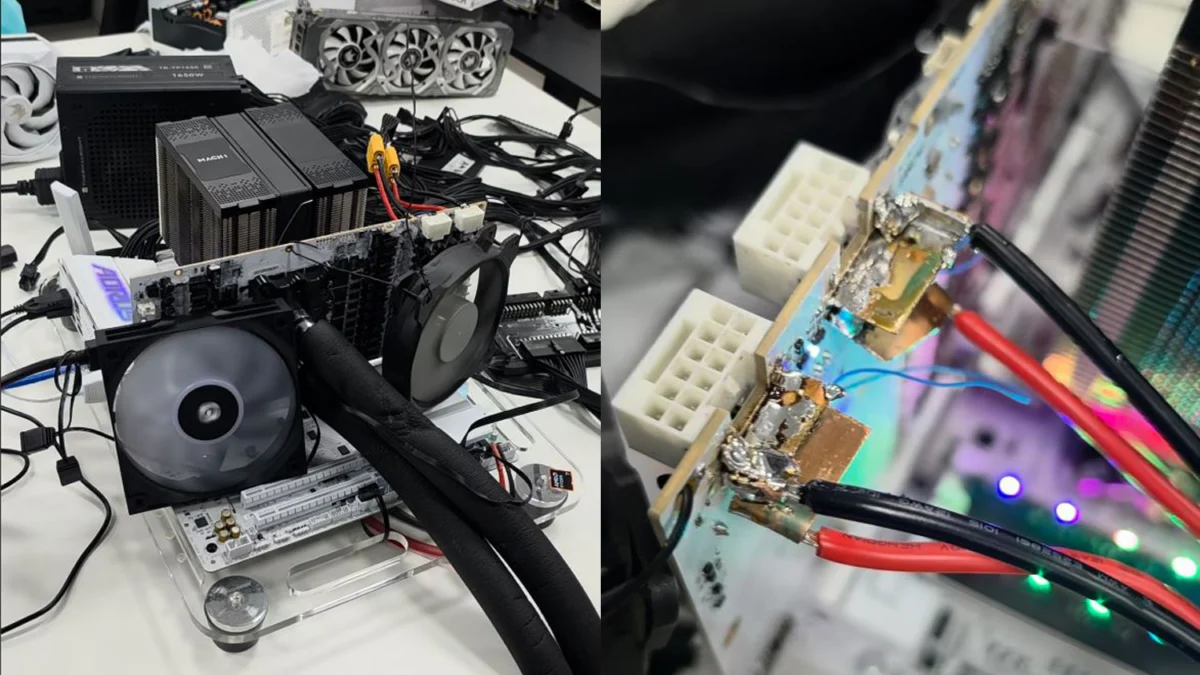
In a bold move that highlights the ongoing tension between high-end hardware enthusiasts and modern power delivery standards, the Brazilian hardware analysis and extreme overclocking group TecLab has demonstrated a radical modification of the NVIDIA GeForce RTX 5090. Motivated by recurring reports of melting 16-pin power connectors on NVIDIA’s latest flagship Blackwell GPUs, the team, led by renowned overclocker Ronaldo Buassali, bypassed the traditional connector interface entirely. By soldering high-gauge power cables directly to the printed circuit board (PCB) traces of a GALAX RTX 5090 D HOF OC LAB XOC, TecLab has provided a provocative, albeit unconventional, commentary on the reliability of current industry-standard power interfaces.
The Context of the Power Connector Controversy
The catalyst for this extreme modification is the persistent issue surrounding the 12VHPWR and the revised 12V-2×6 power connectors. These connectors, introduced with the PCI Express 5.0 standard, were designed to deliver up to 600 watts of power through a single, compact interface. However, since the launch of the GeForce RTX 4090 in late 2022, the enthusiast community has been plagued by reports of these connectors melting at the point of contact.

While the industry attempted to mitigate these failures by introducing the 12V-2×6 revision—which features shorter sense pins to ensure the cable is fully seated before power is delivered—the launch of the GeForce RTX 5090 has seen a resurgence of similar complaints. The RTX 5090, based on the Blackwell architecture, features a Total Graphics Power (TGP) of 600W in its reference form, with custom enthusiast models often exceeding this limit during overclocking. The high current density required to sustain these power levels through small contact pins remains a point of failure, particularly if the cable is subjected to even minor bending or improper seating.
Technical Execution of the Direct-Solder Modification
The subject of TecLab’s experiment was the GALAX GeForce RTX 5090 D HOF OC LAB XOC. This specific model is a high-performance variant designed for the Chinese market (indicated by the "D" suffix), yet it retains the extreme engineering characteristic of the "Hall of Fame" (HOF) series. This card is notably equipped with dual 16-pin power connectors to accommodate the massive power draw required for extreme overclocking.
Rather than utilizing the provided 16-pin headers, the TecLab team opted to strip the interface to its bare essentials. The modification involved the following steps:

- Direct Soldering: The team soldered heavy-duty copper wiring directly onto the PCB traces where the 16-pin headers would normally interface with the board. This method eliminates the mechanical contact resistance inherent in any plug-and-socket system, which is where the heat buildup leading to melting typically occurs.
- Use of Amass XT90 Connectors: To bridge the gap between the GPU and the power supply, TecLab utilized Amass XT90 connectors. These connectors are commonly used in the radio-controlled (RC) hobbyist industry and are rated for significantly higher continuous current (up to 90 Amps) than the standard PC power connectors.
- Cooling and Testing: To ensure the stability of the modified unit, the team utilized an external cooling apparatus to maintain the GPU substrate’s temperature, complemented by high-airflow fans directed at the VRM (Voltage Regulator Module) and the newly soldered power joints.
During the demonstration, the modified GPU was integrated into a test bench featuring a high-end Gigabyte motherboard. The system successfully booted into the operating system, and the card passed various stress tests without any signs of thermal instability or power delivery failure. While the aesthetic of the soldering was described by observers as functional rather than refined, the electrical integrity was sufficient to power one of the world’s most demanding consumer GPUs.
Chronology of NVIDIA Power Delivery Challenges
The move by TecLab is the latest chapter in a multi-year saga regarding GPU power delivery. To understand the significance of this modification, one must look at the timeline of the 16-pin connector’s evolution:
- October 2022: NVIDIA launches the GeForce RTX 4090 featuring the 12VHPWR connector. Within weeks, users began reporting melted connectors.
- November 2022: NVIDIA’s initial investigation suggested that the primary cause of failure was "user error," specifically cables not being fully inserted.
- 2023: The PCI-SIG (the body responsible for PCIe standards) began working on the 12V-2×6 revision to improve the mechanical locking and electrical contact of the 16-pin interface.
- Early 2025: The GeForce RTX 5090 launches. Despite the implementation of the 12V-2×6 standard, early adopters and technical reviewers began documenting cases of thermal damage on the new 50-series cards, suggesting that the high power draw of the Blackwell architecture may still be pushing the limits of the connector’s physical design.
Data and Implications of High-Wattage Power Delivery
The technical challenge lies in the physics of electrical resistance. At a 600W load on a 12V rail, the system must handle 50 Amps of current. In a standard 16-pin connector, this current is distributed across six power pins (with the remaining pins being ground and sense pins). If any single pin has slightly higher resistance due to a poor connection, dust, or a slight angle in the cable, that pin will generate localized heat.

According to data from thermal testing conducted by various hardware labs, a poorly seated 12VHPWR connector can reach temperatures exceeding 150°C in less than 30 minutes of sustained load. Since the plastic housing of the connector typically has a melting point between 120°C and 160°C, the margin for error is dangerously slim. By soldering directly to the PCB, TecLab effectively reduced the contact resistance to near zero, theoretically allowing the GPU to pull hundreds of watts without the risk of thermal runaway at the entry point.
Professional and Industry Reactions
While NVIDIA has not officially commented on the TecLab video, the demonstration has sparked significant discussion among board partners and third-party accessory manufacturers. Many industry experts view this not as a practical guide for consumers, but as a "protest mod" designed to signal to manufacturers that the current power delivery standards are insufficient for the trajectory of GPU power consumption.
Retailers and safety advocates have been quick to warn consumers against replicating this modification. Soldering directly to a GPU PCB immediately voids all manufacturer warranties and carries a high risk of permanent hardware damage or fire if not executed with precision. For the average user, experts recommend alternative solutions such as the WireView II Pro, a specialized adapter developed by Thermal Grizzly and engineer Roman "der8auer" Hartung. These devices provide real-time power monitoring and use high-quality materials to ensure a more secure connection than standard stock cables.

Analysis of Future Implications
The TecLab demonstration underscores a critical juncture in PC hardware design. As GPUs continue to scale in performance, their power requirements are outstripping the capabilities of traditional consumer-grade interconnects. There are three primary paths the industry might take in response to these ongoing issues:
- Refinement of the 12V-2×6 Standard: Further revisions to the connector material, such as using higher-conductivity alloys or more robust terminal designs, may be necessary to increase the safety margin.
- Return to Multiple 8-Pin Connectors: Some enthusiasts argue for a return to the older 8-pin PCIe power standard. While an RTX 5090 would require four or five such cables, the lower current density per pin makes them significantly less prone to melting.
- Shift to Industrial Interconnects: As seen in TecLab’s use of XT90 connectors, there is a precedent for using industrial or high-current RC connectors in applications requiring extreme reliability. However, integrating these into consumer-friendly designs would require a massive overhaul of PSU and GPU manufacturing.
Ultimately, TecLab’s experiment serves as a stark reminder of the engineering hurdles facing the next generation of computing. While the soldered RTX 5090 is a functional marvel, it highlights a fundamental design vulnerability in the world’s most powerful consumer graphics card. As NVIDIA and its partners look toward future iterations of the Blackwell architecture and beyond, the reliability of the power interface will likely remain a top priority for both engineers and the consumer base they serve.