Chandra Wibowo
Despite a significant ethical concession from a prominent memecoin entrepreneur, the Clarity Act, a legislative effort aimed at establishing comprehensive ethics guidelines for public officials in the digital asset space, is currently struggling to gain traction. With the August recess deadline rapidly approaching, Senate Majority Leader John Thune has expressed skepticism regarding the bill’s current vote count, though he remains open to bringing it to the floor to initiate the legislative process. The proposed ethics deal, a cornerstone of the Clarity Act, seeks to prohibit all U.S. officials from issuing or sponsoring digital assets. However, it includes several contentious "get out of jail free" provisions for the President, which have drawn sharp criticism from Democrats. These provisions include the stipulation that the new rules would expire on the President’s scheduled departure from office in 2029, a timeline that Democrats argue undermines the long-term integrity of the legislation.
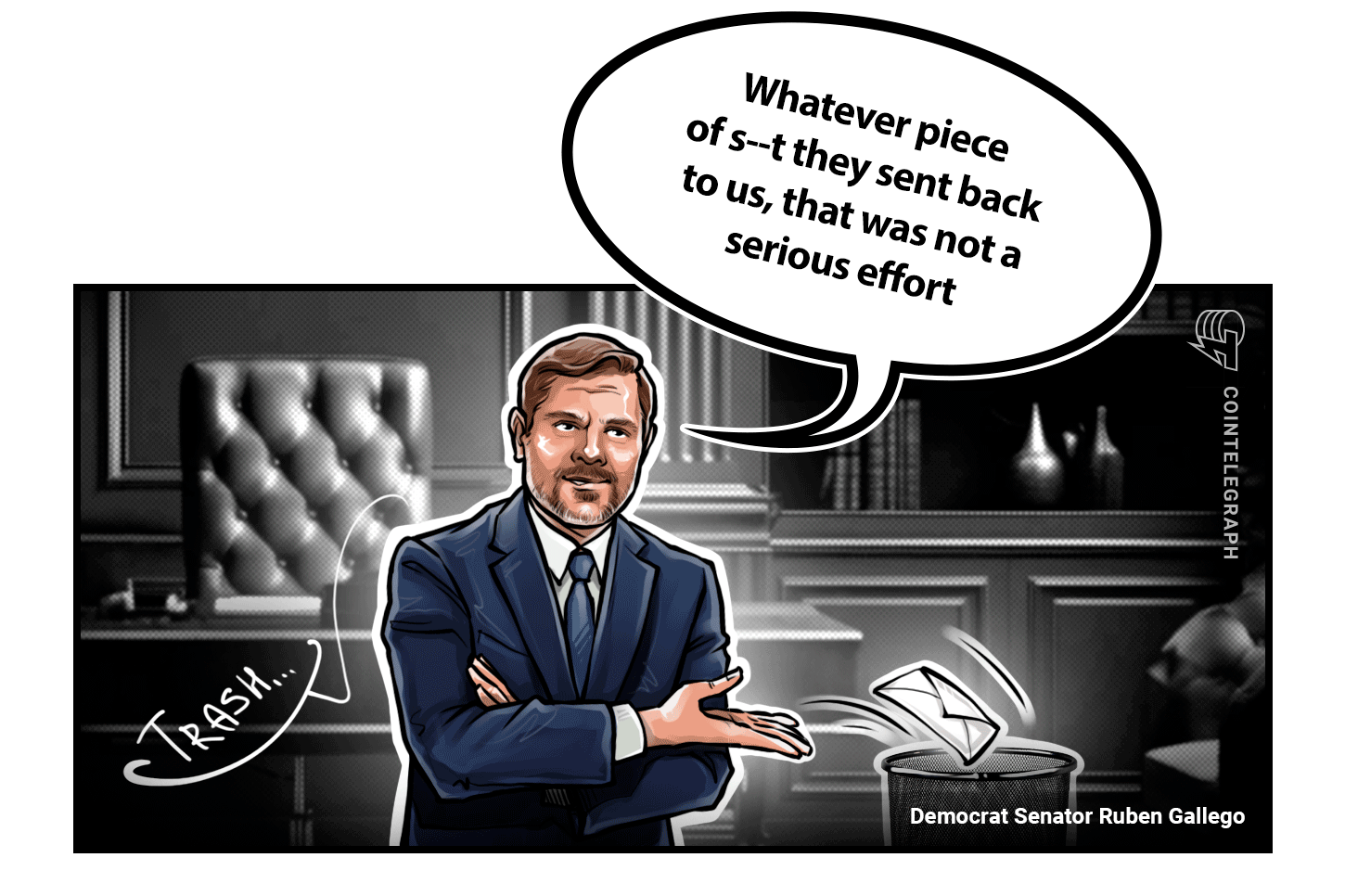
Adding to the controversy, the enforcement of these ethical provisions is slated to be overseen by the Attorney General appointed by the President. Democrats advocate for a more decentralized enforcement mechanism, proposing that state Attorneys General should hold this responsibility. This alternative is met with resistance from the President, who is unlikely to agree to empower numerous state-level officials with the authority to potentially pursue legal action against him. The White House has lauded the bill as a landmark achievement in ethics reform, describing it as the "most comprehensive and wide-ranging ethics provision in history." In stark contrast, Democratic Senator Ruben Gallego has vehemently denounced the bill, labeling it a "piece of shit" and asserting that it "is not a serious effort."
The legislative push comes at a time of increasing scrutiny and debate surrounding the intersection of public office and the burgeoning digital asset industry. The Clarity Act’s trajectory is further complicated by differing interpretations of its core tenets and the potential implications for various stakeholders. While the President’s camp champions the bill as a necessary step towards transparency and accountability, opposition voices highlight perceived loopholes and a lack of robust enforcement mechanisms. The outcome of this legislative battle remains uncertain, with the approaching recess adding a layer of urgency to ongoing negotiations and political maneuvering.

Background of the Clarity Act and the Ethics Deal
The Clarity Act emerged as a response to growing concerns about potential conflicts of interest and undue influence within the digital asset sector, particularly as it relates to public officials. The bill’s proponents argue that the rapid evolution of cryptocurrencies and blockchain technology necessitates clear ethical boundaries to safeguard the integrity of government and public trust. The core of the proposed legislation revolves around preventing public officials from leveraging their positions for personal gain or to influence the digital asset market.
The pivotal "ethics deal" at the heart of the current legislative deadlock aims to impose a blanket ban on U.S. officials from creating or endorsing digital assets. This move is intended to prevent situations where officials might possess insider knowledge or exert influence to benefit specific digital currencies or projects. However, the deal’s stipulations concerning presidential exceptions have ignited a fierce debate. Critics point to the sunset clause, which would render the regulations inoperative upon the end of the President’s term in 2029, as a significant weakness. This provision suggests that the ethical considerations are viewed as temporary rather than a permanent fixture of governance in the digital age.
Furthermore, the proposed enforcement mechanism, delegating authority to the President’s appointed Attorney General, has raised concerns about potential bias and a lack of independent oversight. The Democratic proposal for state-level enforcement aims to distribute this authority and introduce a broader array of checks and balances. The differing views on enforcement underscore a fundamental disagreement about the best approach to regulating the digital asset space and ensuring accountability among public servants.
Law Enforcement Support and Industry Reactions
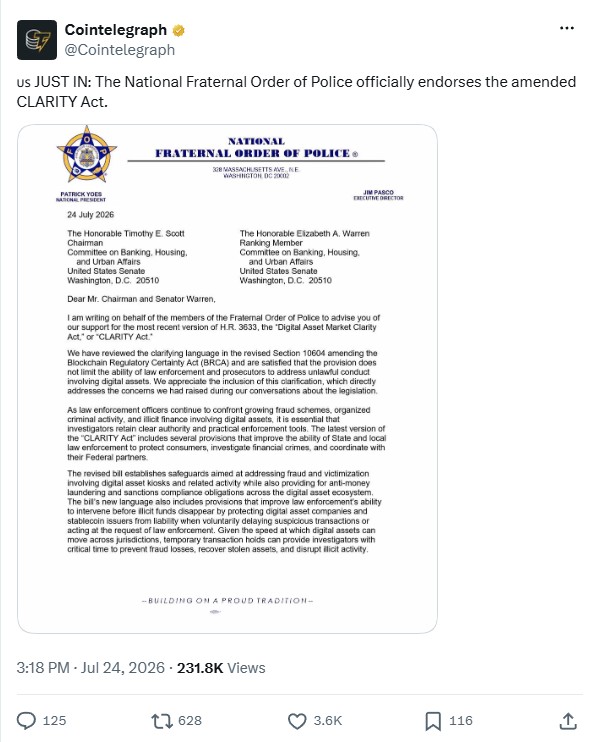
While political debates rage, law enforcement organizations have begun to signal their support for certain aspects of the legislative efforts, provided they do not impede legitimate investigations. The National Fraternal Order of Police, representing a significant contingent of law enforcement officers, has stated that the latest iteration of the bill, which includes provisions to protect developers of decentralized protocols (potentially referencing the Blockchain Regulatory Clarity Act or BRCA), would not hinder their efforts to combat money laundering and fraud. This stance suggests a potential area of bipartisan agreement, focusing on the practical application of regulations to prevent illicit activities.
However, the broader industry reaction remains mixed. The inclusion of strict ethical guidelines, even with proposed exceptions, can be viewed with apprehension by those operating within the digital asset space. The constant flux of regulatory proposals creates an environment of uncertainty, which can stifle innovation and investment. The Polymarket odds, currently standing at 38% for the bill’s passage this year, reflect this pervasive uncertainty and the challenging path ahead for the Clarity Act.
BitMEX Announces Shutdown Amidst Legal Challenges and Industry Consolidation
In parallel to the legislative developments, the cryptocurrency derivatives exchange BitMEX has announced it will cease operations in September, marking the end of an 11-year run. The exchange, a pioneer in the industry, was renowned for introducing 100x leverage perpetual swaps, a product that significantly shaped the early landscape of crypto trading.
The decision to shut down comes after a period of declining trading volumes, attributed to increased competition from major exchanges like Binance and the rise of decentralized trading protocols such as Hyperliquid. CryptoQuant CEO Ki Young Ju noted that BitMEX’s share of the Bitcoin futures market has dwindled to a mere 0.08%, with approximately $84 million in daily trading volume. Ju acknowledged BitMEX’s historical significance, stating, "It was a great exchange that helped shape the industry, and now it is passing the torch to the next generation of exchanges it inspired."
The announcement of BitMEX’s closure had an immediate impact on its utility token, BMEX, which experienced a sharp decline in value. Concurrently, news emerged of a class-action lawsuit accusing the platform of fraudulently engineering customer liquidations to seize traders’ collateral. BitMEX has denied these allegations, asserting its successful defense against similar claims in the past.
The demise of BitMEX is being interpreted by industry analysts as a clear signal of accelerating consolidation within the cryptocurrency sector. Restructuring advisor Roshan Dharia commented to Cointelegraph, "The top five platforms now control an estimated 80% of global spot volume, leaving mid-tier and regional exchanges with shrinking margins and no viable path to scale… The headwinds are structural, not cyclical." This sentiment was further underscored by the subsequent announcement from BitMart that it too would wind down its operations in the coming months, reinforcing the trend of industry consolidation.
S&P Launches Blockchain Fundamentals Index, Excluding Key Players
In a move aimed at institutional investors, S&P Dow Jones Indices, in collaboration with Pantera Capital, has launched a digital asset index designed to track major crypto assets. The S&P Pantera Digital Asset Index, however, notably excludes Bitcoin (BTC) and XRP (XRP) from its constituents. The index employs stringent screening criteria, including minimum thresholds for protocol revenue, market capitalization, and liquidity, to identify eligible assets.
The index debuted with 18 constituents, with Ether (ETH), BNB (BNB), Solana (SOL), TRON (TRX), and Hyperliquid (HYPE) representing its largest holdings. The exclusion of Bitcoin and XRP, two of the most prominent cryptocurrencies by market capitalization, highlights the specific focus of this index on assets that meet certain fundamental criteria beyond just market presence. This development follows a broader industry trend towards the creation of institutional-grade benchmarks for digital assets, with other initiatives including the Nasdaq Crypto Index US ETF and the Franklin Crypto Index ETF.
Robinhood Eyes Expansion of Prediction Markets Amidst CFTC Scrutiny
Online brokerage firm Robinhood is reportedly in discussions with cryptocurrency exchange Crypto.com to expand its prediction market offerings. The talks, as reported by The Wall Street Journal, involve the potential integration of yes-or-no event contracts supplied by Crypto.com. Robinhood initially launched its prediction markets in March 2025, utilizing Kalshi to facilitate these offerings and ensure compliance with U.S. Commodity Futures Trading Commission (CFTC) regulations.

Analysts at Bernstein have expressed optimism about Robinhood’s future, raising their price target for HOOD stock to $160 from $130, citing the company’s prospects in prediction markets and tokenized equities. Meanwhile, the CFTC, which seeks to establish itself as the primary regulator of prediction markets, has issued a stern warning to providers. The commission has cautioned platforms against submitting overly broad, template-style certifications for event contracts, emphasizing the need for more specific documentation. This advisory indicates the CFTC’s intent to bring greater clarity and rigor to the regulation of these emerging markets. Carl Kennedy, a partner at Katten Muchin, suggested at a House Agriculture Committee hearing that the Clarity Act could potentially aid the CFTC in overseeing the "explosive growth of prediction markets."
Balaji Srinivasan’s Network School Relocates to Kazakhstan Following Malaysian Setback
Balaji Srinivasan’s Network School, a community catering to "digital nomads," is reportedly exploring the establishment of a new campus in Kazakhstan. This move comes after its Forest City campus in Malaysia had its business license revoked due to alleged violations related to premises usage. The Network School was compelled to leave Johor, Malaysia, following a controversy surrounding the admission of Israeli dual citizens, a sensitive issue in the Muslim-majority nation with no diplomatic ties to Israel. Despite an investigation that found no visa violations, the Network School was ultimately ordered to cease operations under a different pretext.
The incident has been viewed by some, including Dragonfly Capital managing partner Haseeb Qureshi, as validation of Srinivasan’s "Network State" thesis. Qureshi commented, "The whole idea of a network state is taking a dense group of talent and capital, and collectively negotiating with states. The Malaysia drama set up Balaji to negotiate better terms with another state to copy and paste the network there." The memorandum of understanding signed with Kazakhstan’s Minister Zhaslan Madiyev signals a potential new chapter for the Network School as it seeks to establish a digital hub in the Central Asian nation.
Market Performance and Notable Movements
As the week concluded, Bitcoin (BTC) was trading at $65,395, Ether (ETH) at $1,958, and XRP (XRP) at $1.11, with the total cryptocurrency market capitalization standing at $2.24 trillion, according to CoinMarketCap. Among the top 100 cryptocurrencies, Audiera (BEAT) emerged as a significant winner, with a 53% gain. Shinba Inu (SHIB) also saw a substantial increase of 29%, followed by Venice Token (VVV) with a 19% rise.

Conversely, DeXe (DEXE) experienced a sharp decline, losing 89% of its value. Midnight (NIGHT) fell by 26%, and Pyth Network (PYTH) dropped 10%, marking them as the week’s top altcoin losers.
Prediction of the Week: Hyperliquid and Robinhood to Propel Next Crypto Bull Market
Matt Hougan, Chief Investment Officer at Bitwise, has predicted that Bitcoin is "finally showing signs of a bottom" and anticipates that traditional finance (TradFi) integrations, specifically through platforms like Hyperliquid and Robinhood, will be instrumental in driving the next cryptocurrency bull market. He believes this upward trend will "lift" major cryptocurrencies such as Bitcoin and Ether. Hougan highlighted the benefits that crypto is bringing to traditional markets, such as 24/7 trading. He noted that a significant portion of Hyperliquid’s volume is already derived from conventional assets like oil, silver, and the S&P 500, with further expansion into spot commodities, prediction markets, and options. Bitwise data also indicates a potential reversal in demand for Bitcoin, with metrics showing a divergence between newly mined BTC and supply that has remained inactive for at least a year.
Top FUD of the Week: Wrench Attacks Escalate, Home Invasions Become Prevalent
Blockchain security firm CertiK has reported a concerning surge in crypto-related "wrench attacks" during the first half of 2026. Home invasions have become the most common form of these attacks, with 20 publicly reported incidents, a significant increase from just one in the preceding year. Globally, CertiK verified 52 wrench attacks in H1 2026, a 33.3% rise from the same period in 2025. While kidnappings also increased to 16 from 12, robberies saw a decline. The financial exposure linked to these attacks reached approximately $124.1 million, a substantial jump from $10.5 million a year prior. This trend suggests a disturbing shift towards criminals physically coercing crypto holders and their families, bypassing digital security measures.
Hackers Target Crypto Bridges, Stealing Millions
In a series of swift exploits, hackers managed to steal over $31.6 million across two unrelated cryptocurrency bridge attacks within a seven-hour period. The exploits targeted bridges operated by the decentralized perpetual exchange AFX and Verus Protocol. Blockaid reported that AFX, operating on Arbitrum, lost an estimated $24.15 million through a hack on one of its cross-chain bridges. Shortly thereafter, an exploit targeting the Verus Ethereum Bridge resulted in the theft of approximately $7.5 million in cryptocurrency. Onchain investigator TheCrypticWolf commented on the incidents, stating, "Another bridge, another exploit. Bridges will always be a weak link, until security is upgraded."

Ethereum ETFs Conclude Week with Outflows, Ending Inflow Streak
US-listed spot Ethereum exchange-traded funds (ETFs) experienced net outflows of $70.62 million on Friday, ending a five-day streak of inflows. Over the preceding five sessions, Ethereum funds had seen $211.25 million in net inflows, according to SoSoValue data. Despite Friday’s outflows, Ethereum ETFs still registered $103.9 million in net inflows for the week ending Friday, extending their weekly inflow streak to three consecutive weeks and attracting a total of $337.74 million in net inflows for July thus far. Bitcoin ETFs, in contrast, reversed earlier weekly gains to end the week with $33.9 million in inflows.
Top Magazine Stories of the Week
Cointelegraph’s magazine section featured several in-depth articles exploring critical issues within the crypto space. One prominent piece delved into the complexities surrounding the CLARITY Act, examining why the proposed ethics deal might prove difficult to finalize, with disputes over enforcement mechanisms creating significant obstacles for both parties. Another featured article presented the perspective of Charles Edwards, who argued that a comprehensive development roadmap addressing quantum computing risks could significantly boost Bitcoin’s price, potentially by "double digits" in a short timeframe. A third article tackled the growing concerns around AI-driven hacks in decentralized finance (DeFi), assessing whether fears of a "hackpocalypse" are overstated for now, while acknowledging the increasing danger posed by AI to existing vulnerabilities.