Sisilia Frederika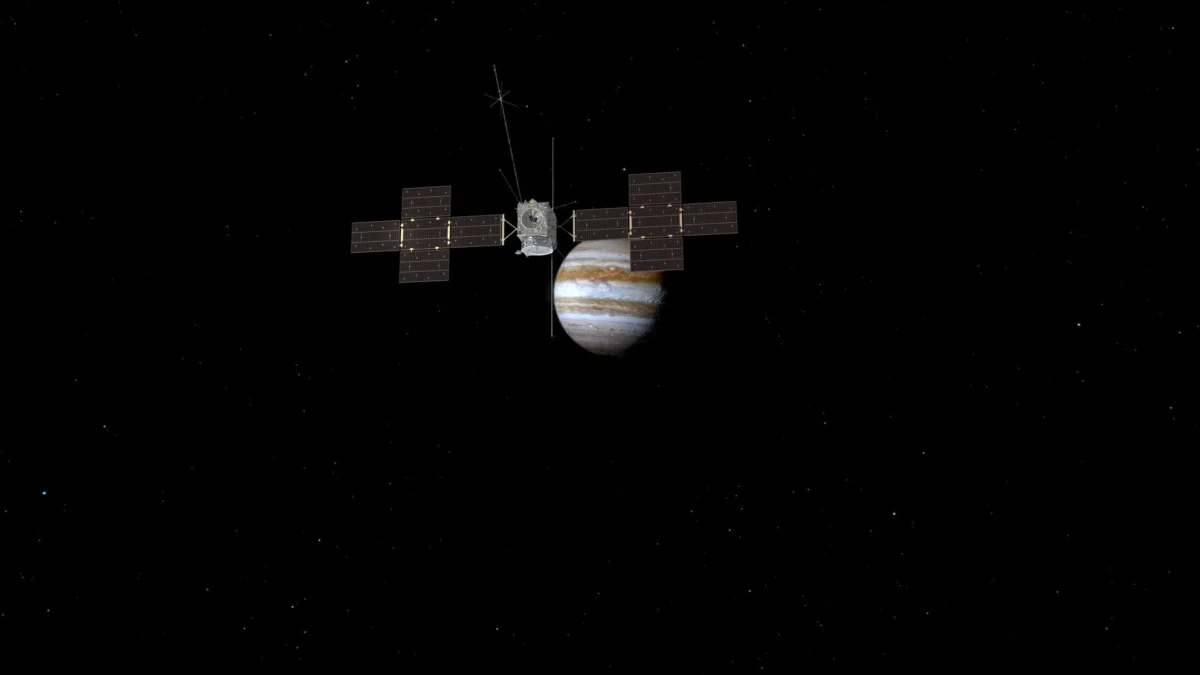
The European Space Agency’s (ESA) Jupiter Icy Moons Explorer (JUICE) is currently navigating the vast expanse of the inner solar system on an eight-year odyssey toward the largest planet in our neighborhood. While the primary scientific objectives of the mission are focused on the "big three" Galilean moons—Ganymede, Europa, and Callisto—recent research highlights a significant expansion in the mission’s scope. A comprehensive paper published in Space Science Reviews by Tilmann Denk of the German Aerospace Center (DLR) and a team of international co-authors details how JUICE will leverage its sophisticated instrument suite to perform "bonus science" on Jupiter’s other 94 confirmed moons, turning a targeted study of icy worlds into a comprehensive survey of the entire Jovian system.
Upon its scheduled arrival in July 2031, JUICE will enter a target-rich environment. While its primary mission involves mapping Ganymede’s unique magnetic field and investigating the subsurface oceans of Europa and Callisto, the probe will remain a vigilant observer of the complex Jovian architecture. This includes the hyper-volcanic moon Io, the inner "ring moons," and the vast swarm of irregular outer satellites that orbit far from the gas giant’s cloud tops.
The Volcanic Majesty of Io: Remote Observation and Plasma Dynamics
Io remains one of the most enigmatic bodies in the solar system. As the most geologically active object known to man, it hosts at least 425 active volcanoes that are in a state of constant eruption, fueled by the intense tidal heating generated by the gravitational tug-of-war between Jupiter and the other Galilean moons. Although JUICE’s trajectory is designed to keep it at a safe distance of several hundred thousand kilometers to avoid the lethal radiation belts surrounding Io, the spacecraft is equipped to conduct high-resolution remote sensing.
The mission’s JANUS camera system is expected to monitor Io’s surface with a resolution of approximately 6 to 12 kilometers per pixel. This capability will allow scientists to track surface changes, new lava flows, and the appearance of transient "hot spots" that may occur during the mission’s lifespan. This data will complement observations from NASA’s Juno mission, which recently documented a record-breaking eruption on Io emitting an estimated 80 trillion watts of energy.
Beyond visual imaging, JUICE will utilize its Ultraviolet Spectrograph (UVS) to monitor sulfur dioxide emissions and auroral activity on Io. This is particularly timely following the James Webb Space Telescope’s (JWST) recent first-time detection of sulfur in Io’s atmosphere. By tracking these gases, JUICE will help scientists understand how volcanic material escapes Io’s gravity to populate the Jupiter system. Furthermore, the Particle Environment Package (PEP) will study the Io plasma torus—a massive, donut-shaped ring of charged particles that follows Io’s orbit. This torus is a critical component of Jupiter’s magnetosphere, and JUICE’s long-term monitoring will provide a baseline for how volcanic output fluctuates over time.
Solving the Inner Moon Mysteries: Amalthea’s Paradox
Closer to Jupiter than the orbit of Io lie four smaller moons: Metis, Adrastea, Amalthea, and Thebe. These "inner moons" reside deep within the planet’s harshest radiation environment and are the primary source of material for Jupiter’s faint, gossamer ring system. Among these, Amalthea presents a long-standing scientific riddle known as "Amalthea’s Paradox."
Despite its proximity to the intense heat and gravity of Jupiter, Amalthea has an unexpectedly low density—less than that of water ice. This suggests the moon is either highly porous, resembling a "rubble pile" of fragments, or that it contains a significant amount of water ice that has somehow survived in a high-radiation environment. JUICE’s instruments will provide the first detailed spectrographic images of these inner moons, allowing researchers to analyze their mineralogical composition and search for "moonlets" or debris clouds in their vicinity. By determining the ratio of ice to rock on Amalthea, JUICE could fundamentally alter our understanding of how moons form in the immediate vicinity of gas giants.
The Irregular Swarm: Exploring Jupiter’s Outer Satellites
As of 2024, the Jovian system is known to host at least 97 moons, the majority of which are "irregular" satellites. These are small, often eccentric bodies that orbit at great distances and are believed to be captured asteroids from the early days of the solar system. JUICE mission planners are currently identifying opportunities to observe these distant targets as the spacecraft maneuvers through the Jovian system.
One primary target of interest is Himalia, the largest of the irregular moons. JUICE will attempt to determine its surface composition to verify if it shares a common origin with C-type asteroids or if it represents a unique class of outer solar system objects. Additionally, mission planners are evaluating a potential close flyby of the moon Kallichore. If approved, this maneuver would occur shortly after JUICE’s arrival in 2031, providing the first-ever close-up images of an irregular Jovian moon. Such data would be invaluable for comparative planetology, helping scientists distinguish between moons that formed in situ and those that were captured by Jupiter’s massive gravity over billions of years.
Chronology of the JUICE Mission: A Decade of Navigation
The journey of JUICE is a masterclass in orbital mechanics. Launched in April 2023 from Europe’s Spaceport in French Guiana, the probe is currently in the midst of a series of complex gravity-assist maneuvers designed to shed orbital energy and align its path with Jupiter.
- April 2023: Successful launch via Ariane 5 rocket.
- August 2024: Completion of the world’s first Lunar-Earth Gravity Assist (LEGA), which utilized the gravity of both the Moon and Earth to slingshot the craft toward Venus.
- 2025: Scheduled Venus gravity assist to further refine the trajectory.
- 2026–2029: Multiple Earth flybys to provide the final velocity boost required to reach the outer solar system.
- July 2031: Jupiter Orbit Insertion (JOI). The spacecraft will begin its initial survey of the system and prepare for its primary flybys of Europa and Callisto.
- 2034: JUICE will perform a historic maneuver to enter orbit around Ganymede, marking the first time a spacecraft has orbited a moon other than our own.
International Cooperation: The JUICE and Europa Clipper Synergy
JUICE will not be exploring the Jovian system in isolation. NASA’s Europa Clipper mission, which launched in October 2024, is taking a faster trajectory and is expected to arrive at Jupiter in April 2030, roughly a year before JUICE. Recognizing the unprecedented opportunity of having two flagship spacecraft in the system simultaneously, ESA and NASA have established a joint coordination committee.
This collaboration will focus on simultaneous observations of the Jovian magnetosphere and the plasma torus. While Europa Clipper focuses almost exclusively on the habitability of Europa, JUICE provides the broader context of the Jovian system. Together, the two missions will provide a stereo view of Jupiter’s environment, allowing scientists to distinguish between localized events on a specific moon and system-wide changes caused by solar wind or Jovian magnetic fluctuations.
Technical Analysis and Instrumentation Capabilities
The ability of JUICE to perform this "bonus science" is a testament to its advanced payload. The spacecraft carries ten state-of-the-art instruments, including:
- JANUS (Optical Camera System): Capable of multi-spectral imaging to characterize the morphology and processes of moon surfaces.
- MAJIS (Moons and Jupiter Imaging Spectrometer): Will determine the composition of surface ices and minerals.
- UVS (UV Imaging Spectrograph): Dedicated to studying the atmospheres and auroras of the moons.
- RIME (Radar for Icy Moons Exploration): A subsurface radar designed to look up to 9 kilometers deep into the ice of the Galilean moons, though it may also provide data on the porosity of smaller moons like Amalthea.
- PEP (Particle Environment Package): Essential for measuring the plasma environment and its interaction with the moons.
The integration of these tools allows for a holistic approach. For example, while JANUS captures the visual evidence of a volcanic plume on Io, UVS can simultaneously measure the chemical composition of that plume, and PEP can detect the resulting increase in charged particles within the plasma torus.
Broader Implications: Jupiter as a Mini-Solar System
The expanded scope of the JUICE mission underscores a growing consensus in the scientific community: Jupiter is not just a planet, but a "mini-solar system." By studying the minor moons alongside the major Galilean satellites, JUICE will provide insights into the formation of planetary systems at large. The irregular moons offer a window into the population of the early Kuiper Belt and asteroid belt, while the inner moons provide data on the limits of moon formation near a massive primary body.
Furthermore, the study of these diverse worlds—ranging from the volcanic inferno of Io to the frozen oceans of Ganymede—informs our search for life elsewhere in the universe. Understanding how energy and matter are distributed in a complex system like Jupiter’s helps astrobiologists define the "habitable zone" of gas giant moons, which may be more common in the galaxy than Earth-like planets.
As JUICE continues its quiet trek through the cold vacuum of space, the scientific community remains in high anticipation. The "bonus science" identified by Tilmann Denk and his colleagues ensures that every moment of the spacecraft’s tenure at Jupiter will be maximized, promising a decade of discovery that will redefine our understanding of the King of Planets and its diverse family of moons.