Chandra Wibowo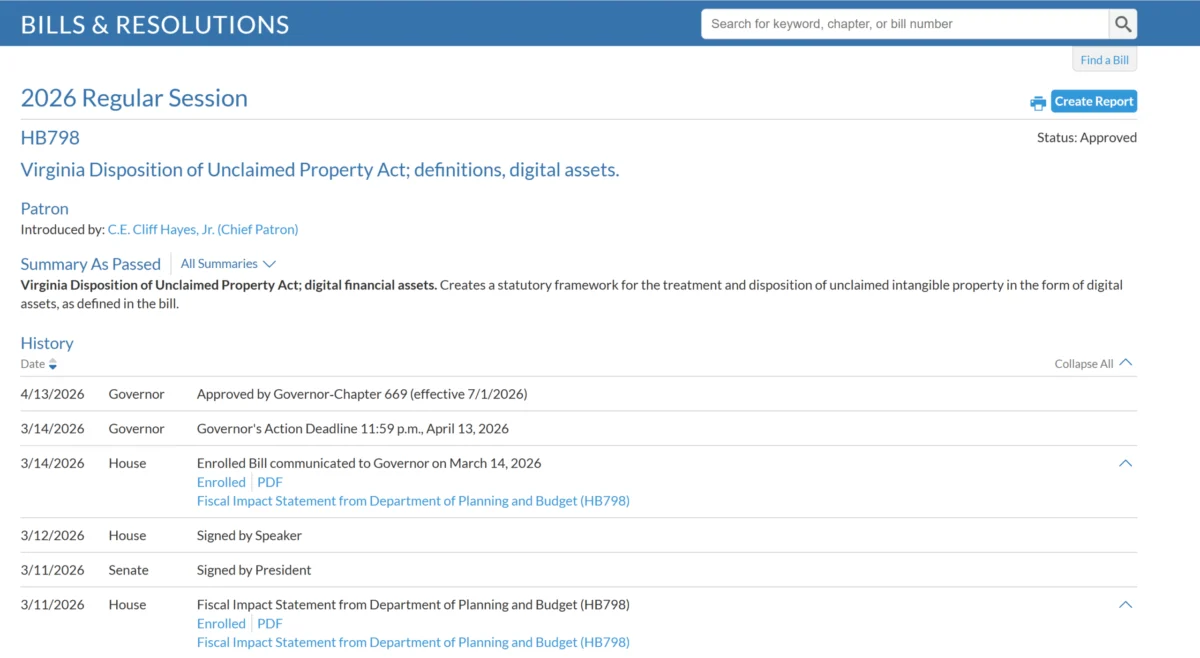
Virginia has officially embraced the digital age by enacting a significant piece of legislation that brings digital assets under the purview of its unclaimed property laws. Governor Abigail Spanberger signed House Bill 798 into law, a move that modernizes the state’s approach to dormant assets and offers a more nuanced strategy for handling cryptocurrencies and other digital holdings that have been abandoned by their owners. This legislation is noteworthy not only for its inclusion of digital assets but also for its provisions that prioritize the preservation of these assets in their original form and establish a minimum holding period before any potential sale, a stark contrast to the immediate liquidation often seen with traditional unclaimed property.
The core of House Bill 798 lies in its amendment of Virginia’s existing Disposition of Unclaimed Property Act. Previously, the act primarily dealt with tangible and financial assets like bank accounts, stocks, and physical property that remained unclaimed for extended periods. The new law explicitly incorporates digital assets, which encompass a wide range of items, including cryptocurrencies, non-fungible tokens (NFTs), and other forms of digital value stored on blockchain technology. Custodians of these unclaimed digital assets, such as cryptocurrency exchanges or digital wallets, will now be legally obligated to report and transfer them to the state.
A critical distinction of Virginia’s new law is the requirement for an "in-kind" transfer. This means that when a digital asset is deemed unclaimed, it must be transferred to the state in its native format. For instance, if a cryptocurrency like Bitcoin is found to be abandoned, the state will receive Bitcoin, not its cash equivalent at the time of reporting. This approach directly addresses concerns within the digital asset community regarding the volatility of cryptocurrency markets. By holding assets in their original form, the state mitigates the risk of forced sales at potentially unfavorable prices, especially during market downturns. This also offers a significant potential benefit to the original owner should they eventually reclaim their property, as they would receive the asset in its current state, potentially with accrued value appreciation.
Furthermore, the law introduces a mandatory one-year holding period before the state can initiate any sale of these unclaimed digital assets. The bill states, "The administrator may subsequently direct such holder of unclaimed digital assets to liquidate the reported but unremitted digital assets not less than one year following the filing of a report." This provision provides a crucial buffer period, allowing for market fluctuations to stabilize and giving owners more time to come forward and claim their assets. This measured approach contrasts with some jurisdictions that might move to liquidate assets more rapidly, potentially at a loss for the rightful owner.
The legislative journey of House Bill 798 reflects a growing national trend among U.S. states to grapple with the complexities of digital assets within existing legal frameworks. In May of the previous year, Arizona Governor Katie Hobbs signed a similar law, allowing the state to take ownership of unclaimed cryptocurrencies after a three-year dormancy period. Arizona’s approach involves placing these unclaimed assets into a state-managed reserve fund. California has also been proactive, passing legislation to bring cryptocurrencies under its unclaimed property laws, signaling a broader recognition of the need for regulatory clarity in the digital asset space. Virginia’s adoption of this forward-thinking approach positions it among the states leading the charge in adapting financial regulations to the evolving digital economy.
Defining Abandonment for Digital Assets
Beyond the handling of discovered assets, House Bill 798 also provides much-needed clarity on when digital asset accounts are considered abandoned. The law establishes a five-year period of inactivity as the benchmark for abandonment, unless the owner demonstrates engagement with the account. This engagement can be as simple as logging into the account or conducting a transaction. This five-year clock provides a substantial window for owners to remain connected to their digital holdings, offering a reasonable balance between protecting dormant assets and respecting individual ownership. The clarity provided by this defined inactivity period is crucial for both custodians managing these assets and for individuals who may have forgotten about their digital holdings.
The passage of this bill has been met with positive reactions from key figures and organizations within the cryptocurrency and blockchain community. Paul Grewal, Chief Legal Officer at Coinbase, a prominent cryptocurrency exchange, took to social media platform X (formerly Twitter) to commend the legislation. He stated, "Some good news out of Virginia. The law updates the state’s unclaimed property statute to cover digital assets and ensures they are escheated in-kind." This endorsement from a major industry player highlights the practical implications of the law for digital asset custodians and users. The emphasis on in-kind transfer is particularly welcomed, as it aligns with the inherent nature of digital assets and avoids the potential value erosion associated with forced conversions to fiat currency.

The Virginia Blockchain Council also voiced its support for House Bill 798, describing it as "an important step." The council highlighted that the bill "helps modernize Virginia’s financial laws and signals the Commonwealth’s continued engagement with emerging technologies." This sentiment underscores the broader economic implications of the legislation, suggesting that Virginia is positioning itself as a state that is open to innovation and supportive of the burgeoning digital economy. By creating a clearer regulatory pathway for digital assets, the state may attract further investment and development in the blockchain and cryptocurrency sectors.
The Broader Context: Evolving Regulatory Landscape
The inclusion of digital assets in unclaimed property laws is part of a larger, ongoing evolution of regulatory frameworks across the United States. As digital assets have moved from niche curiosities to significant financial instruments, policymakers are increasingly recognizing the need to integrate them into existing legal structures. This process involves addressing questions of ownership, taxation, and consumer protection. Unclaimed property laws, designed to manage assets that have been lost or forgotten, are a logical place to begin this integration.
Historically, unclaimed property laws have served as a mechanism for states to safeguard assets that have been dormant for a specified period, with the intention of returning them to their rightful owners. When these assets are not claimed within a statutory timeframe, they are typically transferred to the state treasury, where they can be used for public services. The challenge with digital assets has been their unique characteristics, which do not always fit neatly into traditional categories of property. Their intangible nature, global accessibility, and rapid value fluctuations have necessitated new approaches.
The approach taken by Virginia, with its emphasis on in-kind transfer and a holding period, reflects a growing understanding of these unique characteristics. Unlike a physical item that might depreciate or become obsolete, a cryptocurrency like Bitcoin, if held properly, can retain or increase its value over time. A forced sale at an inopportune moment could result in a significant loss for the owner. By preserving the asset in its original form, Virginia’s law acknowledges the potential for digital assets to grow in value, thereby increasing the likelihood of a positive outcome for owners who eventually reclaim their property.
Implications for Owners and Custodians
For individuals who own digital assets, Virginia’s new law offers a greater degree of assurance. The clear definition of abandonment, coupled with the requirement for in-kind transfer and a holding period, means that even if an account becomes inactive, the value of the digital assets is more likely to be preserved. It also encourages vigilance on the part of owners to maintain access to their accounts and demonstrate activity. The five-year inactivity period, while substantial, is not so long as to be easily forgotten, especially with the increasing awareness surrounding digital asset management.
For custodians of digital assets, such as cryptocurrency exchanges, the law provides a clearer directive on how to handle unclaimed property. The obligation to transfer assets in-kind simplifies the process compared to attempting to determine market values for liquidation. It also aligns with the operational realities of managing digital assets, where the asset itself is the primary unit of value. The one-year holding period also offers a practical window for custodians to manage the reporting and transfer process without immediate pressure to liquidate.
The trend of states enacting such legislation suggests that digital asset regulation is moving beyond nascent stages towards more integrated and practical frameworks. As more states adopt similar measures, a more cohesive national approach to digital asset unclaimed property may emerge, reducing complexity for businesses operating across state lines and providing greater consistency for asset owners. The legislative actions in Virginia, Arizona, and California are indicative of a broader governmental effort to understand and incorporate digital assets into the established financial and legal systems, ensuring that individuals and the state can benefit from the evolving digital economy in a responsible and equitable manner. This proactive stance by Virginia is likely to be observed closely by other states as they consider their own approaches to digital asset regulation.