Lina Irawan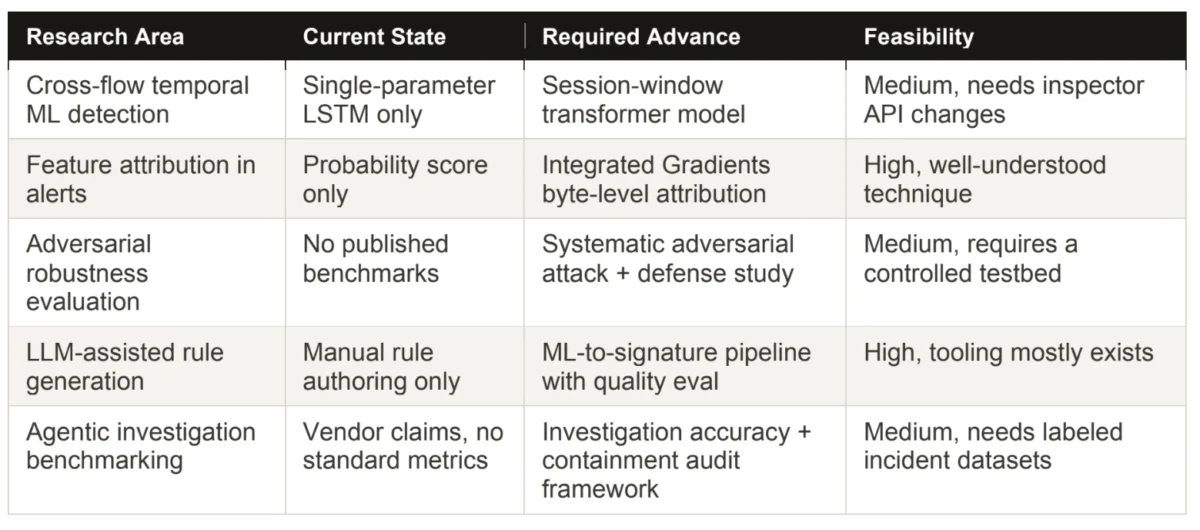
The traditional landscape of Intrusion Detection Systems (IDS) is undergoing a fundamental shift as the limitations of signature-based matching become increasingly apparent in the face of sophisticated, polymorphic threats. For decades, the security industry relied on the precision of signatures—verifiable strings of code designed to identify known exploits with surgical accuracy. However, as cyber adversaries transition toward more dynamic attack vectors, the gap between signature creation and real-world exploitation has widened. In response, the integration of machine learning (ML) directly into the packet-processing pipeline, combined with the rise of agentic Artificial Intelligence (AI) in security operations, is redefining how enterprises defend their networks. This technological evolution represents a move from reactive pattern matching to proactive, contextual reasoning.
The Structural Constraints of Signature-Based Defense
The effectiveness of a traditional IDS like Snort has historically been tied to its specificity. A well-written Snort signature can identify a specific Common Vulnerabilities and Exposures (CVE) entry with near-zero false positives and minimal computational overhead. However, this precision is also its greatest vulnerability. If an attacker modifies a payload to clear the same vulnerable code path via a slightly different route, the signature often fails to fire. This creates a "window of exposure"—the critical time elapsed between the discovery of a novel exploit and the deployment of a validated rule across the global sensor network.

In high-stakes environments, this window is not merely a theoretical risk. For vulnerabilities in widely used software, the process of capturing an exploit, reverse-engineering it, writing a rule, and testing it against a corpus of traffic can take days or weeks. During this period, organizations are effectively blind to variations of the attack. To address this, Cisco Talos introduced SnortML in early 2024, aiming to bridge the gap between known signatures and unknown variants through native, on-device machine learning.
Chronology of Innovation: 2024–2025
The transition toward intelligent network defense has followed a rapid timeline of development and deployment:
- March 2024: Cisco Talos officially launches SnortML, a machine learning detection engine running natively inside Snort 3. The initial focus is on SQL injection (SQLi) detection within HTTP traffic.
- Late 2024: Secure Firewall 10.0.0 is released, introducing adaptive model selection based on query length (256, 512, or 1024 bytes) to optimize performance and accuracy.
- April 2025: IBM introduces ATOM (Autonomous Threat Operations Machine), a multi-agent framework designed to sit above SIEM analytics to handle autonomous investigation and remediation.
- August 2025: Trend Micro releases its Agentic SIEM, focusing on autonomous correlation and multi-step investigation capabilities.
- Late 2025: SnortML coverage expands beyond SQLi to include Cross-Site Scripting (XSS) and command injection attack classes, delivered via the Lightweight Security Package (LSP) system.
This timeline highlights a dual-track evolution: the hardening of the "sensor layer" via SnortML and the sophistication of the "reasoning layer" via agentic AI.
Technical Mechanics of SnortML
SnortML represents a departure from cloud-based reputation services or generic anomaly scorers. It performs inference entirely on the local device, integrated into the standard Snort 3 processing pipeline. This architectural choice ensures that the system maintains a predictable performance profile, typically producing a verdict in under a millisecond.
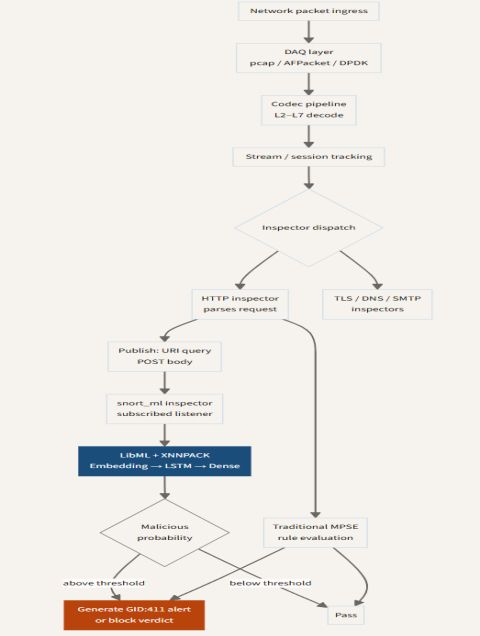
The engine utilizes two primary components: the snort_ml_engine module, which manages pre-trained TensorFlow models, and the snort_ml inspector. The system leverages Snort 3’s internal publish/subscribe interface. When an HTTP inspector finishes parsing a request, it publishes the URI query string and POST body to an event bus. The SnortML inspector then runs this data through a Long Short-Term Memory (LSTM) neural network.
The LSTM architecture is preceded by an embedding layer that maps raw byte values into learned vector representations. Unlike simple frequency analysis, this approach captures the relationships and temporal structure between bytes. For example, the proximity of a single quote (0x27) to specific SQL keywords (OR, SELECT) is encoded as a context-aware pattern. This allows the model to identify the "shape" of an attack even if it has never seen that specific syntactic variation before. To maintain hardware efficiency, SnortML uses XNNPACK for accelerated matrix operations, allowing a single classification pass to run in approximately 350 microseconds on modern processors.
The Rise of Agentic AI in Security Operations
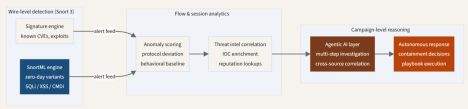
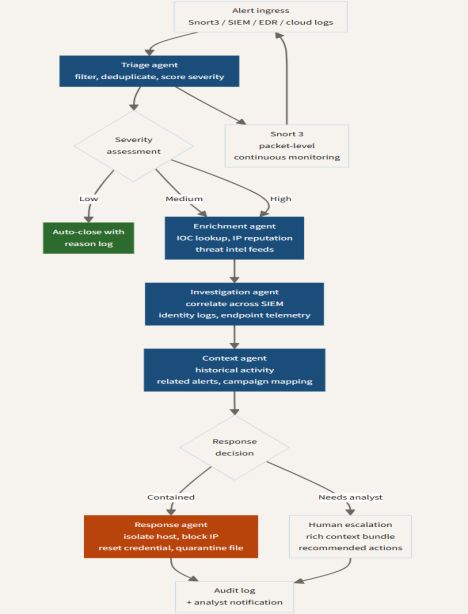
While SnortML operates at the packet level, agentic AI operates at a higher abstraction layer. The distinction between a standard ML model and an AI agent is critical for security practitioners to understand. A conventional ML model scores a single input without memory of previous events. In contrast, an AI agent maintains state across a multi-step investigation.
An agentic system does not simply follow a fixed SOAR (Security Orchestration, Automation, and Response) playbook. Instead, it decides what to examine next based on its initial findings. For instance, if SnortML flags a suspicious SQLi attempt with a high probability score, an agentic system might autonomously query a SIEM for related events from the same source IP, check threat intelligence platforms for the IP’s reputation, and pull the user’s recent activity logs from an identity provider.
This shift is largely driven by the global cybersecurity workforce crisis. With an estimated four million unfilled positions worldwide and 82% of SOC analysts expressing concern over alert fatigue, the industry can no longer scale by adding more human analysts. Agentic AI serves as a force multiplier, performing the tedious "triage and enrichment" phases of an investigation in seconds rather than hours.
Supporting Data and Performance Analysis
Data from early deployments of hybrid ML-signature systems indicate a significant improvement in detection rates for zero-day variants. According to Cisco white papers, the addition of SnortML allows for the detection of obfuscated SQLi attempts that bypass traditional regex-based signatures.
However, the integration comes with a computational cost. Adding 350 microseconds to the per-packet processing budget is significant in high-throughput environments. On a Cisco Secure Firewall appliance, where the total processing budget per packet may range from a few hundred microseconds to several milliseconds, the overhead of ML inference must be carefully managed. This is why the adaptive model selection (using smaller models for shorter queries) is vital; it ensures that the system only spends the full computational budget on complex, high-risk payloads.
Furthermore, the accuracy of these systems is measured through probabilistic outputs. A SnortML alert provides a float value representing the probability of an exploit. In a multi-agent architecture, this probability is used as a weighted signal. An alert that combines a classical signature match with a 0.98 ML score is treated with higher confidence than a standalone ML alert with a 0.65 score, allowing for more nuanced automated response policies.
Integration Architecture: The Multi-Agent SOC
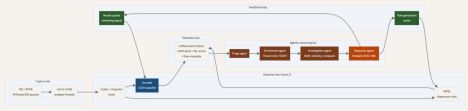
To fully realize the benefits of these technologies, organizations are adopting a tiered integration architecture:
- The Capture Tier: Handles wire-level packet acquisition using DAQ layers and high-speed interfaces like DPDK.
- The Detection Tier: Runs the traditional Hyperscan rule engine in parallel with the SnortML LSTM classifier. Both feed a unified JSON-formatted event stream.
- The Agentic Reasoning Tier: Receives the event stream and dispatches specialized agents. A triage agent deduplicates alerts, while an enrichment agent pulls external IOC data.
- The Feedback Tier: Ideally, confirmed true positives from the investigation agents are fed back into the training pipeline to retrain the ML models, creating a self-improving system.
Broader Impact and Future Implications
The move toward ML-driven and agentic defense has profound implications for the "economics of the attack." By reducing the exposure time to novel variants, defenders increase the cost and effort required for an attacker to successfully execute a campaign. However, this also introduces new research challenges, specifically in the realm of adversarial machine learning.
Researchers have noted that as ML models become primary gatekeepers, attackers will inevitably attempt to "probe the boundary" of these models using obfuscation and whitespace manipulation to find payloads that preserve functionality while scoring below detection thresholds. This has led to an emerging focus on "Feedback Security." As organizations build automated pipelines to retrain models based on production traffic, they must protect against "poisoning" attacks where an adversary intentionally generates traffic to corrupt the model’s future learning.
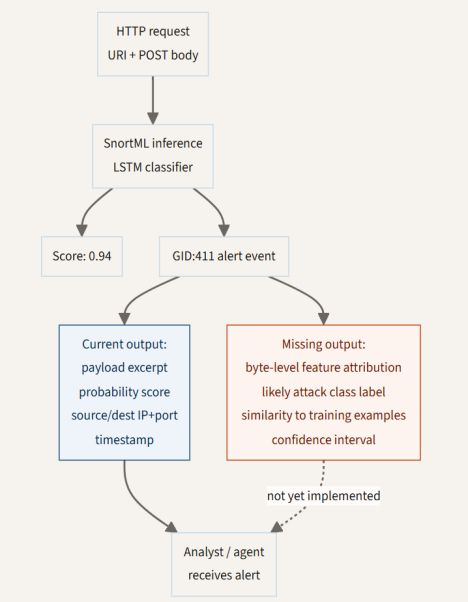
Furthermore, the lack of "explainability" remains a hurdle. When a neural network flags a payload, analysts often ask why it was flagged. Future developments in "Integrated Gradients" and other attribution methods are expected to provide byte-level importance scores, showing analysts exactly which parts of a query triggered the alert.
Conclusion
The integration of SnortML and agentic AI represents a maturation of network security. By moving beyond the rigidity of signatures and the linearity of traditional automation, the industry is building a defense-in-depth strategy that is both fast enough for the wire and smart enough for the SOC. While challenges regarding latency, adversarial robustness, and interoperability standards remain, the transition to an agent-augmented, ML-enhanced sensor network is no longer a theoretical goal—it is the current operational standard for resilient enterprise defense. As these systems continue to evolve, the focus will shift from simply detecting threats to autonomously reasoning through the complex, multi-stage campaigns of the modern era.