Chandra Wibowo
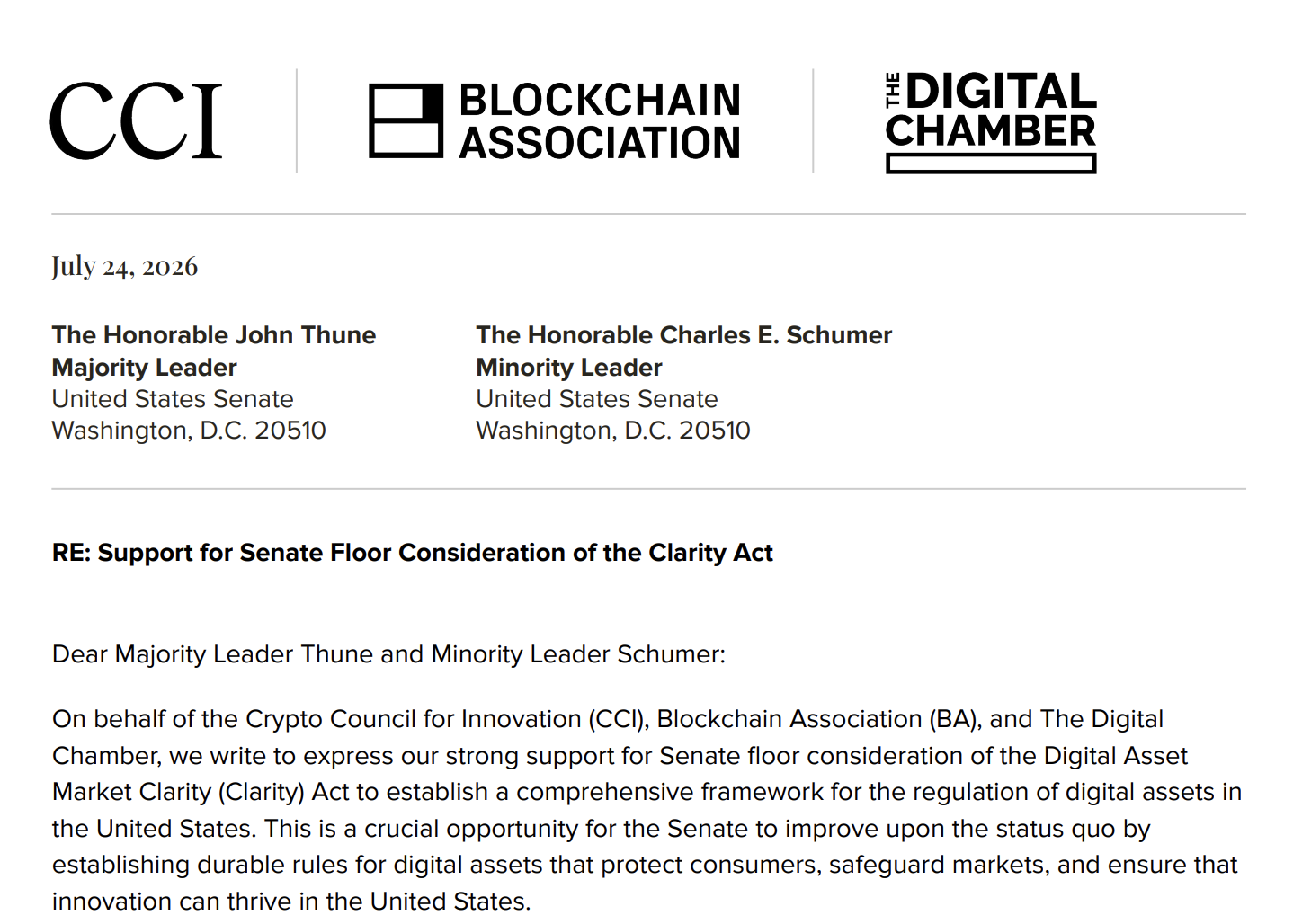
In a significant push to establish a clearer regulatory framework for the burgeoning digital asset industry, leading cryptocurrency advocacy groups have formally called upon U.S. Senate leadership to prioritize floor consideration of the Digital Asset Market Clarity (CLARITY) Act. The Crypto Council for Innovation, the Digital Chamber, and the Blockchain Association penned a joint letter on Friday, urging Senate Majority Leader Chuck Schumer and Minority Leader John Thune to expedite the legislative process. This appeal comes as Republican lawmakers have been actively campaigning for a vote on the bill before the Senate recesses for state work periods in August, a timeline that adds a layer of urgency to ongoing negotiations.
While the CLARITY Act has successfully navigated through both the Senate Banking and Agriculture Committees, indicating a degree of bipartisan traction, its ultimate passage hinges on addressing concerns raised by several lawmakers. These concerns, particularly surrounding the bill’s ethics provisions, have led some senators to signal a potential withholding of their votes until satisfactory amendments are incorporated. The advocacy groups acknowledged the ongoing "constructive bipartisan negotiations" aimed at solidifying and expanding support for the legislation, expressing appreciation for the "good-faith efforts of Senators on both sides of the aisle" and encouraging the continuation of these vital discussions.
Background and Legislative Journey of the CLARITY Act
The CLARITY Act represents one of the most anticipated and potentially transformative pieces of legislation poised to shape the future of the cryptocurrency and digital asset markets in the United States. Its progression through Congress has been a multi-stage process, reflecting the complex and evolving nature of digital assets and the challenges in crafting comprehensive regulatory oversight.
The bill’s journey began with significant input from various stakeholders, including industry participants, consumer protection advocates, and financial regulators. Following initial drafting and committee reviews, the text of the market structure bill was released by Republican lawmakers earlier in the week. This release included specific ethics provisions designed to prevent corruption and conflicts of interest within the government regarding digital assets. Notably, these provisions aim to bar public officials from issuing or sponsoring cryptocurrencies, a measure intended to safeguard the integrity of the market and public trust.

However, the proposed ethics rules have become a focal point of contention, particularly for many Democratic lawmakers. While acknowledging the need for ethical safeguards, a significant contingent of Democrats has argued that the current measures do not sufficiently address potential avenues for corruption or adequately protect against illicit activities. This divergence in perspective has created a bottleneck in the legislative process, necessitating further negotiation and compromise.
Senator Ruben Gallego, a vocal critic of the Republican-proposed ethics provisions, articulated his dissatisfaction in a statement on Thursday, describing the counterproposal as "not a serious effort." He further elaborated, expressing his disappointment that after months of collaborative work with Republican colleagues, the offered amendments were perceived as a misinterpretation and a significant departure from the spirit of bipartisan cooperation. This sentiment underscores the deep divisions that still need to be bridged to achieve the 60-vote threshold required for passage in the Senate.
Industry Leaders Voice Support and Concerns
The urgency expressed by the advocacy groups is echoed by prominent figures within the cryptocurrency industry. Coinbase CEO Brian Armstrong, in a widely circulated post on X (formerly Twitter) on Wednesday, articulated the prevailing sentiment that the current regulatory landscape is inadequate. Armstrong stated, "The status quo in the US isn’t working." He highlighted the absence of a federal framework, which he contends has enabled bad actors like FTX to exploit U.S. customers and has driven significant portions of the industry offshore, thereby diminishing U.S. oversight. Armstrong believes the CLARITY Act offers a solution by introducing "strong consumer protections, real tools for law enforcement, and a path for America to lead in this industry."
Orest Gavryliak, Chief Legal Officer of the decentralized finance (DeFi) platform 1inch, also weighed in on the bill’s significance during an appearance on Cointelegraph’s Chain Reaction podcast on Friday. Gavryliak emphasized that the CLARITY Act would be instrumental in establishing a regulatory framework specifically tailored for non-custodial protocols, moving away from what he described as "regulating with enforcement." He explained that certain regulators attempt to fit decentralized, non-custodial protocols into existing custodial frameworks, which he deems inappropriate and misapplied to the unique nature of DeFi. Gavryliak stressed that the passage of the CLARITY Act is "very important" to ensure that innovation in this space is not stifled by misaligned regulatory approaches.
The broader implications of the CLARITY Act extend to its potential impact on U.S. global competitiveness in the digital asset sector. Proponents argue that a clear and well-defined regulatory environment will attract innovation and investment, preventing a brain drain of talent and capital to more crypto-friendly jurisdictions. Conversely, continued regulatory uncertainty could hinder growth and push businesses and developers to establish operations elsewhere, potentially ceding leadership in a rapidly evolving technological frontier.
The Road Ahead: Navigating the August Recess and Midterm Elections
The looming August recess presents a critical juncture for the CLARITY Act. If a vote cannot be secured before the Senate adjourns, consideration of the bill could be pushed into the period immediately preceding the 2026 U.S. midterm elections. This proximity to a major electoral event could further complicate bipartisan negotiations, as political considerations may increasingly influence legislative priorities.
The urgency to pass the bill before the recess is palpable, as evidenced by market indicators. As of Friday, the prediction market platform Kalshi offered event contracts with approximately a 40.3% probability that the CLARITY Act would pass before the Senate’s August recess, reflecting the uncertainty surrounding its immediate future.
The CLARITY Act is not merely a technical piece of legislation; it is a signal of the U.S.’s commitment to integrating digital assets into its financial infrastructure. The ongoing debates highlight the fundamental challenges of balancing innovation with robust consumer protection, market integrity, and ethical governance. The outcome of these negotiations will have far-reaching consequences, not only for the cryptocurrency industry but also for the broader U.S. economy and its position in the global digital landscape. The coming weeks are therefore pivotal in determining whether the CLARITY Act will usher in a new era of regulatory certainty or remain a subject of protracted debate.