Clarissa Hana
The European Union’s groundbreaking AI Act is beginning to reshape the landscape of artificial intelligence development and deployment, with major players like Anthropic now implementing measures to comply with its transparency mandates. Anthropic, a leading AI safety and research company, has announced the rollout of an invisible watermarking system for text generated by its large language model, Claude. This move, aimed at enhancing the detectability of AI-generated content, signifies a critical step towards fulfilling the EU’s vision for responsible AI and offers a glimpse into the future of digital content provenance.
Anthropic’s commitment to the EU’s Code of Practice on AI, which mandates the labeling of AI-generated content for users within its market, has spurred this technological advancement. By becoming one of the first major AI providers to detail its implementation, Anthropic is setting a precedent for how AI companies will navigate the increasingly stringent regulatory environment in Europe and potentially beyond. The watermarking system, designed to be imperceptible to the average user, will not affect the quality, creativity, or readability of Claude’s output, according to the company. This invisible approach mirrors existing technologies used for AI-generated images, extending the concept of digital provenance to textual content.
A New Era of AI Transparency: The Genesis of Invisible Watermarking
The development of AI-generated content detection tools has been a persistent challenge for researchers and policymakers alike. As artificial intelligence models become more sophisticated, distinguishing between human-created and AI-generated text, images, and other media has become increasingly difficult. This ambiguity raises significant concerns regarding the spread of misinformation, intellectual property rights, and the erosion of trust in digital information. The EU AI Act, which officially entered into force in March 2024 and will be fully applicable from June 2025, aims to address these issues by establishing a comprehensive legal framework for AI, categorizing AI systems based on their risk level and imposing corresponding obligations.
The requirement for AI providers to mark AI-generated content is a cornerstone of the Act’s transparency provisions. This directive is not merely about identifying AI outputs but about fostering accountability and empowering users with the knowledge of content origin. Anthropic’s proactive adoption of watermarking for Claude demonstrates a commitment to this principle, anticipating the broader implications of the EU’s regulatory push. While the immediate impetus for this implementation is EU compliance, Anthropic has indicated that the watermarking will initially be applied globally to all Claude-generated text. This decision stems from the current technical limitations in geographically segmenting the watermarking process, as stated by the company in a recent blog post.
"We’re applying watermarking globally at launch because we don’t yet have a durable way to scope it by region," Anthropic explained, underscoring the practical challenges of implementing such sophisticated technology. This global rollout suggests a strategic foresight, preparing for potential future regulatory shifts in other jurisdictions and establishing a baseline for content attribution across its user base.
The Technical Nuances: How Claude’s Watermark Works

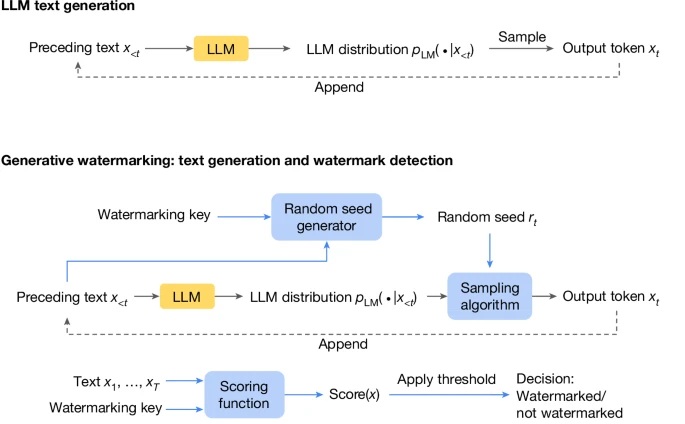
Anthropic’s watermarking implementation is based on Google DeepMind’s SynthID-Text approach, a sophisticated method that subtly influences the AI’s generation process rather than altering the final output. Unlike traditional watermarking techniques that might add visible markers or hidden characters, Claude’s system operates during the token selection phase—the core mechanism by which large language models construct text.
Large language models generate text by predicting the most probable "token" (a word or part of a word) that should follow a given sequence. This process involves a degree of randomness, allowing for diverse and creative outputs. Anthropic’s watermarking technology intervenes in this random selection process. Instead of relying on a purely arbitrary random number generator, the watermarking system incorporates a secret key and a portion of the preceding text to influence the choice of the next token. This subtle "nudge" ensures that while the chosen token is still statistically likely to be part of a coherent and natural-sounding response, it also carries a unique statistical signature.
"Watermarking uses low-stakes choices like these—which occur many times over a piece of generated text—to leave a pattern in Claude’s responses," Anthropic detailed in their announcement. "That pattern is undetectable to the reader, but is detectable to anyone who has a key that encodes it."
This means that an ordinary user reading text generated by a watermarked Claude model would perceive no difference in quality or style. The changes are so subtle that they are imperceptible to human readers. However, a specialized detector, equipped with Anthropic’s secret key, can analyze the sequence of word choices and identify the statistical pattern indicative of Claude’s generation. By measuring the consistency of these choices with those predicted by the watermarked model, the detector can assign a probability that the text was indeed generated by Claude.
The underlying principle is rooted in generative watermarking research, as further elucidated by Google’s own publications on the subject. A research paper from Google DeepMind explains: "Generative watermarking works by carefully modifying the next-token sampling procedure to inject subtle, context-specific modifications into the generated text distribution. Such modifications introduce a statistical signature into the generated text; during the watermark detection phase, the signature can be measured to determine whether the text was indeed generated by the watermarked LLM." A key benefit highlighted in such research is that detection does not necessitate computationally intensive operations or access to the underlying proprietary LLM itself.
Anthropic emphasizes that this method has no practical impact on Claude’s performance. The company stated that internal testing revealed no discernible effect on creativity, readability, or the overall content of the model’s responses. Furthermore, the watermarking process requires no additional computational tokens and has a negligible impact on generation speed, ensuring that the user experience remains seamless and cost-effective. "Nothing is added to the text and there are no hidden characters," Anthropic reassured users. "Watermarking doesn’t require extra tokens, and will not be more expensive."
Exceptions and Limitations: Where Watermarking May Be Less Prevalent
While the invisible watermarking system is designed for broad application, Anthropic has acknowledged certain exceptions where the watermark might not be applied or could be less effective. These exceptions are primarily for scenarios where precision and factual accuracy are paramount, or where the nature of the output demands a singular correct answer.

For instance, in factual statements where only one answer is definitively correct, the watermarking system will not interfere with the choice. This ensures that AI responses to simple arithmetic problems or historical queries remain accurate and uncompromised. Similarly, in the realm of computer programming, where a single misplaced character can render code non-functional, the watermark is not applied if an exact output is required. "Where an exact output is required—where there isn’t a choice, and something would be factually wrong or a piece of code would break if a different term was chosen—the watermark isn’t applied," Anthropic clarified.
The company provided illustrative examples: "For example, once the model has written ‘2 + 2 =’, there is a very clear best choice for the next token… For the same reason, code—which in very many cases has to be exact—has generally less watermarking than some other forms of text." However, Anthropic noted that watermarking can still be employed in parts of code where arbitrary choices exist, such as comments, with a negligible effect on the functional code itself.
The effectiveness of generative watermarks is also influenced by the entropy of the AI model’s output distribution. As highlighted in Google’s research, watermarking performs better when there is more variation and choice in the LLM’s response generation. Conversely, when the model is highly confident and consistently produces the same output for a given prompt (low entropy), the watermark’s impact may be diminished.
Another important consideration is the potential for human editing to obscure or remove the watermark. Light proofreading, such as minor grammar or punctuation corrections, might not alter the statistical signature enough for reliable detection. Anthropic indicated that their watermark only applies to the words the model itself chooses, meaning that a few editorial tweaks might leave insufficient evidence for detection. However, a more substantial rewrite, where every word is replaced, would likely render the watermark undetectable. For translated content produced by Claude, the watermark is expected to be present, as Claude makes every word choice in the translated output.
The Future of Detection: An API for Watermark Identification
To facilitate the widespread identification of AI-generated content, Anthropic is developing an Application Programming Interface (API) specifically designed to detect Claude’s watermarks. This API will enable developers and platforms to programmatically assess the likelihood that a given piece of text was generated or significantly influenced by Claude.
Anthropic is keen to emphasize that this API is a detection tool, not a definitive proof of authorship. "A watermark can only determine that Claude was likely involved with the content at some point. It cannot distinguish ‘Claude wrote this’ from ‘Claude heavily edited this’," the company stated. The API will not be able to identify content generated by other AI models, as different providers may employ distinct watermarking techniques and proprietary keys.
The reliability of watermark detection is also contingent on the length of the text sample. Shorter texts offer less statistical evidence, making detection more challenging. As the Google DeepMind paper also notes, "longer texts contain more watermarking evidence, and so we have more statistical certainty when making a decision." This means that while the API will provide a valuable tool for content verification, its accuracy will vary depending on the size of the text being analyzed.
For AI-generated image files (PNG, JPG, SVG), Anthropic is adopting a different approach. Instead of embedding an invisible watermark within the image data itself, Claude will attach cryptographically signed C2PA (Coalition for Content Provenance and Authenticity) provenance metadata. This metadata will serve as a verifiable record, indicating that the file was created or processed using Claude, thereby ensuring transparency in visual media as well.
Broader Implications and the Path Forward
The implementation of invisible watermarking by Anthropic represents a significant development in the ongoing effort to foster trust and transparency in the digital age. As AI continues to permeate various aspects of our lives, the ability to reliably identify AI-generated content becomes increasingly critical. The EU AI Act’s proactive regulatory stance, coupled with the technological advancements by companies like Anthropic, signals a commitment to addressing the potential risks associated with advanced AI while harnessing its benefits.
The global rollout of Claude’s watermarking suggests that this technology may become a de facto standard, influencing how other AI developers approach content attribution. The development of a dedicated detection API further democratizes the process, empowering a wider range of users and platforms to verify content origins.
However, the effectiveness of watermarking technologies will likely evolve alongside the sophistication of AI models. Adversarial attacks aimed at circumventing watermarks, as well as the continuous development of AI that can mimic human writing more convincingly, will necessitate ongoing innovation in detection methods. The interplay between AI developers, regulators, and the broader tech community will be crucial in navigating these challenges and building a future where AI-generated content can be managed responsibly and transparently. The move by Anthropic is not just a compliance measure; it’s a significant step in building a more accountable digital ecosystem in the age of artificial intelligence.