admin
admin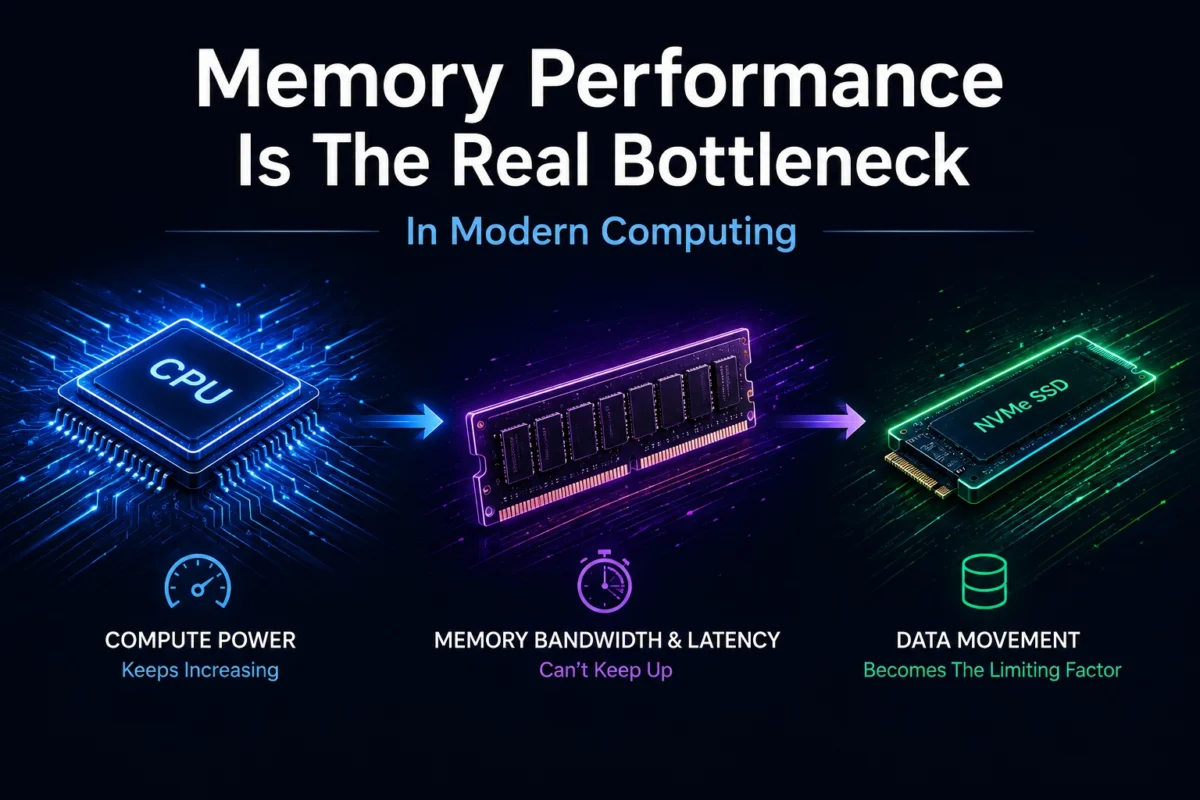
For decades, the trajectory of computing performance was defined by a few easily quantifiable metrics: central processing unit (CPU) clock speeds, core counts, and floating-point operations per second (FLOPS). In the early eras of personal computing, a higher megahertz rating almost guaranteed a proportional increase in user experience and throughput. However, as semiconductor fabrication has advanced, a fundamental imbalance has emerged between the ability of a processor to perform arithmetic and the ability of the surrounding system to provide the necessary data. Modern computing has reached a critical juncture where theoretical performance is increasingly dictated not by how fast a chip can calculate, but by how efficiently it can move data to where it needs to go.
The Emergence of the Memory Wall
The disparity between processor speed and memory access time is a phenomenon often referred to in architectural circles as the "Memory Wall." While CPU performance historically improved at a rate of roughly 60% per year throughout the late 1990s and early 2000s, the latency of dynamic random-access memory (DRAM) improved by only about 7% annually. This divergence created a vacuum where high-performance execution units—ranging from standard CPU cores to massive graphics processing unit (GPU) arrays—often sit idle, consuming power while waiting for operands to arrive from relatively distant system memory.

A modern high-end GPU may contain thousands of arithmetic units capable of pushing matrix multiplication into the petaFLOP range. Similarly, AI accelerators are designed to handle the massive computational loads required by Large Language Models (LLMs). Yet, these hardware marvels are functionally useless without a constant stream of instructions, model weights, and intermediate results. Consequently, the focus of modern computer architecture has shifted from sheer arithmetic density to the sophisticated management of memory hierarchies, locality, and interconnect topologies.
Chronology of Architectural Adaptation
The industry’s response to the widening gap between compute and memory has evolved through several distinct phases. In the early 1980s, processors often accessed main memory directly. As clock speeds rose, designers introduced small, fast on-chip memory known as Static Random-Access Memory (SRAM) to serve as a cache.
By the 1990s, a single level of cache was no longer sufficient. This led to the standardization of multi-level cache hierarchies: L1 for immediate execution, L2 for local data retention, and eventually L3 as a shared pool for multi-core processors. In the 2010s, as core counts exploded, the management of cache coherence—ensuring all cores see the same data version—became a primary architectural challenge. Today, the industry has entered the era of 3D stacking and advanced packaging, exemplified by technologies such as AMD’s 3D V-Cache, which vertically integrates additional SRAM to expand the "working set" available to the processor without increasing the physical footprint of the chip.

Sequential versus Random Access Patterns
To understand why simple bandwidth figures are often misleading, it is necessary to distinguish between sequential and random data access. When a system reads a large, contiguous file, the hardware can employ prefetching. Hardware prefetchers recognize predictable streams and begin pulling future data into the cache before it is explicitly requested. This pipelining allows modern computers to approach their theoretical maximum bandwidth.
In contrast, random access patterns, such as traversing a linked list or querying a scattered database, present a significant hurdle. In these "pointer-chasing" scenarios, the address of the next data point is not known until the current request is fulfilled. This dependency prevents the overlapping of requests and forces the processor to endure the full latency of the memory subsystem. Technical documentation from major silicon providers suggests that two workloads moving the identical amount of data can differ in execution speed by an order of magnitude based solely on their access patterns.
The Physics of the Memory Hierarchy
The necessity of a tiered hierarchy—L1 through L3 caches, followed by DRAM and eventually non-volatile storage—is driven by the laws of physics and economics. SRAM is exceptionally fast and can be placed directly next to execution units, but it is physically bulky and expensive. DRAM is denser and cheaper but requires significantly more time to charge and discharge its capacitors to read or write data.

According to research from Intel and Micron, the internal organization of DRAM has become increasingly complex to compensate for these physical limitations. Modern DDR5 memory, for example, utilizes bank groups to allow more memory pages to remain open simultaneously. This increases the probability of a "row-buffer hit," where the requested data is already in a high-speed buffer within the DRAM chip, significantly reducing the time required for a transaction.
Data Movement in the Age of Artificial Intelligence
The rise of generative artificial intelligence has turned data movement into a first-class performance problem. Large Language Models, such as those powering ChatGPT or Claude, involve billions of parameters. During the inference phase, the processor must retrieve these model weights from memory for every token generated.
Supporting data from the AI industry highlights the scale of this challenge. A 70-billion-parameter model, even when quantized to 4-bit precision, requires approximately 35 GB of memory just to reside in the system. If the memory bandwidth is insufficient, the most powerful AI accelerator in the world will be limited to the speed at which it can "read" the model from its VRAM. This has led to the adoption of High Bandwidth Memory (HBM), which uses through-silicon vias (TSVs) to stack DRAM dies directly on the processor package. AMD’s Instinct MI355X, for instance, provides up to 8 TB/s of theoretical bandwidth—a figure that would have been inconceivable in a consumer context a decade ago but is now a baseline requirement for frontier AI research.

The Complexity of Gaming and Ray Tracing Workloads
Gaming represents one of the most volatile and "messy" memory workloads in modern computing. Unlike scientific simulations that often operate on predictable, dense arrays, a game engine must simultaneously manage physics, AI, geometry streaming, and texture sampling.
The introduction of real-time ray tracing has further complicated this landscape. Ray tracing relies on Bounding Volume Hierarchies (BVHs), tree-like structures that determine where a light ray intersects with scene geometry. Because rays can bounce in unpredictable directions, they create extreme "data divergence," where neighboring threads on a GPU may need to access completely different parts of the scene’s memory. NVIDIA’s Ada Lovelace architecture addressed this through Shader Execution Reordering (SER), a technology designed to regroup these divergent threads into more coherent batches, thereby improving the efficiency of the cache.
Storage Performance Beyond Sequential Throughput
The evolution of Solid-State Drives (SSDs) provides a clear case study in the limitations of headline specifications. While PCIe Gen5 NVMe drives advertise speeds exceeding 14 GB/s, these figures only apply to large, sequential transfers. Real-world performance, particularly for operating system boot times or game level loading, is often determined by random Input/Output Operations Per Second (IOPS) and low-queue-depth latency.

Solidigm’s workload analysis indicates that many consumer applications rarely reach the high "queue depths" required to saturate the maximum theoretical bandwidth of a modern SSD. Instead, performance is dictated by the efficiency of the SSD controller’s address translation and how effectively the drive manages its internal NAND flash. Furthermore, the use of SLC (Single-Level Cell) caching means that an SSD may perform brilliantly during a short benchmark but see performance drop precipitously once its fast cache is exhausted and it must write directly to denser, slower TLC or QLC NAND.
Implications for Future Hardware Design
The industry’s realization that "compute is cheap, but data movement is expensive" is driving several paradigm shifts in hardware design.
- Near-Memory Computing: Designers are exploring ways to move simple logic operations directly into the memory controller or the memory chips themselves, reducing the need to move data across a power-hungry bus for trivial calculations.
- Advanced Compression: Technologies like GPU-accelerated texture compression and neural network quantization (moving from 32-bit floating point to 8-bit or 4-bit integers) are now standard. These methods effectively "increase" bandwidth by reducing the number of bits that must be moved.
- Chiplet Architectures: By breaking a large processor into smaller "chiplets," companies like AMD and Intel can place massive amounts of cache on dedicated dies, optimizing the manufacturing process for memory density rather than just logic speed.
Broader Impact and Industry Analysis
The shift toward a memory-centric view of performance has profound implications for software developers and consumers alike. For developers, "mechanical sympathy"—the act of writing code that respects the underlying hardware’s memory hierarchy—has become a mandatory skill for high-performance applications. Software must be designed to maximize locality, keeping the "hot" working set within the fastest cache levels.

For consumers, these developments mean that a simple upgrade in clock speed or core count may no longer provide the expected performance boost if the rest of the system is imbalanced. The success of specialized hardware, such as gaming-specific CPUs with massive L3 caches, suggests that the market is beginning to recognize that the fastest operation is often not the one that completes the quickest, but the one that avoids fetching data from distant memory altogether.
As we look toward the next decade of computing, the "Memory Wall" remains the most significant hurdle to achieving the next order of magnitude in performance. Whether through room-temperature superconductors, optical interconnects, or even more sophisticated 3D stacking, the primary goal of computer architecture will remain unchanged: getting the right data to the right place at the right time. In the modern era, data movement is no longer a supporting act; it is the main event.