Lina Irawan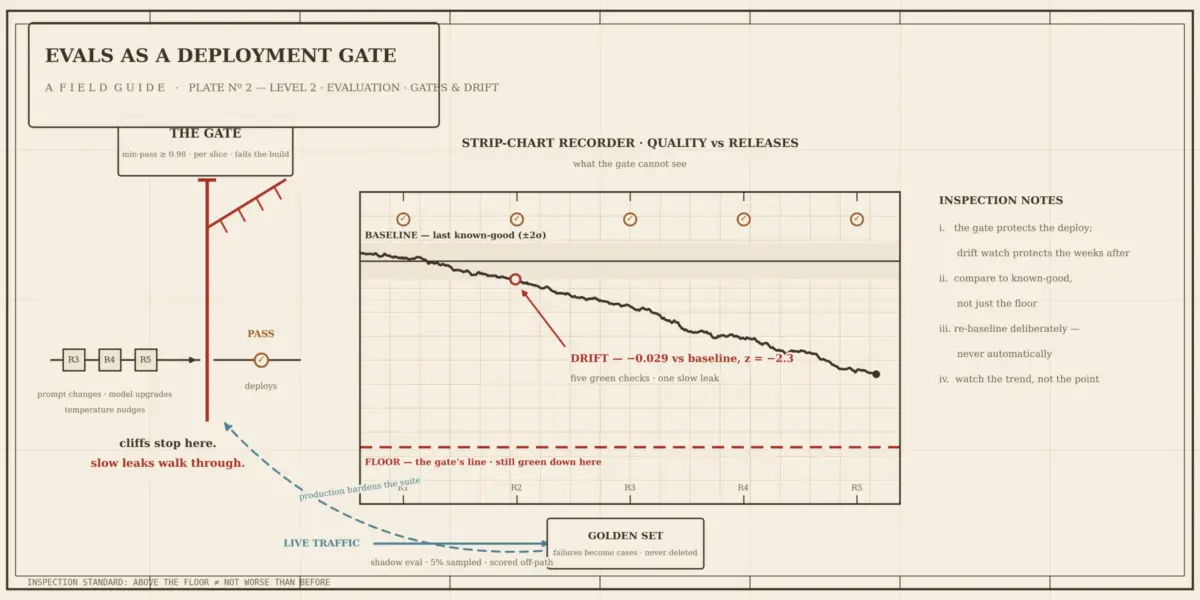
The shift from experimental artificial intelligence to production-grade deployment has exposed a critical vulnerability in the modern software stack: the lack of robust, automated evaluation for Large Language Models (LLMs). As enterprises move past the "proof of concept" phase, the industry is witnessing a transition toward what experts call Level 2 of the LLM Maturity Model. This stage is defined by the move away from manual "vibe checks" in Jupyter notebooks toward integrated evaluation gates and drift detection mechanisms. In this paradigm, a prompt change is no longer a gamble but a governed software release. The core principle of this level is that deployment should never be based on hope, but on a rigorous, multi-layered "gate" system, followed by continuous monitoring for performance drift.
The Evolution of LLM Quality Assurance
In the early stages of the generative AI boom, developers often managed prompt engineering and model selection through manual experimentation. This "notebook-centric" approach, while useful for discovery, fails to provide the safety required for customer-facing applications. The industry is now recognizing that the most significant threats to LLM system integrity are not traditional code bugs, but subtle regressions caused by prompt tweaks, model version upgrades, or slight changes in temperature settings. These "quiet" failures often tank quality on a small but significant percentage of inputs, remaining invisible to manual testers until they reach the end-user.
To combat this, leading engineering teams are treating LLM evaluation as a first-class citizen in the Continuous Integration (CI) pipeline. This involves the creation of a "Golden Set"—a curated collection of test cases that cover common scenarios, known edge cases, and every past failure the system has encountered. By housing these cases in version control alongside the source code, any change to the model’s behavior becomes a reviewable and measurable event.
Implementing the Evaluation Gate
The first line of defense in a mature LLM system is the evaluation gate. Unlike traditional unit tests that check for exact string matches, LLM gates utilize a mix of exact assertions and statistical tolerances. A typical test case in a modern CI environment includes the input request, the necessary context, and the expected output parameters. For example, a system might be required to reach a minimum confidence score of 0.80 or be strictly forbidden from making certain automated decisions.
The scoring mechanism must be explicit and typed. Engineers are increasingly utilizing data classes to structure results, ensuring that every check—from decision accuracy to confidence thresholds—is tracked. When a developer submits a Pull Request (PR) containing a prompt change, the CI runner executes the entire golden suite. If the pass rate drops below a predefined bar, such as 98%, the build fails and the deployment is automatically blocked. This immediate feedback loop ensures that an improvement in one scenario does not come at the cost of two others.
Routing and Slicing for Global Scale
As LLM applications scale across different request types, user segments, and locales, a single global pass rate becomes an insufficient metric. A system might maintain a 99% accuracy rate globally while suffering a catastrophic 30% failure rate in a specific "slice," such as non-English inputs or high-tier enterprise requests.
To address this, mature evaluation frameworks now utilize automated routing. Each test case is tagged with a "slice" attribute, and the runner automatically directs cases to the matching slice using the same logic the system employs at runtime. This eliminates the drift between what is tested and what is actually run in production. By gating per slice, organizations can ensure that no specific user demographic or functional area experiences a regression, even if the overall system metrics appear stable.
The Statistical Mechanics of Drift Detection
While CI gates protect the moment of deployment, they are inherently blind to changes that occur after the code is live. Production environments are dynamic; user inputs shift, model providers update underlying architectures, and subtle prompt optimizations can have long-tail consequences. This is where drift detection—the second pillar of Level 2 maturity—becomes essential.
Drift detection is fundamentally different from gating. While a gate asks if the system is "above the floor," drift detection asks if the system is "worse than before." This requires the capture of a "baseline"—a set of metrics from the last known-good release. Comparing current performance to this baseline requires sophisticated statistical analysis.
Engineers are moving away from simple mean comparisons, which can be misled by sample size and variance. Instead, they are employing two-proportion z-tests for rate-based metrics (like human override rates) and calculating the standard error of the difference for continuous variables (like confidence scores). This statistical rigor prevents "false alarms" caused by noise in small sample sizes while highlighting meaningful regressions. For instance, a 0.029 drop in exact-match accuracy might still leave the system above the absolute "floor" for deployment, but it represents a significant regression against the baseline that warrants immediate investigation.
Shadow Evaluation: Monitoring the Infinite Production Stream
The golden set, no matter how comprehensive, is finite. Real-world production traffic is infinite and often surprising. To bridge this gap, organizations are implementing "shadow evaluation." This process involves sampling a percentage of live, de-identified decisions and scoring them out-of-band using an automated "judge" model or a set of predefined rules.
By using deterministic hashing of decision IDs, engineers can ensure that sampling is reproducible and does not introduce flakiness into the testing environment. When a shadow evaluation reveals a failure, that specific production case is added to the review queue and eventually integrated into the golden set. This creates a self-hardening loop where production realities constantly inform and strengthen the pre-deployment test suite.
Industry Implications and Expert Perspectives
The push toward automated LLM evaluation is driven by the high cost of failure in regulated industries. In sectors like fintech, healthcare, and legal services, a "hallucination" or a logic regression can lead to significant financial loss or compliance violations.
"The transition to Level 2 maturity is effectively the ‘professionalization’ of AI engineering," says one lead AI architect at a major Silicon Valley firm. "We are moving away from the era of ‘it looks good to me’ toward an era where every prompt change is backed by a statistical guarantee. If you can’t prove your model hasn’t regressed on a thousand edge cases in ten seconds, you shouldn’t be shipping it."
Data from recent industry surveys suggests that teams implementing automated CI gates for LLMs see a 40% reduction in production incidents related to model updates. Furthermore, the ability to catch "slow leaks"—gradual declines in quality that don’t trigger immediate alarms—has become a key differentiator for companies maintaining high user retention in AI-powered products.
Conclusion: Moving Fast Without Breaking Quality
The objective of Level 2 evaluation is to transform prompt engineering from a gamble into a predictable engineering discipline. By implementing a three-pronged approach—CI gates for deployment protection, baseline comparisons for drift detection, and shadow evaluations for production hardening—teams can achieve the speed of iteration that AI demands without sacrificing the reliability that users expect.
As LLM systems continue to evolve toward Level 3 and beyond (involving sophisticated fine-tuning and autonomous agent loops), the foundation of rigorous evaluation will remain the most critical component of the stack. In the high-stakes environment of production AI, the organizations that survive will be those that stop "shipping on hope" and start shipping on the strength of a green gate. The slow leaks of quality degradation are the primary threat to LLM success; identifying them requires a system that is constantly watching for what is "worse than before," not just what is "below the line." Through these rigorous engineering practices, the promise of generative AI can be realized with the stability and precision required for the modern enterprise.