Lina Irawan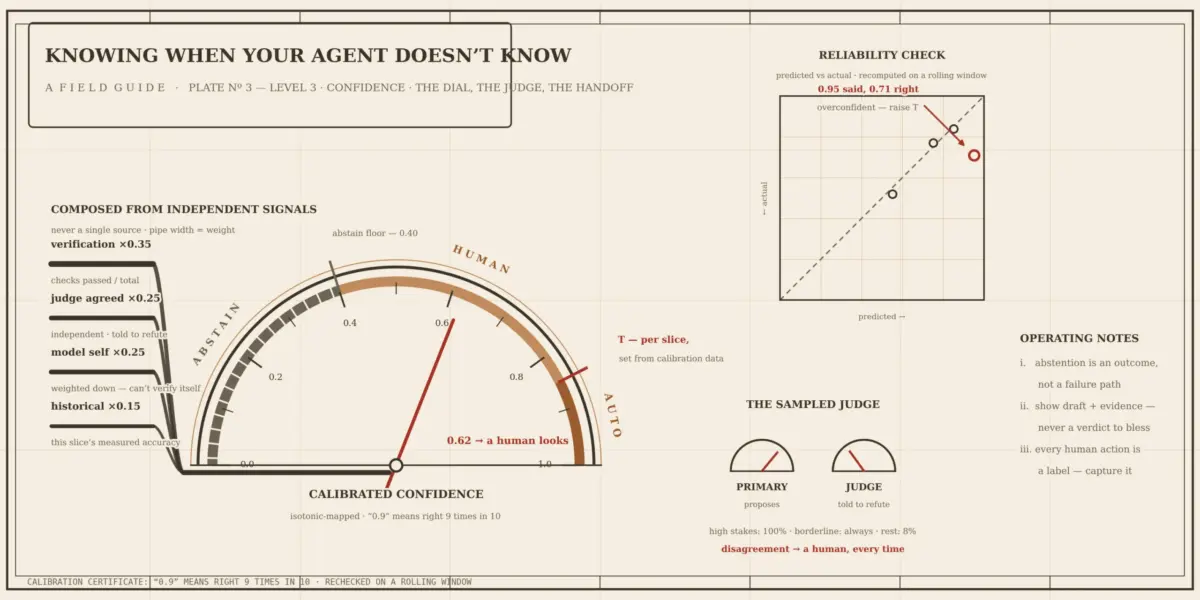
The most critical metric a Large Language Model (LLM) agent produces is not the final answer itself, but rather the calibrated measure of its own certainty. As organizations move beyond the initial excitement of generative AI toward mission-critical deployment, the industry is witnessing the emergence of a six-level maturity model for running LLM systems in production. While Levels 1 and 2 focus on basic functionality and observability—ensuring the system works and that its operations are visible—Level 3 introduces the concept of "Confidence." This stage marks a pivotal transition where the system acts autonomously only when its calibrated confidence is high, subjects high-stakes decisions to an independent judge, and routes uncertain outcomes to human reviewers in a manner designed to catch errors rather than merely rubber-stamp them.
The Engineering of Confidence: Moving Beyond Self-Reporting
A recurring challenge in the field of artificial intelligence is the tendency for models to be "cheerfully certain" even when they are factually incorrect. This phenomenon, often referred to as hallucination coupled with overconfidence, makes raw model output a liability in high-stakes environments such as legal, medical, or financial services. To mitigate this, Level 3 maturity requires the engineering of a "composed" confidence signal. Rather than relying on the model’s internal probability scores or its self-reported certainty, engineers are now building multi-factor scoring systems.
A robust production score is typically composed of four independent signals. The first is the model’s self-reported score, which is intentionally weighted lower—often at just 25%—because of its inherent unreliability. The second signal is deterministic verification, which measures the fraction of hard-coded checks or business logic rules the output has passed. The third is the "judge agreement," a binary or probabilistic signal from a secondary model tasked with refuting the primary model’s decision. Finally, historical accuracy—data reflecting how the specific "slice" or category of the query has performed in the past—is factored in. By ensuring that no single source of confidence acts as a single point of failure, developers create a system where a "confidently wrong" model is dragged down by failed verification or a disagreeing judge.
Statistical Calibration and the Reliability Gap
For a confidence score to be actionable, it must be "calibrated." In technical terms, this means that a confidence score of 0.9 must correlate with an empirical accuracy of approximately 90% over a large dataset. Data from early production environments suggests a significant "reliability gap" in uncalibrated systems. For instance, in many Level 2 systems, a model might report 95% confidence while achieving only 71% accuracy in practice.
To bridge this gap, engineers are employing Isotonic Regression, a statistical technique that fits a monotonic map from raw composed scores to empirical accuracy. This process involves bucketizing decisions by predicted confidence and measuring real accuracy per bucket to create a reliability diagram. If the top bucket (0.90–1.00) shows an accuracy of only 71%, the automation threshold is deemed too loose and must be recalibrated. Experts recommend using the Brier score or signed per-bucket gaps rather than simple Expected Calibration Error (ECE), as ECE can be sensitive to binning and may provide a false sense of security for miscalibrated models.
The Role of the Independent Adversarial Judge
A cornerstone of Level 3 maturity is the introduction of a "Judge" model. This is a second, independent LLM—ideally from a different model family to avoid shared blind spots—that evaluates the primary model’s decision before it is finalized. The design of this judge is critical; it is not asked to confirm the answer, but rather to refute it.
Prompting a judge to be a "strict reviewer" tasked with finding the strongest reason a decision might be wrong has proven significantly more effective than asking for a simple validation. This adversarial framing surfaces failure modes that would otherwise go undetected until they reach the end user. However, judging every single decision can double the operational cost. Consequently, sophisticated routing policies are being implemented: 100% of high-impact or irreversible decisions are judged, while borderline cases near the confidence threshold are also prioritized. For routine, low-stakes tasks, a random sample of 5% to 10% is used as a continuous quality probe.
Chronology of LLM Production Evolution
The journey to Level 3 maturity follows a clear timeline of technological and operational milestones:
- Late 2022 – Mid 2023 (The Prototyping Era): Organizations focused on prompt engineering and basic RAG (Retrieval-Augmented Generation) patterns. Success was defined by "vibes" and anecdotal evidence.
- Late 2023 – Early 2024 (The Observability Era): The rise of Level 1 and 2 maturity. Tools for tracing, logging, and basic evaluation (LLM-as-a-judge) became standard. Systems were "visible," but automation was still risky.
- Mid 2024 – Present (The Confidence Era): The current shift toward Level 3. The focus has moved to calibration, formal routing logic, and Human-in-the-Loop (HITL) optimization. Companies are now defining "abstention floors" where the model refuses to answer if it cannot meet a minimum confidence bar.
Redefining Human-in-the-Loop UX
Perhaps the most common failure point in AI systems is the "lazy handoff." In many early-stage implementations, human reviewers are presented with an "Approve" or "Reject" button for a model’s verdict. Under high volume, this leads to "automation bias," where humans reflexively approve suggestions to clear their queue, creating a false audit trail of human oversight.
Level 3 maturity demands a more sophisticated HITL user experience. Instead of a verdict to bless, the system provides a draft with evidence. The reviewer is shown the reasoning, the specific policy matched, and the "routed because" signal (e.g., "confidence below threshold 0.62 < 0.85"). By making the "why" transparent, the human is empowered to act as a genuine safety layer. Furthermore, every human action—especially an edit—is captured as a rich training signal. These edits flow back into the system’s "golden set," allowing for continuous recalibration of the confidence dial.
Industry Perspectives and Expert Reactions
Technical leaders across the Silicon Valley ecosystem have begun to emphasize that "abstention" is a feature, not a bug. "An agent that says ‘I don’t know’ is infinitely more valuable than one that guesses correctly 90% of the time but lies the other 10%," says one senior AI infrastructure engineer. This sentiment is echoed in recent white papers from AI safety labs, which argue that the "appearance of oversight" is the most dangerous outcome of modern AI deployment.
In the financial sector, where regulatory compliance is paramount, the adoption of Level 3 protocols is becoming a prerequisite for deployment. Analysts suggest that the ability to defend every automated decision with historical accuracy data is the only way to satisfy audit requirements. The "confidence dial" allows firms to start with high thresholds—routing almost everything to humans—and gradually lower them only as calibration data proves the safety of specific categories or "slices" of tasks.
Broader Impact and Implications for the AI Economy
The move toward Level 3 maturity has significant economic implications. By accurately identifying which tasks can be safely automated and which require human intervention, companies can optimize their labor costs without sacrificing quality. This "calibrated automation" prevents the "Denial of Service" (DoS) on human reviewers that occurs when a system routes too much noise to the manual queue.
Furthermore, the implementation of independent judges and calibration layers represents a new market for AI "middleware." A suite of tools is emerging specifically to handle Isotonic Regression, Brier score monitoring, and adversarial judge prompting. This layer of the stack is becoming as essential as the LLMs themselves.
Ultimately, the goal of Level 3: Confidence is to build a system that knows the edges of its own competence. By composing confidence from independent signals, calibrating those signals against reality, and ensuring a high-quality human handoff, organizations can finally move AI out of the playground and into the core of their business operations. A system built this way does not just produce answers; it produces trust. As the industry moves toward Levels 4, 5, and 6—which involve more complex multi-agent orchestration and self-healing capabilities—the foundation of calibrated confidence will remain the most important number an agent can produce.