Lina Irawan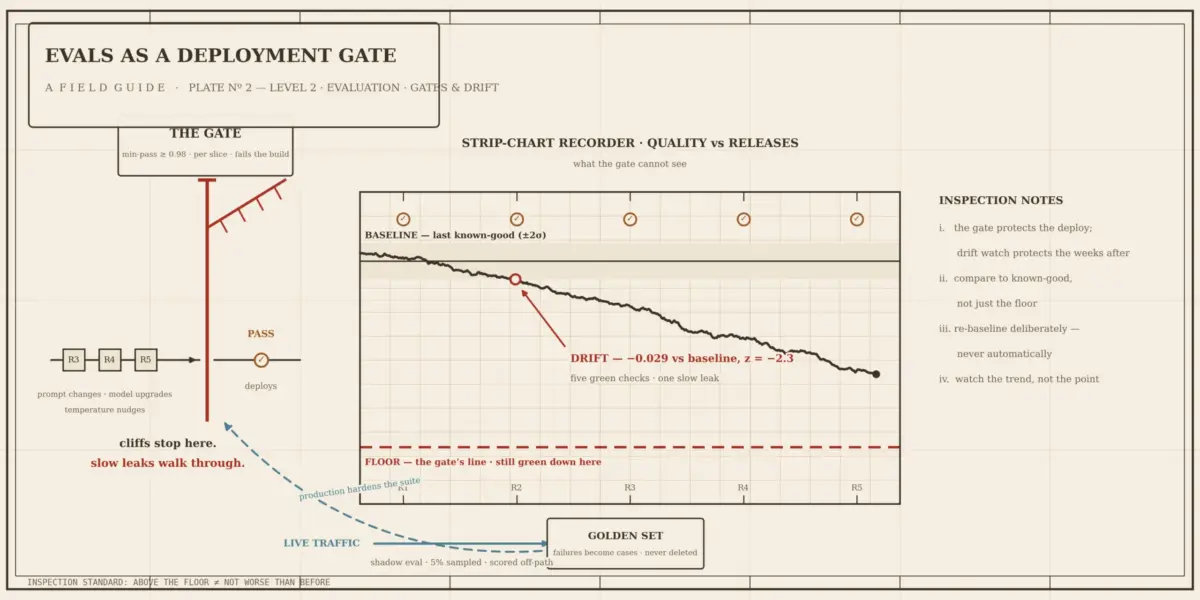
In the rapidly advancing landscape of Large Language Model (LLM) integration, the industry is witnessing a critical shift in how engineering teams move from experimental prototypes to reliable production systems. As organizations transition through what is increasingly recognized as a six-level maturity model for AI deployment, "Level 2: Evaluation" has emerged as the most significant hurdle for maintaining long-term software quality. The shift represents a fundamental move away from "shipping on hope"—a practice where prompt changes are deployed based on anecdotal success—toward a rigorous, gate-based methodology that treats prompts with the same level of scrutiny as compiled code.
The Problem of Non-Deterministic Regressions
The primary challenge in LLM development is the inherent non-determinism of the models. Unlike traditional software, where a specific input generally yields a predictable output, LLM systems are subject to "silent regressions." A minor adjustment to a system prompt, a slight nudge in temperature settings, or an unannounced model update from a provider can result in localized quality drops. Industry data suggests that while a prompt change might improve performance on 90% of standard queries, it can simultaneously tank quality on 8% to 10% of specific edge cases, such as specialized industry jargon or non-English locales.
Historically, teams have managed these risks using manual evaluation in computational notebooks. This "Level 1" approach is characterized by intermittent, manual checks performed after a failure has already been detected in production. However, as LLM systems scale, this reactive posture becomes unsustainable. Experts argue that if a developer can deploy a prompt change without an evaluation suite failing the build, the system is essentially unmanaged. To address this, the industry is adopting a dual-layered defense strategy: the deployment gate and the drift detection loop.
Establishing the ‘Golden Set’: Evaluation as Versioned Data
The foundation of Level 2 maturity is the "Golden Set"—a curated collection of test cases that reside in version control alongside the application code. This set is not merely a list of inputs and outputs but a sophisticated dataset that includes common requests, known-hard cases, and every historical failure the system has encountered. By treating regression cases as permanent fixtures of the codebase, teams ensure that a bug once fixed never returns.
A standard evaluation case now includes detailed metadata, such as the specific "slice" or category of the request (e.g., "tier1/en"), expected decisions, confidence thresholds, and "must-not" constraints. For example, a financial services LLM might have a case requiring an "approve" decision with a minimum confidence of 0.80, while explicitly forbidding an "auto-resolve" action for high-risk transactions.
By integrating these cases into the Continuous Integration (CI) pipeline, the evaluation becomes a "gate." If a prompt change causes the pass rate to drop below a predefined threshold—such as 98%—the build fails, and the deployment is automatically blocked. This mechanism ensures that regressions are identified in the Pull Request (PR) stage, long before they reach the end-user.
The Technical Framework of Automated Scoring
Moving beyond simple string matching, modern evaluation frameworks utilize typed, explicit scoring. This involves a mix of exact assertions and statistical tolerances. The scoring logic must be sensitive enough to fail on a wrong decision while remaining resilient to the natural linguistic variations of LLM outputs.
Professional engineering teams are now implementing scoring functions that return structured data, detailing exactly which check failed—be it a confidence threshold, a logic error, or a violation of a negative constraint. This granular reporting allows developers to diagnose whether a failure is a catastrophic logic error or a minor calibration issue. Furthermore, the routing of these tests is becoming automated. Rather than manually selecting which tests to run, modern runners use the same attributes the system uses at runtime to route cases to their matching "slices." This ensures there is no "drift" between the testing environment and the production environment.
Beyond the Gate: The Necessity of Drift Detection
While a CI gate protects the moment of deployment, it is inherently blind to changes that occur after the code is live. Production environments are dynamic; user inputs shift, and model providers often tweak underlying weights. This creates "slow leaks" where a system that was green at the time of deployment gradually loses efficacy.
To combat this, the industry is adopting statistical drift detection. This process involves capturing a "baseline"—a set of metrics from the last known-good release—and comparing current production performance against it. This comparison requires more than a simple subtraction of means; it necessitates a rigorous statistical check, such as a two-proportion z-test for rate metrics or an analysis of the Standard Error (SE) of the difference for continuous variables.
The goal of drift detection is to answer the question: "Is the system performing significantly worse than before?" By utilizing the standard deviation and sample size of both the baseline and the current run, teams can distinguish between statistical noise and meaningful regressions. For instance, a 2.9% drop in exact-match accuracy might still leave the system above the "floor" required by the CI gate, but it would trigger a drift alert if it represents a statistically significant deviation from the baseline.
The Shadow Evaluation Loop
The most advanced implementation of Level 2 maturity is the "shadow eval" loop. This process samples a percentage of live, de-identified production traffic and runs it through an out-of-band evaluation process. By scoring actual production decisions against the established rules or a "judge" model, teams can track the real-world pass rate in real-time.
Shadow evaluation serves two purposes. First, it provides a realistic view of how the system handles the "infinite and surprising" nature of live traffic, which a finite golden set can never fully replicate. Second, it acts as a discovery mechanism for new test cases. When a shadow eval fails, that specific production input is flagged for review and added to the golden set, effectively allowing production reality to harden the testing suite.
To ensure stability, engineers use deterministic hashing of decision IDs rather than random number generation for sampling. This ensures that the sampling is reproducible and does not introduce flakiness into the testing pipeline.
Leading Indicators of System Decay
In addition to accuracy, technical leaders are monitoring several "smell tests" that indicate quality slips before they manifest as total failures. These include:
- Human Override Rate: An increase in how often human operators must reverse an agent’s decision.
- Confidence Distribution Shift: A trend toward lower confidence scores, or a dangerous trend toward higher confidence while accuracy remains flat (indicating miscalibration).
- Judge Disagreement Ratio: When using a second, larger model to audit a primary model, an increase in disagreements often signals a loss of nuance in the primary model.
- Abstention Rate: An increase in the system "punting" or refusing to answer queries it previously handled.
Broader Implications and Industry Impact
The move toward rigorous LLM evaluation has profound implications for the speed of AI development. In the early days of the current AI boom, prompt engineering was often viewed as a "black art" that required cautious, slow deployments. By implementing automated gates and shadow loops, organizations can move significantly faster. A green check in a CI pipeline provides the psychological safety necessary for developers to iterate on prompts daily rather than monthly.
Furthermore, this structured approach addresses growing concerns regarding AI governance and accountability. As regulatory frameworks like the EU AI Act begin to take shape, the ability to provide a versioned, auditable trail of evaluation results and drift logs becomes a legal necessity rather than just a technical best practice.
In conclusion, the transition to Level 2 maturity transforms LLM deployment from a gamble into a disciplined engineering exercise. By treating evaluations as a gate rather than a notebook, and by supplementing those gates with statistical drift detection and shadow loops, teams can protect their systems against both the sudden cliff of a bad deployment and the slow leak of production drift. As LLM systems become more integrated into critical infrastructure, these methodologies will define the standard for what it means to ship reliable AI.