
 Lina Irawan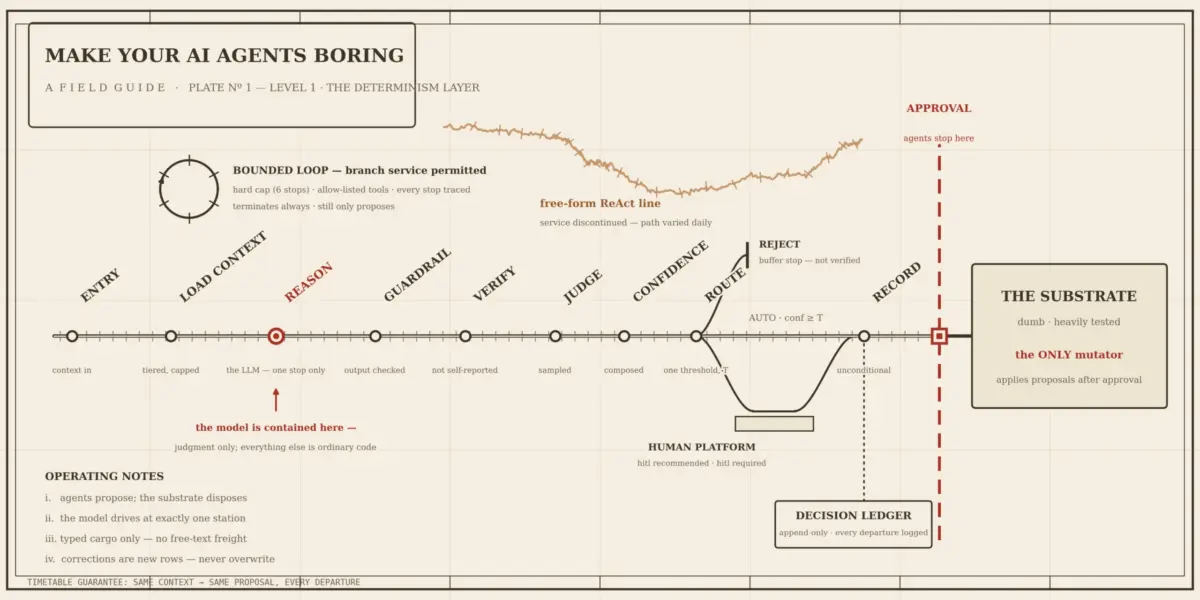
The rapid evolution of Large Language Models (LLMs) has transitioned from the era of conversational novelties to the implementation of autonomous agents capable of executing complex business logic. However, as these systems move from experimental sandboxes into high-stakes production environments—such as financial transaction processing, clinical healthcare decision support, and critical infrastructure management—the inherent unpredictability of generative AI has emerged as a primary barrier to adoption. To address this, a new architectural framework known as "The Determinism Layer" has been established as the foundational level of a six-stage maturity model for LLM operations. This framework shifts the focus from building "smarter" models to engineering rigid structural containers that isolate non-deterministic AI behavior within a controlled, testable, and auditable environment.
The Architectural Shift: Containing the "Black Box"
The fundamental challenge of deploying LLM agents lies in their non-deterministic nature. In a standard software environment, a specific input consistently yields the same output. In contrast, an LLM might "wander" down different reasoning paths on different days, even when presented with identical prompts. For regulated industries, this variability is a liability. The solution, according to industry-standard engineering practices, is to treat the LLM not as the controller of the system, but as a single, isolated node within a larger, traditional software architecture.
This design philosophy dictates that the agent must be a "pure function." In programming terms, this means the agent receives context and proposes a decision, but it lacks the authority to execute that decision or alter the state of the business database. The actual execution is handled by a "substrate"—a separate, heavily tested, and entirely deterministic component that applies the proposed changes only after meeting specific validation or human approval criteria. By decoupling the "thinking" (the LLM) from the "doing" (the substrate), organizations can ensure that every action taken by an AI system is traceable to a specific, approved proposal.
A Chronology of LLM Integration Strategies
The path to the Determinism Layer has evolved through several distinct phases of software engineering over the last 24 months:
- The Prompt-Response Era (Late 2022): Developers primarily used LLMs for simple text completion. Logic was handled entirely by the user, and the model was a passive tool.
- The ReAct and Tool-Use Explosion (Mid 2023): The introduction of "Reasoning and Acting" (ReAct) loops allowed models to call external tools. While powerful, this led to "infinite loops" and unpredictable API calls that were difficult to debug or cost-control.
- The Framework Proliferation (Late 2023): Tools like LangChain and AutoGPT popularized autonomous agents. However, many enterprises found these frameworks too "magical" and difficult to audit for production use.
- The Determinism Layer (2024): The current best practice involves moving away from free-form autonomy toward fixed-graph architectures. This approach prioritizes reliability over "cleverness," ensuring that the model’s judgment is utilized only at specific, pre-defined intervals.
The Fixed-Graph Model: Replacing Loops with Logic
One of the most significant advancements in production-ready AI is the transition from free-form ReAct loops to fixed-graph sequences. In a ReAct loop, the model decides its next step dynamically. While flexible, this makes it impossible to guarantee latency, cost, or outcome. In a fixed-graph model, the sequence of operations is known in advance, and the model is only consulted at specific "judgment nodes."
A standard production graph typically consists of twelve distinct nodes. While some are specific to the task at hand, most are shared across all capabilities to ensure a uniform audit trail:
- Entry and Context Loading: These nodes initialize the request, verify the identity of the requester, and fetch only the specific data slices needed for the decision.
- LLM Decision Node: This is the only non-deterministic part of the system. It receives structured input and is required to provide structured output.
- Verification and Guardrails: Following the decision, deterministic code checks the model’s output against business invariants. For example, if an agent proposes a refund, the verification node checks if the amount exceeds the customer’s lifetime value—a check that does not require an LLM.
- Confidence Composition and Routing: The system calculates a confidence score based on the model’s self-reported certainty and the results of the verification checks.
- The Ledger and Exit: Every decision, regardless of whether it is approved or rejected, is written to an immutable, append-only ledger.
Data-Driven Reliability: Structured Output and Validation
Data from early enterprise LLM deployments suggests that a significant percentage of system failures stem from "parsing errors"—cases where the model returns a slightly different text format than expected, breaking downstream code. To mitigate this, the Determinism Layer enforces "constrained generation."
By using protocols such as JSON Schema or grammar-constrained decoding, developers force the model to emit a validated structure rather than free prose. If a model fails to conform to the schema, the system initiates a bounded retry loop, feeding the error back to the model to correct its formatting. This turns a vague natural language problem into a crisp validation problem.
Industry benchmarks indicate that implementing schema-guided constraints can reduce post-processing failure rates by over 90% compared to free-text parsing. Furthermore, by using typed objects (such as those provided by the Pydantic library in Python), developers can establish a "contract" between the AI and the rest of the software stack.
Human-in-the-Loop: The Economic Balancing Act
A critical component of the Determinism Layer is the routing node, which manages the "Human-in-the-Loop" (HITL) workflow. High-stakes systems rarely permit 100% automation. Instead, they use confidence thresholds (often denoted as T) to determine the path of a proposal.
- Auto-Approval: If confidence exceeds the threshold (e.g., T > 0.85) and all verification checks pass, the system may proceed automatically.
- Human Recommended: If the confidence is near the threshold, the AI pre-fills a proposal for a human to review, significantly reducing the human’s workload while maintaining oversight.
- Human Required: For low-confidence outputs, the system bypasses automation entirely, requiring a human to handle the case from scratch.
This tiered approach allows organizations to scale their operations while concentrating expensive human attention on the most ambiguous or high-risk cases.
The Decision Ledger: Auditability as a Requirement
In regulated sectors like finance and healthcare, "an AI did it" is not a legally or operationally sufficient explanation for an action. The Determinism Layer solves this through the implementation of a decision ledger. Unlike standard application logs, which can be verbose and ephemeral, the decision ledger is a canonical, append-only record of every proposal.
The ledger typically records the model version, the prompt version, the hashed inputs (to protect privacy while ensuring verifiability), the raw model output, the verification scores, and the final routing decision. By revoking UPDATE and DELETE permissions on this database table, organizations create a tamper-evident audit trail. If an AI’s decision is questioned six months later, the organization can reconstruct the exact state of the system at the moment the decision was made.
Industry Implications and Future Outlook
The move toward deterministic AI architectures represents a maturing of the field. While the "cleverness" of autonomous agents continues to capture public imagination, the "boring" predictability of the Determinism Layer is what allows these technologies to be used in real-world applications.
Analysts suggest that as more organizations adopt these Level 1 maturity standards, the focus will shift to Level 2 and beyond, involving automated evaluations (Evals) and real-time performance monitoring. However, without the foundation of a deterministic layer, these higher-level functions remain built on "shifting sands."
The implications of this shift are profound. By containing the model to a single node and surrounding it with testable code, engineers are proving that LLMs can be part of a reliable system without the system itself becoming unreliable. This architectural discipline is the bridge between AI as a laboratory experiment and AI as an industrial-grade utility. For the modern enterprise, the goal is no longer to build a system that is "smart," but one that is defensible, predictable, and—above all—contained.









