Chandra Wibowo
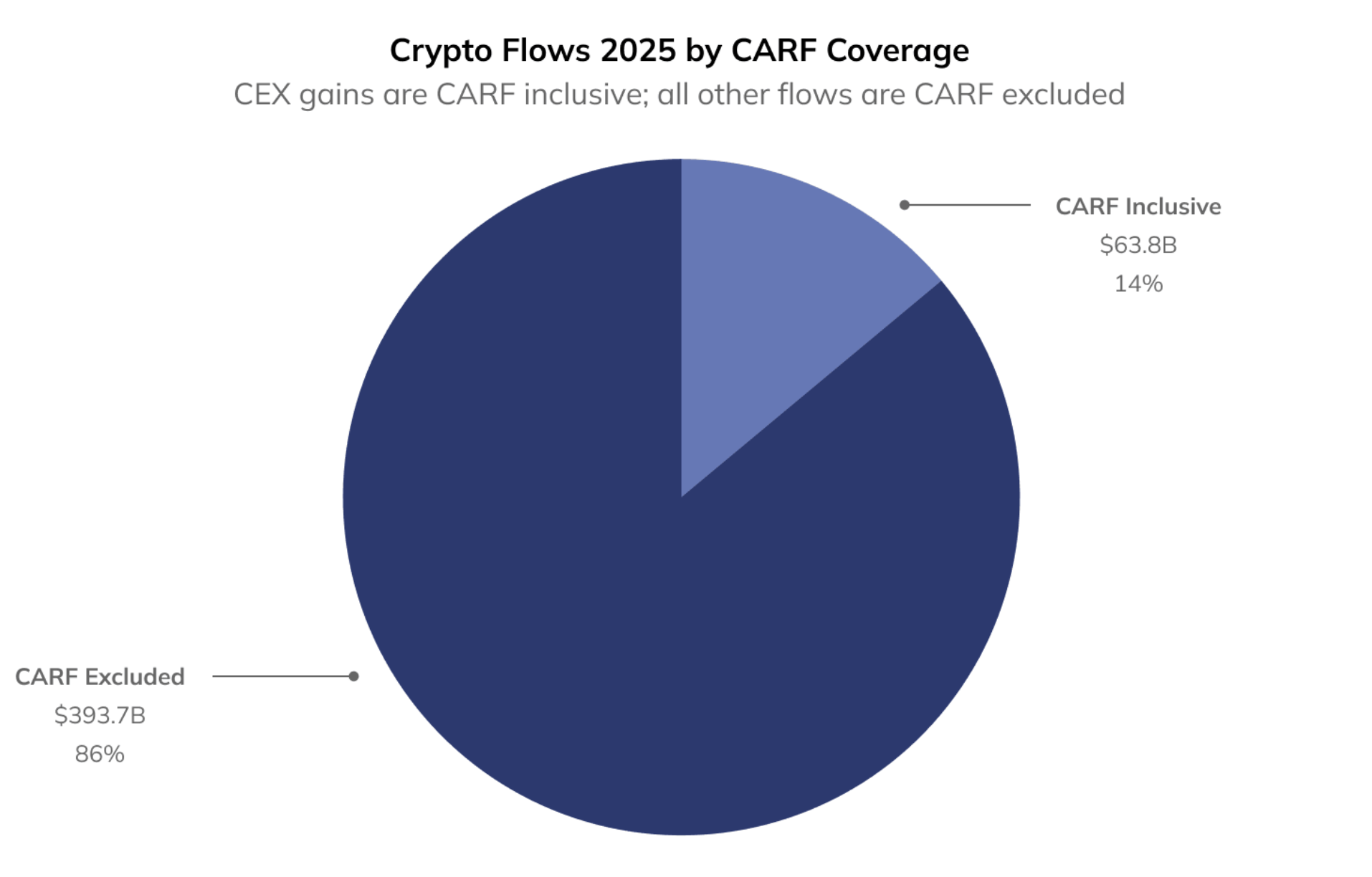
A groundbreaking report released by blockchain analytics firm Chainalysis has illuminated a significant chasm in the global effort to tax cryptocurrency activities. In 2025, potentially taxable on-chain crypto transactions amounted to an astonishing $457 billion worldwide. However, the report reveals that current international reporting frameworks, such as the Organisation for Economic Co-operation and Development’s (OECD) Crypto-Asset Reporting Framework (CARF), are only poised to capture a minuscule 14% of this burgeoning financial landscape. This stark discrepancy poses substantial challenges for tax authorities worldwide as they grapple with the rapid evolution of digital assets and their complex on-chain ecosystem.
The Chainalysis analysis, which meticulously tracked realized gains, income from activities like mining, staking, and lending, and cryptocurrency-denominated payments across six major blockchains, excludes transactions conducted solely within centralized exchanges. This focus on on-chain activity is crucial, as it represents a significant portion of the crypto economy that often operates outside the traditional financial system’s oversight.
Geographically, North America emerged as the leading region in terms of on-chain taxable crypto activity, with an estimated $134.6 billion. The United States alone accounted for a substantial $112.6 billion of this total. Following closely behind was the European Union, with an impressive $125.1 billion in taxable on-chain crypto transactions. These figures underscore the global reach and economic significance of cryptocurrency activities, even when limited to on-chain operations and excluding centralized exchange volumes.
The Limitations of CARF in Capturing On-Chain Activity
The core of Chainalysis’s findings lies in the stark contrast between the sheer volume of on-chain crypto activity and the limited scope of the CARF framework. Launched by the OECD in 2022, CARF mandates that covered crypto service providers report customer transaction data to tax authorities. While a crucial step towards greater transparency and tax compliance, its current design appears to fall short of encompassing the full spectrum of on-chain transactions.
According to the report, the 14% of on-chain taxable activity captured by CARF primarily includes transactions facilitated by entities that fall under the definition of "crypto service providers." This typically involves intermediaries that offer services like exchange, brokerage, or custody. The remaining 86% of identified taxable on-chain activity encompasses a wide array of operations that are inherently decentralized and often lack a single, identifiable intermediary responsible for reporting. This includes transactions on decentralized exchanges (DEXs), peer-to-peer transfers directly between wallets, and income generated from DeFi protocols, as well as crypto-denominated payments made directly from one wallet to another.
A Timeline of Regulatory Evolution and the Rise of DeFi
The genesis of CARF can be traced back to the growing recognition by governments worldwide of the tax implications of cryptocurrency. As Bitcoin and other digital assets gained traction in the late 2010s, tax authorities began to grapple with how to classify and tax these new forms of wealth and income. Early efforts were often ad hoc, relying on existing tax laws designed for traditional assets, leading to confusion and inconsistent application.

By 2022, the OECD, a leading international forum for economic cooperation, recognized the need for a standardized global approach. This led to the development of CARF, aimed at providing a consistent framework for the reporting of crypto-asset transactions by intermediaries to tax authorities. CARF’s data collection officially commenced on January 1, 2026, in 48 jurisdictions, including major economies within the United Kingdom and the European Union. The framework requires in-scope crypto providers to collect comprehensive customer and tax residency information, which is then reported to domestic tax authorities. These authorities, in turn, are empowered to share this information across borders through existing international tax cooperation mechanisms.
However, the rapid evolution of the cryptocurrency space, particularly the explosive growth of Decentralized Finance (DeFi), has outpaced the initial design of CARF. DeFi platforms, by their very nature, often operate without centralized entities or custodial relationships. This makes it challenging, if not impossible, to impose traditional reporting requirements on them.
Analyzing the Implications of the Reporting Gap
The implications of this reporting gap are significant and multifaceted. For governments, it means a substantial potential loss of tax revenue. As the on-chain crypto economy continues to expand, the untaxed portion represents a growing fiscal challenge. This could lead to increased pressure on tax authorities to find new ways to monitor and tax these activities, potentially through more intrusive methods or by developing entirely new regulatory frameworks.
For crypto users and investors, the current situation creates a complex and potentially risky tax environment. While CARF aims to simplify tax compliance for those engaging with regulated intermediaries, individuals participating in DeFi or conducting peer-to-peer transactions may face uncertainty regarding their tax obligations. The lack of clear reporting mechanisms can lead to unintentional non-compliance, which could result in penalties and interest.
Furthermore, the disparity in reporting could create an uneven playing field, potentially incentivizing activity on decentralized platforms over those that are subject to reporting requirements. This could, in turn, hinder the development of a transparent and well-regulated crypto market.
Expert Perspectives on the Future of Crypto Taxation
Colby Mangels, a former OECD adviser who played a role in the development of CARF, has previously spoken about the framework’s design philosophy. He explained to Cointelegraph in January that CARF was intentionally constructed around intermediaries that facilitate crypto transactions as a business. This approach was deemed the most practical way to gather actionable data from a nascent and rapidly evolving industry.
Mangels acknowledged that much of decentralized finance inherently lies outside this reporting perimeter due to the absence of a clear point of imposition for reporting requirements. However, he also noted that the regulatory landscape is continuously evolving. Tax authorities are actively monitoring developments in anti-money laundering (AML) regulations, including efforts to define when DeFi platforms or their operators should be considered regulated crypto service providers. This suggests a future where the scope of reporting requirements may expand to encompass more decentralized activities, albeit through potentially different regulatory mechanisms.
The challenge for regulators is to strike a balance between fostering innovation and ensuring fiscal responsibility. Overly restrictive regulations could stifle the growth of the crypto ecosystem, while insufficient oversight could lead to illicit activities and significant tax evasion. The current situation, as highlighted by Chainalysis, indicates that a more comprehensive and adaptable approach to crypto taxation is urgently needed.
Broader Economic and Technological Context
The rise of cryptocurrency and the subsequent efforts to regulate and tax it are part of a broader technological and economic transformation. The internet initially presented similar challenges to tax authorities, as e-commerce grew rapidly without a clear framework for cross-border taxation. The evolution of digital assets represents a new frontier, pushing the boundaries of traditional financial and regulatory systems.
The data from Chainalysis underscores the immense potential of the on-chain economy. Beyond speculative trading, activities like staking and lending are becoming increasingly sophisticated, generating income streams that are subject to taxation. Crypto-denominated payments, while still nascent in widespread adoption, also represent a future where transactions can occur seamlessly across borders without traditional banking intermediaries.
The fact that the US accounts for a significant portion of this activity, despite not being the sole leader regionally, highlights its position as a major hub for crypto innovation and adoption. Similarly, the EU’s substantial contribution indicates a robust and active crypto community within its member states.
The Path Forward: Adaptability and Innovation in Tax Policy
The Chainalysis report serves as a critical wake-up call for policymakers and tax authorities globally. It highlights the need for a proactive and adaptable approach to cryptocurrency taxation. Simply applying existing tax laws to a fundamentally new asset class and economic system is proving insufficient.
Future regulatory efforts may need to explore several avenues:
- Expanding the Definition of Crypto Service Providers: As DeFi matures, regulators may need to develop clearer criteria for identifying entities or individuals that effectively act as service providers, even in a decentralized context.
- Leveraging Technology for Compliance: Blockchain analytics tools, like those developed by Chainalysis, could be instrumental in helping tax authorities gain visibility into on-chain activities. However, the ethical and privacy implications of such surveillance need careful consideration.
- International Cooperation and Harmonization: While CARF is a step in the right direction, further international collaboration will be essential to ensure a globally consistent approach to crypto taxation, preventing regulatory arbitrage.
- Education and Guidance: Providing clear and accessible guidance to crypto users on their tax obligations is crucial to promote voluntary compliance and reduce unintentional errors.
The $457 billion in on-chain taxable crypto activity in 2025 is not merely a statistic; it represents a significant economic force that requires careful consideration. The current reporting frameworks, while well-intentioned, are clearly not equipped to capture the full scope of this evolving financial landscape. As the crypto economy continues its trajectory of innovation and adoption, so too must the regulatory and tax frameworks designed to govern it. The challenge lies in creating a system that fosters innovation, protects investors, and ensures fairness and fiscal responsibility in the digital age. The gap identified by Chainalysis is a testament to the ongoing race between technological advancement and regulatory adaptation, a race that will undoubtedly shape the future of global finance.