Sisilia Frederika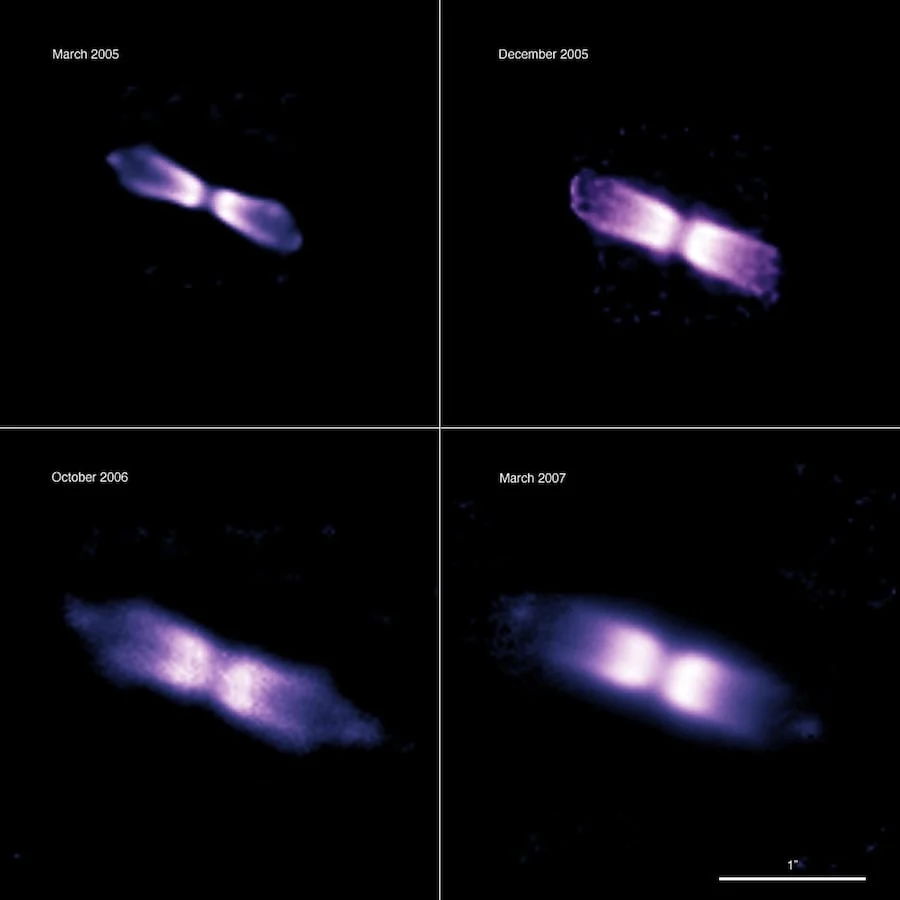
The astronomical community has long grappled with a celestial enigma located in the constellation Puppis, a case that has remained unsolved for nearly a quarter of a century. In late 2000, a stellar eruption designated V445 Puppis captured the attention of observers worldwide, not merely for its brightness, but for its chemical composition—or lack thereof. Unlike the vast majority of novae, which are fueled by the thermonuclear combustion of hydrogen, V445 Puppis exhibited an absolute absence of the universe’s most abundant element. For twenty-four years, the internal mechanics of this system remained shielded behind a self-generated shroud of dense cosmic dust. Now, a comprehensive study led by John Mills of the University of Warwick has finally pierced this veil, utilizing a multi-observatory approach to reveal the true nature of the only confirmed helium nova in the Milky Way galaxy.
The Nature of the Stellar Outburst
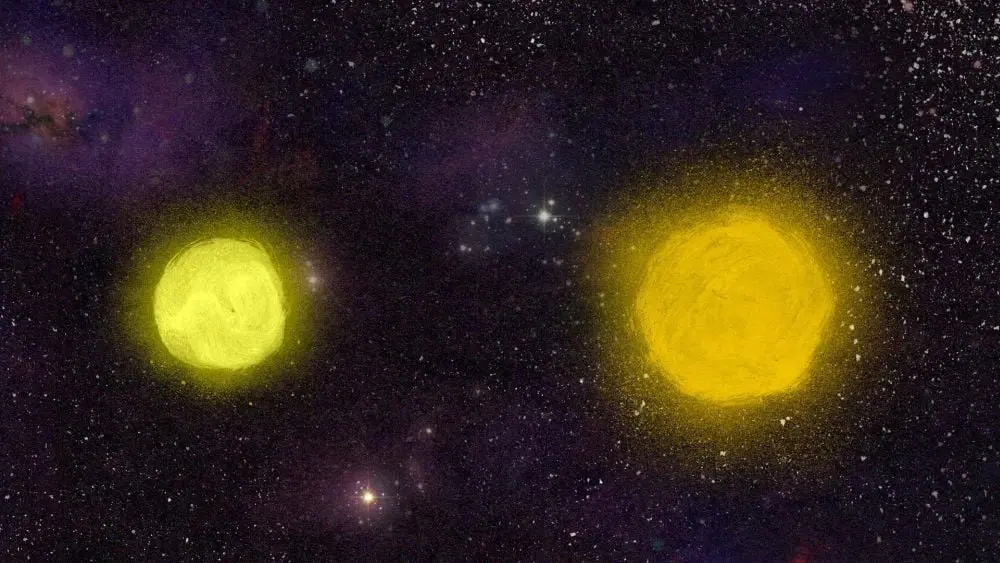
To understand the significance of V445 Puppis, one must first understand the standard mechanics of a classical nova. In a typical binary system, a white dwarf—the ultra-dense, carbon-oxygen remnant of a Sun-like star—orbits a companion star. Through gravitational attraction, the white dwarf siphons hydrogen-rich gas from its partner. This material accumulates on the surface of the white dwarf, compressed by immense gravity until it reaches a critical temperature and pressure. At this tipping point, a runaway thermonuclear reaction occurs, resulting in a brilliant flash of light and the ejection of the accumulated shell of gas.
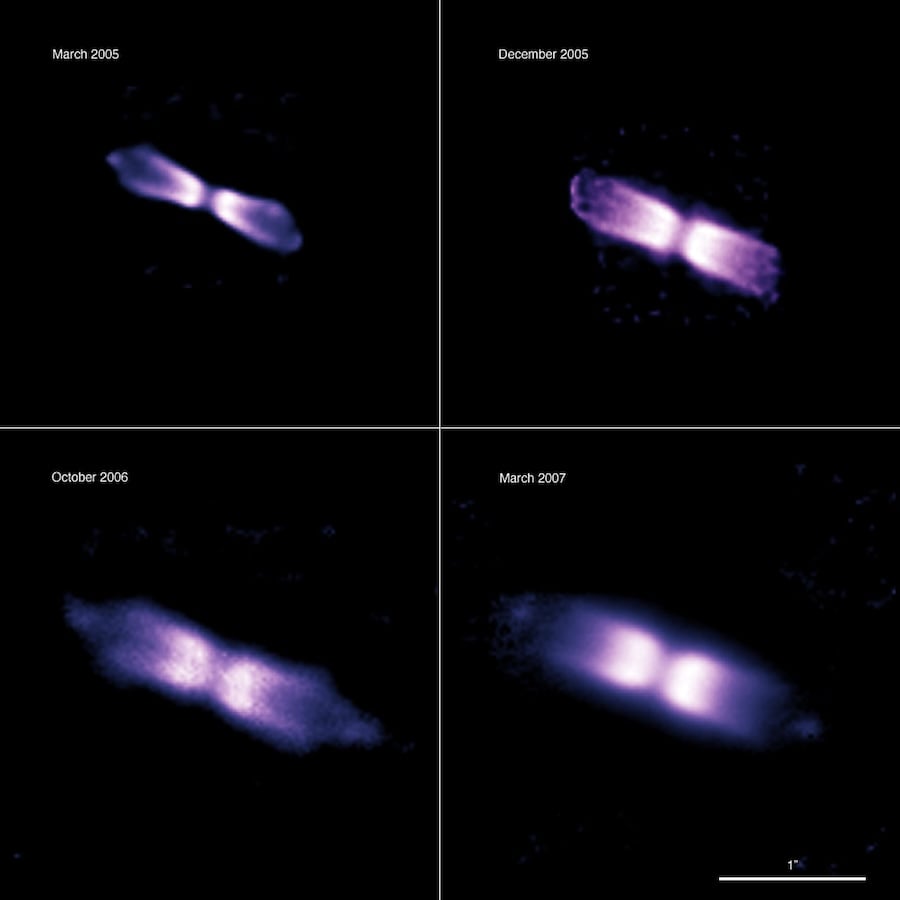
V445 Puppis defied this convention. When it erupted in November 2000, spectroscopic analysis revealed a startling anomaly: the spectrum was dominated by helium and carbon, with no detectable hydrogen. This marked the event as a "helium nova," a theoretical phenomenon that had rarely been observed and never before confirmed within our own galaxy. The eruption was not merely a flash but a transformative event that launched a bipolar outflow of material stretching over a trillion kilometers into space. Almost immediately following the explosion, the system manufactured a thick, opaque disc of dust, effectively hiding the central stars from view for over two decades.
A Chronology of Discovery and Obscuration
The timeline of V445 Puppis is a testament to the patience required in modern astrophysics. The event was first detected in late 2000, peaking in brightness and then rapidly fading as the dust began to condense. By 2003, the system was almost entirely obscured at visible wavelengths, leaving astronomers to monitor the expanding debris cloud rather than the engine driving it.
Throughout the mid-2000s and 2010s, various teams utilized infrared imaging to track the expansion of the bipolar nebula. The shape of the debris—two lobes of gas moving in opposite directions—suggested a highly constrained environment, likely influenced by a dense equatorial disc of material. However, without a clear view of the central binary, the orbital period, the mass of the stars, and the rate of material transfer remained speculative.
The breakthrough came as the dust finally began to dissipate, allowing the light from the central system to leak through. John Mills and his team synthesized twenty years of data to reconstruct the scene. By combining high-resolution infrared data from the European Southern Observatory’s Very Large Telescope (VLT), optical imaging from the Hubble Space Telescope, and two decades of spectroscopic records from the Southern African Large Telescope (SALT), the researchers were able to look back in time. Furthermore, data from NASA’s Transiting Exoplanet Survey Satellite (TESS) provided the high-precision photometry needed to pin down the system’s orbital dynamics.
Technical Insights into the Binary Engine
The study’s findings have fundamentally rewritten the understanding of V445 Puppis. The system is confirmed to be a binary consisting of a massive white dwarf and a companion helium star. The companion is a rare object in its own right—a star that has been stripped of its outer hydrogen envelope, leaving an exposed helium core. It is highly probable that the white dwarf itself was the agent of this stripping, having spent eons robbing its partner of its outer layers.
One of the most significant revelations from the Mills study is the orbital period of the pair. Previous estimates had suggested a rapid orbit, but the new data confirms the stars circle each other every 3.7 days—roughly twice as long as prior assumptions. This orbital period is crucial for modeling the mass-transfer rate, which determines how often the system will erupt.
Perhaps most startling is the discovery of "clumps" of gas embedded within the outflow. These clumps, which appear to be rich in oxygen, are moving at staggering velocities of up to twelve million kilometers per hour (approximately 3,300 kilometers per second). Mills and his colleagues suspect these were launched shortly after the primary outburst, yet their specific origin remains a mystery. No similar structures have been documented in any other nova event, suggesting that the physics of helium-driven explosions produces unique hydrodynamic instabilities.
Supporting Data and Observational Precision
The success of this investigation relied on the unique strengths of various astronomical instruments:
- The Very Large Telescope (VLT): Provided the infrared sensitivity required to peer through the thinning dust clouds and resolve the structure of the bipolar nebula.
- Hubble Space Telescope: Offered the angular resolution to map the expansion of the debris over decades, allowing for a "light-echo" style reconstruction of the initial blast.
- Southern African Large Telescope (SALT): Contributed long-term spectroscopic monitoring, which acted as a chemical fingerprinting tool to track the evolution of helium and carbon lines.
- NASA’s TESS: The mission’s "staring" capability allowed for the detection of minute fluctuations in brightness, which eventually revealed the 3.7-day orbital signature of the binary.
This multi-wavelength approach allowed the team to confirm that the "theft" of material—the accretion of helium onto the white dwarf—has already resumed. This indicates that V445 Puppis is a recurrent system, destined to erupt again once the helium layer reaches critical mass.
Broader Impact: The Road to Type Ia Supernovae
While V445 Puppis is an exotic rarity—with perhaps only a few thousand such helium-binary systems existing among the hundreds of billions of stars in the Milky Way—its implications for cosmology are profound. The primary reason astronomers are invested in helium novae is their potential link to Type Ia supernovae.
Type Ia supernovae occur when a white dwarf exceeds the Chandrasekhar limit (approximately 1.4 times the mass of the Sun), leading to a total thermonuclear incineration of the star. Because these explosions always occur at roughly the same mass, they have a consistent intrinsic brightness. This makes them "standard candles," the primary yardstick used to measure the distances to faraway galaxies. It was through the study of Type Ia supernovae that astronomers discovered the expansion of the universe is accelerating, driven by the mysterious force known as dark energy.
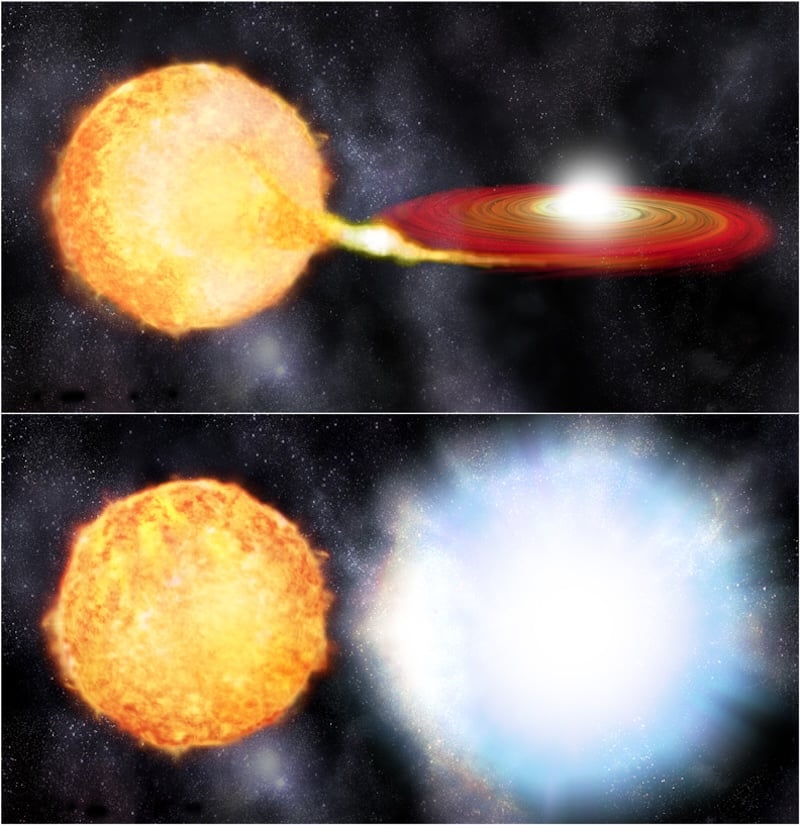
However, the "progenitor problem" remains one of the biggest holes in modern astrophysics: we do not fully understand which types of binary systems lead to these explosions. There are two main theories: the double-degenerate model (two white dwarfs merging) and the single-degenerate model (a white dwarf accreting material from a companion). V445 Puppis is a prime candidate for the single-degenerate path. If the white dwarf in V445 Puppis can retain enough of the helium it accretes during each cycle without blowing it all away during novae, it will eventually reach the limit and explode as a Type Ia supernova.
Scientific Analysis and Future Outlook
The findings published by the University of Warwick team provide a vital laboratory for testing stellar evolution models. If helium novae like V445 Puppis are indeed precursors to Type Ia supernovae, then the chemical signatures found in the debris—specifically the high concentrations of carbon and oxygen—should match the remnants of supernova explosions.
"V445 Puppis is a unique window into a process that is usually hidden from us," noted one researcher familiar with the study. "By the time a star goes supernova, the evidence of its prior life is often destroyed. Here, we are seeing the precursor phase in real-time."
The mystery of the high-speed oxygen clumps also opens a new sub-field of inquiry. If these clumps are a standard feature of helium-rich accretion, they may explain certain "anomalous" spectra observed in distant supernovae that have previously puzzled researchers.
As the dust around V445 Puppis continues to clear over the next decade, the system will become an even clearer target for the James Webb Space Telescope (JWST) and the upcoming Extremely Large Telescope (ELT). These instruments will likely provide the final pieces of the puzzle, allowing astronomers to calculate the exact mass of the white dwarf. If it is found to be near the Chandrasekhar limit, V445 Puppis will transition from a curiosity of the Milky Way to one of the most important objects in the sky—a ticking time bomb that holds the key to our understanding of the cosmic expansion.