Garick Elordi
Valve Corporation has officially initiated public beta testing for "Steam Achievement Sets," a significant structural overhaul of its digital storefront’s reward system designed to allow developers to categorize in-game milestones into distinct collections. This update represents one of the most substantial changes to the Steam achievement ecosystem since its inception, addressing a long-standing grievance among the platform’s "completionist" community regarding how downloadable content (DLC) and seasonal updates affect overall game progress. According to an official announcement from Valve, the new system is a direct response to the evolving nature of modern gaming, where titles frequently receive years of post-launch support that can inadvertently penalize players who had previously "perfected" a game.
The Evolution of Achievement Tracking in the Live Service Era
The core motivation behind the introduction of Achievement Sets lies in the shifting landscape of game development. Valve noted that modern games "live longer than ever," often expanding far beyond their initial scope through expansions, seasons, and consistent content patches. While these updates provide value to the player base, they have historically created a dilemma for achievement hunters. When a developer adds new achievements via a DLC pack, a player who had previously earned 100% of the base game’s achievements would see their "Perfect Game" status revoked and their completion percentage drop.
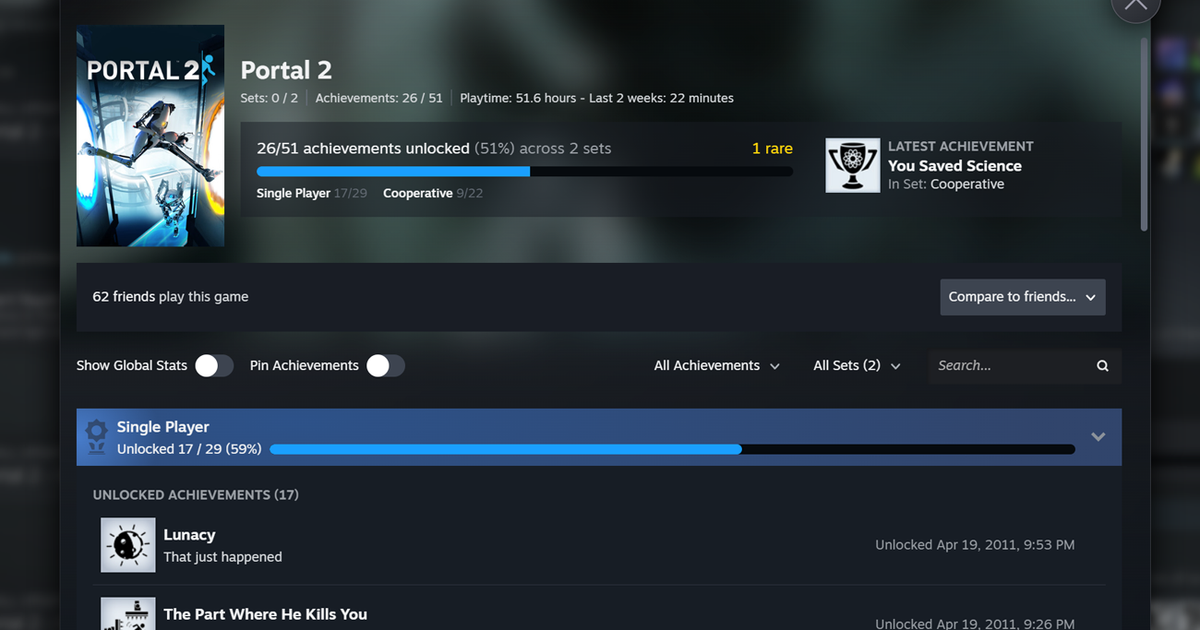
Under the new beta framework, developers can now specify the number of sets and the specific purpose of each to match their game’s unique architecture. For instance, a developer might choose to separate achievements into "Single-player" and "Multiplayer" groups, or a complex RPG might utilize a dozen different sets based on character classes or narrative chapters. This modular approach ensures that players can maintain a sense of accomplishment in one area of the game even as new content is introduced in another.
Technical Mechanics: Base Game vs. DLC Sets
The Achievement Sets feature introduces a color-coded hierarchy to help players distinguish between core content and optional expansions. Valve has outlined two primary categories:
- Base Game Sets (Blue): These sets contain achievements that are accessible to every player who owns the core title. Progress bars and completion trophies for these sets are rendered in blue.
- DLC Sets (Purple): These collections group achievements that are exclusive to additional paid content. To prevent the "completion drop" phenomenon, DLC achievements are now excluded from a player’s overall game progress calculation until the player actually gains access to that specific content. Once a player owns the DLC, the purple set becomes active, and its progress is tracked independently.
This distinction is a pivotal shift for the Steam platform. Previously, Steam treated all achievements as a single pool, meaning a player who did not wish to purchase a specific expansion would be permanently locked out of achieving a 100% completion rating for that title. By decoupling DLC progress from the base game, Valve is aligning Steam more closely with the "Platinum Trophy" system used by Sony’s PlayStation Network, while offering even greater flexibility for developers to organize their content.
Preserving Completion and the Introduction of "Archiving"
One of the most innovative aspects of the beta is the "preserved completion" mechanic. If a developer adds new achievements to an existing set, the "set complete" status for players who previously finished it is maintained. This allows returning players to easily identify new challenges without feeling that their prior efforts have been erased.
Furthermore, Valve is introducing a tool that allows developers to "archive" achievements. This feature is specifically tailored for "season-based games" or titles that feature time-limited holiday events. In the past, missing a one-time holiday achievement could permanently stain a player’s profile, making a 100% completion impossible. With the new archiving tool, players who earned the achievement during the event will still see it on their profiles, but the achievement will no longer appear for those who missed the window. Crucially, archived achievements will not count toward the completion percentage of a set or the game, ensuring that new players are not penalized for content that is no longer available.
Enhanced User Interface and Social Integration
The Achievement Sets update is accompanied by a comprehensive redesign of the Steam achievements page. Users can access this updated interface via the Games List on the web or directly through their Steam Library. The new page features a robust search engine with filters that allow players to sort by specific sets, locked versus unlocked status, and rarity.
Social competition has also been a focal point of the update. Players can now compare their progress with up to three friends simultaneously. This comparison tool tracks not only raw achievement counts but also "rare" achievements, completed sets, and progress within specific DLC packs. This granular level of data sharing is intended to foster community engagement and friendly competition within the Steam ecosystem.
Additionally, Valve has renamed the "Perfect Games" tab on user profiles to "Completed." This tab has been expanded to display both fully completed games and games where the player has finished specific achievement sets. This change acknowledges that "completion" is no longer a binary state but a multi-tiered journey.
Historical Context and Industry Comparison
To understand the weight of this update, it is necessary to look at the history of digital achievements. Steam first introduced achievements in 2007 with the release of The Orange Box. For over a decade, the system remained relatively static compared to its competitors. Microsoft’s Xbox Live pioneered the "Gamerscore" system, which aggregates points across all titles, while PlayStation’s "Trophy" system introduced the "Platinum" tier for base-game completion.
Valve’s new system arguably surpasses both by offering developers the ability to create bespoke categories. While PlayStation separates DLC trophies into sub-folders, they do not offer the "archiving" functionality for seasonal content that Steam is now testing. By addressing the "completionist anxiety" associated with live service updates, Valve is positioning Steam as the most sophisticated platform for long-term player progression.
Participating Titles and Beta Availability
The Achievement Sets feature is currently in an open beta phase, available to both players and developers. Valve has indicated that the system will continue to be refined based on user feedback. A diverse array of titles has already integrated the new sets, ranging from massive AAA shooters to niche simulation games. The initial list of supported games includes:

- Simulation & Strategy: Against the Storm, Age of Wonders 4, American Truck Simulator, Crusader Kings III, Euro Truck Simulator 2, Victoria 3.
- Action & Adventure: Call of Duty: Modern Warfare 4, Dredge, Forza Horizon 5, LEGO Batman: Legacy of the Dark Knight.
- Valve Classics: Left 4 Dead 2, Portal 2, Team Fortress 2.
- Indie Hits: Flock Around, He is Coming, PowerWash Simulator, PowerWash Simulator 2.
The inclusion of long-running titles like Team Fortress 2 and Euro Truck Simulator 2 is significant, as these games have accumulated hundreds of achievements over the years, making them the primary beneficiaries of a more organized categorization system.
Market Context: Steam’s Dominance and the Competitive Landscape
The launch of Achievement Sets comes at a time of record-breaking growth for Valve. On a recent Sunday, Steam set a new all-time record for concurrent users, reaching a peak of 43,505,724 players online simultaneously. This massive user base provides Valve with a significant data set to analyze how players interact with the new achievement structures.
The update also serves as a strategic maneuver in the ongoing "launcher wars." While the Epic Games Store (EGS) has made strides in acquiring exclusives, it has historically struggled to match Steam’s feature-rich social and meta-game infrastructure. Recent reports indicate that Epic Games is attempting to leverage generative AI and "vibe-coding" to accelerate the development of its launcher. However, Valve’s focus on deep, systemic improvements like Achievement Sets reinforces Steam’s reputation as the more mature and player-centric platform.
Impact Analysis: What This Means for the Future of PC Gaming
The introduction of Achievement Sets is likely to have several long-term effects on the PC gaming market:
- Increased DLC Engagement: By ensuring that new achievements do not "break" a player’s profile, developers may see higher attachment rates for DLC. Completionists who were previously wary of buying expansions that would lower their average completion percentage may now be more inclined to purchase new content.
- Reduced Player Burnout: The ability to "complete" a base game and walk away with a blue trophy, even if more DLC is released later, reduces the feeling of being on a "treadmill" where 100% status is impossible to maintain.
- Data-Driven Development: Developers can use the set-based data to see exactly where players are dropping off. If a "Multiplayer" set has a 5% completion rate while the "Single-player" set has 80%, it provides clear feedback on where to focus future development resources.
- Standardization of Live Service UX: As more developers adopt these tools, the expectation for organized, fair achievement tracking will likely become a standard requirement for major releases on other platforms.
As the beta progresses, Valve expects more developers to utilize these tools, eventually leading to a full rollout across the entire Steam store. For now, the Achievement Sets represent a thoughtful evolution of a system that has become a cornerstone of the modern gaming experience, proving that even after nearly two decades, the Steam platform continues to innovate in the realm of user experience.