Sisilia Frederika
Astronomers have long regarded pulsars as the most reliable timekeepers in the cosmos, utilizing their rapid and predictable rotations to probe the fundamental laws of physics. These highly magnetized, rotating neutron stars emit beams of electromagnetic radiation that sweep across the Earth with the regularity of an atomic clock. Because of this extreme precision, researchers can detect minute variations in the arrival times of these pulses—deviations often measured in nanoseconds—to uncover subtle shifts in the pulsars’ positions or the medium through which their signals travel. This phenomenon, rooted in the Doppler effect, allows scientists to turn the galaxy into a massive laboratory for detecting gravitational waves. Decades before the Laser Interferometer Gravitational-Wave Observatory (LIGO) directly observed the ripples in spacetime caused by merging black holes, pulsar timings provided the first indirect evidence that gravitational waves existed, proving that orbiting massive objects lose energy through radiation as predicted by General Relativity.
This foundational success led to the development of the Pulsar Timing Array (PTA), a concept that involves monitoring a network of pulsars across the sky to detect low-frequency gravitational waves. By observing dozens of pulsars over several decades, researchers can statistically analyze timing shifts to identify a "background" of gravitational waves—a cosmic hum produced by the collective movement of massive objects throughout the history of the universe. One of the most prominent efforts in this field is the North American Nanohertz Observatory for Gravitational Waves (NANOGrav). Over a 15-year observation period, NANOGrav monitored 67 pulsars, culminating in a landmark 2023 announcement regarding the detection of a stochastic gravitational wave background (GWB). While the initial hope was to find evidence of cosmic inflation—the rapid expansion of the universe following the Big Bang—the data suggested a different primary source: the slow, rhythmic dance of supermassive black hole binaries.
The Mystery of Early Supermassive Black Hole Formation
The discovery of a gravitational wave background dominated by supermassive black holes has shifted the focus of the astrophysical community toward a long-standing paradox: the "impossible" existence of supermassive black holes in the very early universe. Observations from the James Webb Space Telescope (JWST) and high-redshift quasar surveys have identified black holes with masses exceeding a billion suns existing less than 800 million years after the Big Bang. According to standard stellar evolution models, there simply was not enough time for a "seed" black hole—formed from the collapse of a first-generation star—to grow to such gargantuan proportions through the steady accretion of gas and dust.
To resolve this discrepancy, theorists have proposed several "fast-track" formation mechanisms. A new study by Sohan Ghodla and Cosmin Ilie, published in Physical Review D, investigates whether the gravitational wave signals detected by PTAs can distinguish between these competing theories. The study specifically evaluates two primary candidates for the seeds of these ancient giants: Direct Collapse Black Holes (DCBHs) and Supermassive Dark Stars (SMDSs). By reconstructing the PTA measurements, the researchers have begun to map the demographic history of the early universe, providing a potential limit on how many of these exotic objects could have existed.
Direct Collapse Black Holes: The Standard Alternative
The first model explored by Ghodla and Ilie involves Direct Collapse Black Holes. In the traditional model, black holes form when a massive star exhausts its fuel and collapses under its own gravity. However, this process limits the initial mass of the black hole to a few tens or hundreds of solar masses. In contrast, the DCBH model suggests that in the dense environment of the early universe, massive clouds of hydrogen and helium gas could collapse directly into a black hole without ever forming a star.
For a DCBH to form, specific conditions must be met. The gas cloud must be large enough—potentially millions of times the mass of the Sun—and it must be prevented from fragmenting into smaller, star-forming clumps. This fragmentation is usually prevented by a nearby source of ultraviolet radiation that breaks down molecular hydrogen, keeping the cloud "warm" and allowing it to collapse as a single unit. If these conditions are met, a DCBH could form with an initial mass of $10^4$ to $10^6$ solar masses. This provides a significant "head start" for the black hole to eventually reach the supermassive status observed in the early cosmos.
However, the Ghodla and Ilie study suggests that there are strict limits to this theory based on the gravitational wave data. Their analysis found that if DCBHs were too common, the resulting gravitational wave signal from their eventual mergers would be significantly louder than what NANOGrav and other PTAs have observed. The researchers established an upper bound of approximately one DCBH per 10 cubic megaparsecs. Current cosmological estimates suggest that DCBHs are indeed rare, occurring perhaps only once every million cubic megaparsecs, which falls safely within the observed limits but also suggests they may not be the only pathway to supermassive black hole formation.
Supermassive Dark Stars: A Dark Matter Solution
The second, more speculative model involves Supermassive Dark Stars. Unlike conventional stars powered by nuclear fusion, SMDSs would be powered by the annihilation of dark matter particles. In this scenario, as clouds of regular hydrogen and helium collapse in the early universe, they pull in vast quantities of dark matter. If dark matter consists of Weakly Interacting Massive Particles (WIMPs) that can annihilate with one another, this process would release immense amounts of energy in the form of heat and light.
This internal pressure from dark matter annihilation would prevent the cloud from collapsing into a star or a black hole immediately. Instead, it would create a "Dark Star"—a massive, cool, and incredibly bright object that could grow to be millions of times the mass of the Sun and reach diameters larger than the orbit of Saturn. These stars would shine with the intensity of a billion Suns but at lower temperatures, appearing as "cool" blue giants. Once the dark matter fuel is exhausted, the SMDS would collapse into a supermassive black hole.
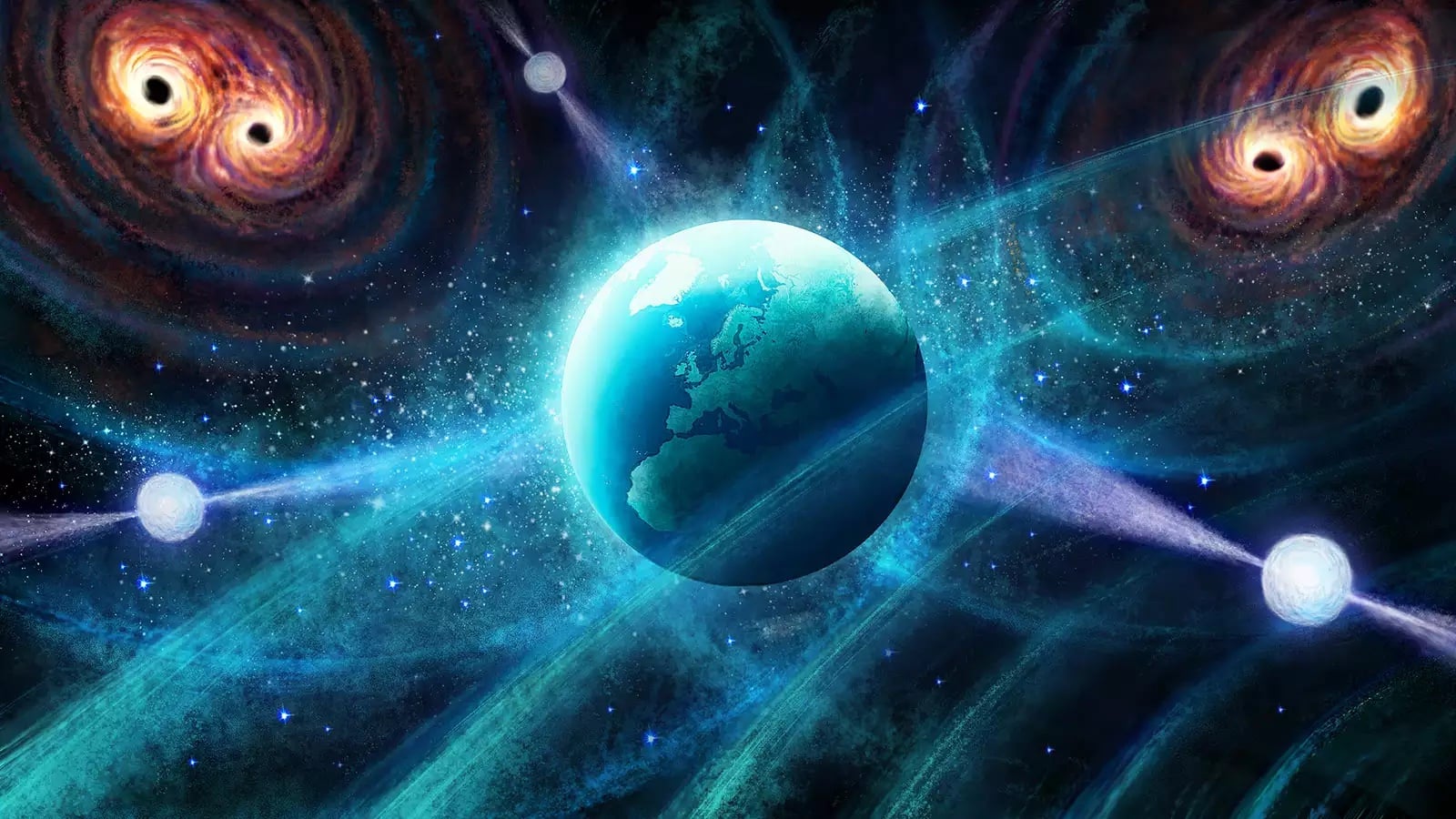
The implications of the SMDS model for gravitational wave detection are profound. Because dark matter is roughly five times more abundant than regular matter, SMDSs could have been much more common than DCBHs. Ghodla and Ilie’s research indicates that the gravitational waves produced by the mergers of black holes born from SMDSs would produce a signal that aligns closely with the intensities currently being observed by pulsar timing arrays. While this does not provide definitive proof of their existence, it suggests that SMDSs are a viable and statistically significant candidate for explaining the early-universe black hole population.
Chronology of Gravitational Wave Discovery and PTA Evolution
The journey toward these findings spans decades of theoretical work and observational breakthroughs. The timeline of pulsar timing and gravitational wave research highlights the increasing precision of our cosmic measurements:
- 1967: Discovery of the first pulsar by Jocelyn Bell Burnell and Antony Hewish.
- 1974: Discovery of the Hulse-Taylor binary pulsar (PSR B1913+16). Observations of its decaying orbit provided the first indirect evidence of gravitational waves, earning Hulse and Taylor the Nobel Prize in 1993.
- 1978: Sdetich and Hellings propose that a network of pulsars could be used to detect a background of gravitational waves.
- 1983: Hellings and Downs derive the "Hellings-Downs curve," the specific correlation pattern between pulsars that would prove the existence of a gravitational wave background.
- 2004: The North American Nanohertz Observatory for Gravitational Waves (NANOGrav) is founded.
- 2015: LIGO makes the first direct detection of gravitational waves from a stellar-mass black hole merger.
- 2023: A global collaboration of PTAs (NANOGrav, EPTA, PPTA, InPTA, and CPTA) announces the first evidence of a stochastic gravitational wave background, likely originating from supermassive black hole binaries.
- 2024-2026: Researchers like Ghodla and Ilie begin using this background data to constrain models of the early universe, including DCBHs and SMDSs.
Supporting Data and Statistical Analysis
The strength of the Ghodla and Ilie study lies in its use of the "stochastic background" as a diagnostic tool. A stochastic background is essentially a "noise" floor created by countless overlapping signals from across the universe. By analyzing the frequency and amplitude of this noise, scientists can infer the mass and distance of the objects that created it.
The researchers used Bayesian inference to reconstruct the PTA measurements. They found that the "strain"—the amount by which spacetime is stretched or compressed—correlates with the mass density of the black hole seeds. The study’s data suggests that the observed signal is consistent with a population of black holes that grew from seeds of approximately $10^5$ to $10^6$ solar masses.
In the case of DCBHs, the rarity of the necessary conditions (specifically the presence of a nearby UV source) limits their density. If the density were higher than the calculated limit of $0.1$ per cubic megaparsec, the resulting mergers would create a "crunchier" signal—one with more distinct peaks—than the relatively smooth background detected by NANOGrav. SMDSs, however, fit the "smoothness" of the background better because they are expected to be more uniformly distributed, following the distribution of dark matter halos in the early universe.
Broader Impact and Future Implications for Cosmology
The ability to use pulsar timing arrays to probe the nature of dark matter and the formation of the first black holes represents a major leap in observational cosmology. If Supermassive Dark Stars are eventually confirmed, it would not only solve the mystery of how supermassive black holes formed so quickly but would also provide the first direct evidence of dark matter’s self-interaction and annihilation properties. This would be a breakthrough of Nobel-level significance, finally moving dark matter from a theoretical placeholder to a physically observed substance.
Furthermore, these findings create a synergy between PTAs and the James Webb Space Telescope. JWST has already identified several high-redshift objects that some astronomers, including Katherine Freese and Cosmin Ilie, have suggested could be candidates for Dark Stars. If JWST can provide the visual evidence and PTAs can provide the gravitational evidence, the two independent methods would offer a robust confirmation of these exotic objects.
The ongoing work of pulsar timing arrays is also paving the way for future missions like the Laser Interferometer Space Antenna (LISA). While PTAs are sensitive to nanohertz frequencies (waves that take years to pass by), LISA will look at millihertz frequencies, capturing the mergers of black holes in a different mass range. Together, these instruments will create a "multi-band" gravitational wave astronomy, allowing us to see the history of the universe not through light, but through the very fabric of space and time.
As the sensitivity of PTA networks improves with the addition of more pulsars and longer observation baselines—especially with the inclusion of the Square Kilometre Array (SKA) in the coming years—the statistical "noise" of the gravitational wave background will begin to resolve into a detailed map. Whether that map reveals the signature of direct gas collapse or the faint glow of dark matter annihilation, it is clear that pulsars have become more than just clocks; they are the key to unlocking the darkest secrets of the early universe.