Chandra Wibowo
The number of unique wallets engaging in peer-to-peer (P2P) stablecoin transactions within China witnessed an astonishing 43-fold increase between the first quarter of 2024 and the second quarter of 2026, according to a comprehensive report by blockchain analytics firm Chainalysis. This remarkable growth, detailed in Chainalysis’s latest “Geography of Cryptocurrency” report, underscores a persistent and evolving demand for digital assets within China, even amidst stringent regulatory landscapes.
During the 2026 reporting period, which spanned from July 2025 to June 2026, Chainalysis meticulously recorded a staggering $104.1 billion in transaction volume across 18.1 million individual transfers involving China’s self-custodied stablecoin holdings. This volume highlights a significant shift in how Chinese users are interacting with digital assets, moving beyond speculative trading towards a more utilitarian approach.
A key indicator of this shift is the velocity of stablecoin holdings. In China, these holdings turned over an average of 33.2 times per year. This figure is more than three times the global average of 9.3 turnovers per year, a pattern that Chainalysis attributes to users increasingly treating stablecoins as a form of working capital. This suggests that stablecoins are being actively used for everyday transactions, remittances, or as a readily accessible store of value that can be quickly deployed, rather than being held passively for long-term appreciation.
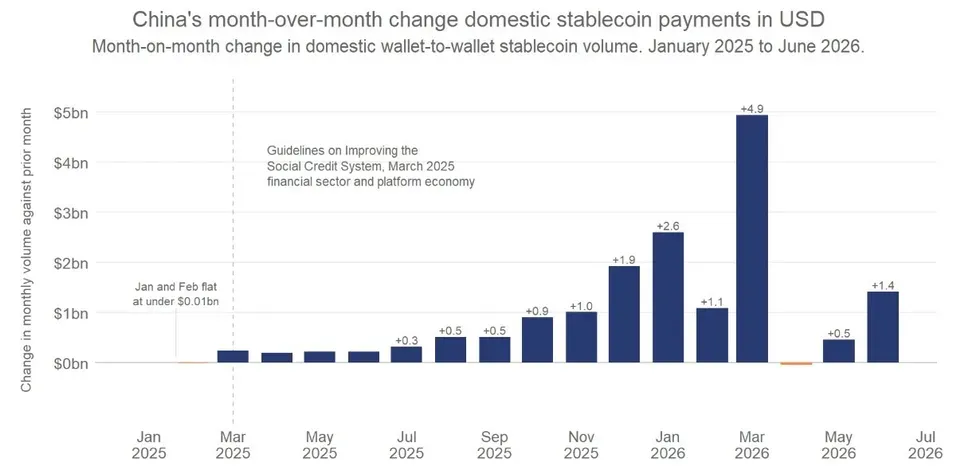
Chainalysis’s report further estimates the total value of China’s cryptocurrency economy to be at least $176 billion. Within this substantial market, domestic P2P activity emerged as a dominant force, accounting for an impressive 59.1% of the total cryptocurrency transaction volume. This is a dramatic increase from the 2025 reporting period, where its share was significantly lower, indicating a substantial pivot towards decentralized, peer-to-peer transactions. The report specifically highlights March 2026 as a period of significant acceleration, with domestic stablecoin transfer volume adding $4.9 billion for that month alone, marking the largest monthly increase observed in the data.
The sustained growth in P2P stablecoin activity in China, despite official restrictions on centralized cryptocurrency exchanges and trading, suggests a robust underground economy and a growing reliance on decentralized methods for financial transactions. This trend could be driven by a number of factors, including capital controls, a desire for greater financial autonomy, or the use of stablecoins to facilitate cross-border commerce in a more agile manner than traditional banking channels.
South Korea: A Crypto Behemoth Navigating Shifting Tides
In a contrasting yet equally significant development, South Korea has been identified as East Asia’s largest cryptocurrency economy, boasting a valuation of $449.1 billion. Despite this immense market size, the landscape for its crypto exchanges has become considerably more challenging. Chainalysis data reveals that while overall crypto activity in South Korea grew by 12.3% in the year leading up to June 2026, a significant segment of this growth was fueled by retail traders showing a pronounced preference for AI-linked tokens.
However, the first half of 2026 proved to be a difficult period for South Korean crypto exchanges. Their operating profits plummeted by an alarming 78%, a stark indicator of a market under pressure. This downturn is attributed to a confluence of factors, including a decline in overall trading activity, a contraction in market valuations, and a reduction in customer deposits.

The Korea Financial Intelligence Unit (KoFIU) provided further granular details on this decline. Their findings indicate that the average daily trading volume on domestic virtual asset exchanges fell by 44% in the first six months of 2026 compared to the preceding six months. Concurrently, the overall market capitalization of cryptocurrencies traded on these platforms dropped by 33%, and won-denominated deposits decreased by 35%. Exchange sales saw a decline of 41% over the same period. Despite these headwinds, the number of accounts eligible to trade experienced a marginal increase of 0.4%, suggesting a persistent user base, albeit one with reduced trading intensity.
This dichotomy between the overall size of the South Korean crypto economy and the struggles of its exchanges points to a potential maturation of the market, with a greater emphasis shifting towards decentralized finance (DeFi) protocols or off-shore trading platforms. The strong preference for AI-linked tokens also suggests a trend towards more niche, technology-driven investment strategies among retail investors.
Tokenization Push Propels Securitize Stock
In tandem with the evolving digital asset landscape, the tokenization sector is gaining significant traction. Shares of Securitize, a prominent tokenization platform, experienced a notable surge of 8% following the announcement of a strategic partnership with South Korean technology giant LG CNS.
This collaboration, formalized through a Memorandum of Understanding (MOU), aims to foster the development of tokenized assets and establish robust digital asset infrastructure tailored for South Korean financial institutions. The partnership provides Securitize with a crucial early-mover advantage in South Korea, a market poised to embrace a new regulatory framework for tokenized securities.
The South Korean Financial Services Commission (FSC) has been proactively laying the groundwork for this future. Last week, the FSC proposed new rules designed to govern the issuance and circulation of tokenized stocks, bonds, funds, and other securities. This comprehensive framework is slated to take effect in February 2027, signaling a clear regulatory pathway for the burgeoning tokenization industry. The move by Securitize and LG CNS indicates a strategic alignment with this forthcoming regulatory environment, positioning them to capitalize on the anticipated wave of tokenized asset adoption.
Singapore: A Hub for Institutional Digital Asset Services
Singapore continues to solidify its position as a leading financial and innovation hub, attracting significant interest from global financial institutions looking to engage with digital assets. Standard Chartered, a multinational banking giant headquartered in London, has announced its intention to launch digital asset custody services specifically for institutional clients in Singapore.
The bank plans to offer custody solutions for a curated selection of cryptocurrencies, stablecoins, and tokenized real-world assets. This service will be available to institutional and corporate clients who meet the criteria of accredited investors, reflecting a cautious yet determined approach to integrating digital assets into traditional finance. Standard Chartered’s decision underscores Singapore’s strategic importance in its global expansion, leveraging the city-state’s advanced financial infrastructure and supportive regulatory environment.
Further bolstering Singapore’s digital asset ecosystem, Independent Reserve, a cryptocurrency exchange licensed in Singapore, has introduced new cross-border payment tools. These tools enable businesses to facilitate fiat and stablecoin payouts to suppliers and employees in over 20 currencies. The accounts can be funded in either Singapore or US dollars, offering flexibility and efficiency for international transactions. Additionally, Independent Reserve has launched crypto derivatives trading for sophisticated investors through its subsidiary, ReserveX, signaling an expansion of its service offerings to cater to a broader range of market participants.
In another significant development, Payward, the parent company of the prominent cryptocurrency exchange Kraken, has partnered with Singapore Gulf Bank. This collaboration aims to facilitate round-the-clock institutional crypto settlement, a crucial service for institutional investors seeking seamless and efficient digital asset transactions. The increasing number of such partnerships and service launches by major financial players highlights Singapore’s commitment to becoming a premier destination for institutional digital asset activities.
Hong Kong Accelerates Crypto Licensing Framework
Hong Kong is making decisive moves to establish a comprehensive regulatory framework for its digital asset sector. The Hong Kong government has reaffirmed its commitment to submitting an amendment bill before the end of 2026, which will introduce licensing regimes for digital asset trading, custody, advisory, and management services. This initiative is a critical component of the city’s broader strategy to foster a regulated and secure environment for virtual assets.
Christopher Hui, the Secretary for Financial Services and the Treasury of Hong Kong, confirmed that the government intends to submit an amendment bill "within this year" to establish a more encompassing framework for digital asset activities. This proactive legislative approach aims to provide clarity and certainty for businesses operating in the virtual asset space, attracting both domestic and international players.
Chainalysis’s “Geography of Cryptocurrency” report also highlights Hong Kong’s strong performance in institutional activity within the East Asian region. The report indicates that institutional platforms account for 16% of service inflows in Hong Kong, a share nearly three times that of its regional neighbors. The city has seen substantial inbound business-to-business flows, approaching $24 billion. This surge in institutional interest is likely bolstered by the issuance of Hong Kong’s first stablecoin licenses in April, further signaling its intent to become a significant player in the regulated digital asset market.
Japan: Decentralized Exchanges Flourish Amidst Evolving Regulations
Japan’s cryptocurrency market is demonstrating a significant surge in the adoption of decentralized exchanges (DEXs). According to the Chainalysis report, DEXs now constitute nearly 35% of the service activity in Japan, the highest proportion among mature East Asian markets. This indicates a growing preference among Japanese users for peer-to-peer trading and decentralized financial services.
Chainalysis further noted that a substantial 65.7% of DEX swaps in Japan fall within the $10 to $1,000 range, suggesting that a broad spectrum of retail users are actively engaging with these platforms. The overall DEX activity in Japan has more than doubled since 2022, reflecting a rapid and sustained growth trajectory. This trend coincides with legislative efforts in Japan to integrate digital assets more formally into the country’s financial markets. In July, Japanese lawmakers passed revisions that bring digital assets under the purview of the nation’s financial markets framework, providing a more defined regulatory environment for the burgeoning sector.
In a separate development with international implications, the Japanese government has added the Russian cryptocurrency exchange Garantex to its expanded list of sanctions against Russia. This action, taken in response to the ongoing war in Ukraine, is part of a broader effort to curtail Russia’s financial capabilities. The inclusion of Garantex, which has previously been sanctioned by the United States, the European Union, and other jurisdictions for its alleged role in helping Russian entities evade financial restrictions, signals Japan’s firm stance on international sanctions and its commitment to global financial stability. The Ministry of Foreign Affairs, Ministry of Finance, and Ministry of Economy, Trade and Industry jointly issued a statement detailing the addition of 33 organizations and nine individuals linked to Russia to the asset-freeze list.
India Faces Challenges with International Crypto Scams
In India, the focus has been drawn to illicit activities rather than market growth. The Central Bureau of Investigation (CBI) has apprehended four individuals in connection with an alleged international tech-support fraud and extortion racket that specifically targeted U.S. seniors. The scam involved the use of fraudulent computer pop-ups displaying toll-free "Microsoft" numbers. Victims who called these numbers were informed of fictitious computer compromises or alleged connections to illegal activities, such as child pornography, as a means to extort money. One particularly egregious case involved a Florida resident who reportedly lost $440,000 to these scammers. This incident highlights the cross-border nature of cryptocurrency-related fraud and the challenges faced by law enforcement agencies in combating such sophisticated criminal operations.
Thailand Experiences a High-Profile Crypto Robbery
Thailand has seen a brazen act of cryptocurrency theft, where three armed assailants reportedly robbed a home in Bang Lamung. The perpetrators allegedly forced a foreign resident to transfer cryptocurrency valued at $820,000. In addition to the digital assets, the robbers also made off with cash and three Rolex watches. Preliminary police investigations suggest that the robbers may be Chinese nationals, underscoring the potential for international criminal networks to be involved in such high-value heists. This incident serves as a stark reminder of the security risks associated with holding and transacting large amounts of cryptocurrency, particularly in regions with less developed regulatory oversight.