Sisilia Frederika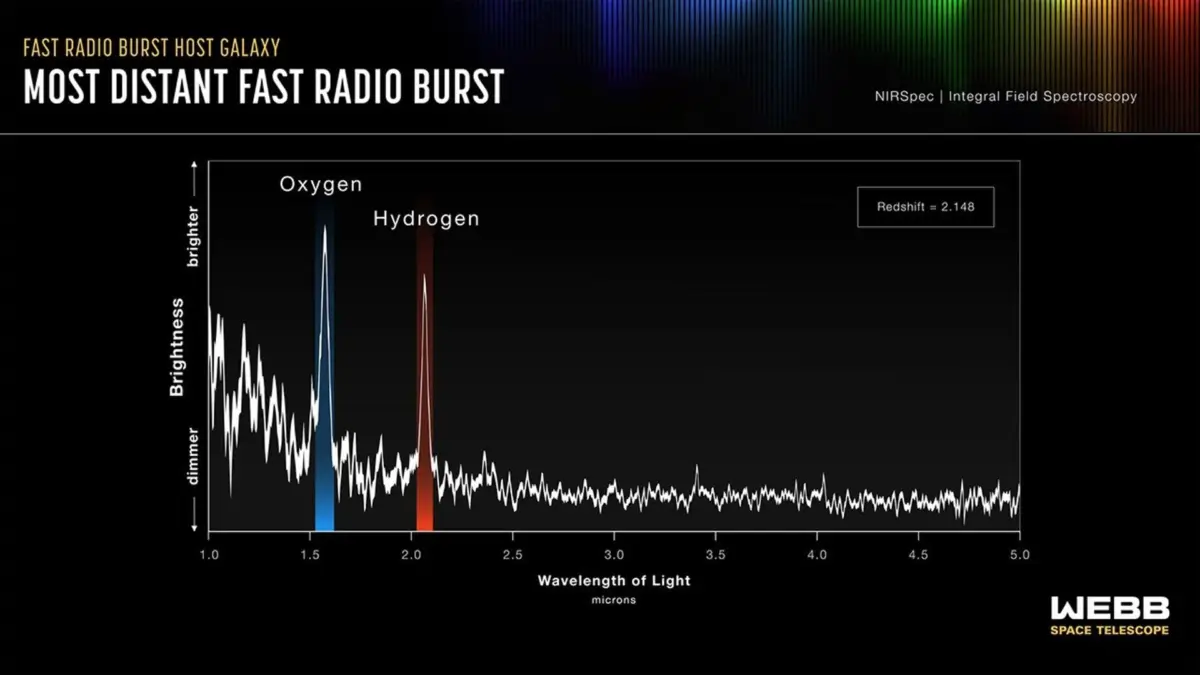
The discovery of FRB 20240304B has marked a significant milestone in the field of radio astronomy, providing unprecedented insight into the nature of Fast Radio Bursts (FRBs) and their cosmic origins. These transient phenomena, characterized by intense pulses of radio waves lasting only milliseconds, have remained one of the most profound mysteries in astrophysics since their initial discovery nearly two decades ago. By leveraging the combined power of the MeerKAT radio telescope array and the James Webb Space Telescope (JWST), researchers have successfully localized a burst to a galaxy existing when the universe was just 3 billion years old. This finding not only sets a new record for the most distant FRB ever observed but also offers compelling evidence that points toward magnetars—highly magnetized neutron stars—as the primary engines behind these high-energy events.
The Evolution of Fast Radio Burst Research
The history of FRB research is a relatively short but intensive chapter in modern astronomy. The first FRB, known as the "Lorimer Burst," was identified in 2007 within archival data from the Parkes Observatory in Australia. Since then, hundreds of these events have been recorded, yet the brief nature of the pulses makes them notoriously difficult to track. For years, a primary challenge for scientists was distinguishing genuine extraterrestrial signals from terrestrial interference. A notable example occurred with "perytons," which were initially thought to be a new class of astronomical signals but were eventually traced back to the premature opening of microwave oven doors at the observatory.
As detection algorithms improved and specialized arrays like the Canadian Hydrogen Intensity Mapping Experiment (CHIME) and the MeerKAT array in South Africa came online, the scientific community began to distinguish real FRBs with greater precision. Most FRBs are now known to originate from extragalactic distances, implying that the energy released in a few milliseconds is equivalent to the energy the Sun emits over several days. This realization shifted the focus from "what are they?" to "what could possibly generate such immense power in such a short timeframe?"
The Detection of FRB 20240304B and the MeerKAT Array
In early 2024, the MeerKAT radio telescope, located in the Karoo region of South Africa, detected a high-intensity burst designated FRB 20240304B. MeerKAT is uniquely suited for this type of work; its 64 antennas provide high sensitivity and excellent spatial resolution, allowing astronomers to "pinpoint" the coordinates of a radio source with high accuracy.
Unlike many FRBs that are detected by wide-field telescopes with poor localization, FRB 20240304B was captured with enough precision to allow for follow-up observations in other wavelengths. However, initial attempts to identify a host galaxy using ground-based optical telescopes yielded no results. The area of the sky corresponding to the burst appeared empty, suggesting that if a host galaxy existed, it was either extremely faint, heavily obscured by cosmic dust, or located at a distance beyond the reach of standard optical instruments.
The James Webb Space Telescope Intervention
To solve the mystery of the missing host galaxy, an international team of astronomers utilized the James Webb Space Telescope (JWST). The JWST’s Near-Infrared Camera (NIRCam) and Near-Infrared Spectrograph (NIRSpec) are designed specifically to peer through cosmic dust and observe the highly redshifted light of the early universe. Because the expansion of the universe stretches light into longer, redder wavelengths, distant galaxies that are invisible to optical telescopes often shine brightly in the infrared spectrum.
The JWST observations were successful. The telescope identified a small, faint galaxy at the exact coordinates provided by the MeerKAT data. This galaxy was not visible in previous surveys because of its extreme distance and relatively small size. By performing a spectroscopic analysis of the galaxy’s light, the team was able to calculate its redshift, which serves as a cosmic speedometer and distance marker. The results confirmed that the light from this galaxy had been traveling for over 10 billion years, placing the event in an era when the universe was only 3 billion years old—roughly 20% of its current age.
Analyzing the Host Galaxy: A Portrait of Youth
The data gathered by the JWST provided more than just a distance measurement; it offered a detailed look at the environment where FRB 20240304B originated. The galactic spectrum revealed that the host is a "starburst" galaxy, characterized by an exceptionally high rate of star formation.
Specifically, the analysis suggested that the majority of the stars in this galaxy formed within a window of approximately 30 million years. In astronomical terms, this is an incredibly short period, indicating a very young stellar population. The presence of young, massive stars is a crucial piece of the puzzle. These stars live fast and die young, often ending their lives in supernova explosions that leave behind compact remnants such as neutron stars and black holes. The youthful nature of this galaxy suggests that the object responsible for the FRB must have been created relatively recently after the star-formation peak.
Evaluating the Theories: Magnetars vs. Neutron Star Mergers
The discovery of a young host galaxy for FRB 20240304B has significant implications for the two leading theories regarding FRB origins: the merger of binary neutron stars and the activity of magnetars.
The Case Against Neutron Star Mergers
One popular hypothesis suggests that FRBs are produced when two neutron stars in a binary system spiral inward and eventually collide to form a black hole. While this process releases enormous amounts of energy, it is a time-consuming one. It can take hundreds of millions, or even billions, of years for a binary system to lose enough orbital energy through gravitational waves to finally merge. If this were the primary cause of FRBs, we would expect to find them predominantly in older, more mature galaxies where binary systems have had sufficient time to evolve and collide. The fact that FRB 20240304B occurred in a galaxy only 30 million years into its star-forming life strongly argues against the merger scenario for this specific event.
The Magnetar Hypothesis
The alternative theory posits that FRBs are caused by "starquakes" or magnetic flares on the surface of a magnetar. A magnetar is a type of neutron star with a magnetic field a thousand times stronger than a typical neutron star and a trillion times stronger than Earth’s. These extreme magnetic fields can become twisted, leading to sudden reconfigurations that release bursts of gamma rays and radio waves.
Magnetars are formed immediately following the supernova of a massive star. Because they have very short lifespans (their magnetic fields decay over about 10,000 years), they are always found in regions of active star formation. The discovery of FRB 20240304B in a young, star-forming galaxy aligns perfectly with the magnetar model. It suggests that the progenitor of the burst was a massive star that went supernova, became a magnetar, and emitted the burst all within a very short cosmic timeframe.
Broader Implications for Cosmology and Physics
The identification of FRB 20240304B at such a great distance provides astronomers with a powerful new tool for probing the "Intergalactic Medium" (IGM). The space between galaxies is not truly empty; it contains a thin haze of ionized gas. As the radio signal from an FRB travels through this gas, the different frequencies within the burst are slowed down by different amounts—a phenomenon known as dispersion.
By measuring the "dispersion measure" of FRB 20240304B, scientists can calculate the total amount of matter the signal encountered on its 10-billion-year journey. This helps "weigh" the universe and locate the "missing baryons"—normal matter that is predicted by Big Bang models but is difficult to detect through traditional imaging.
Furthermore, this discovery suggests that FRBs have been occurring since the very early stages of cosmic history. If magnetars in young galaxies are the primary source, then as telescopes become more sensitive, we may find FRBs originating from the "Epoch of Reionization," the period when the first stars and galaxies began to light up the cosmos.
Looking Ahead: The Future of Radio Astronomy
The success of the MeerKAT and JWST collaboration sets a precedent for future multi-messenger and multi-wavelength astronomy. The upcoming Square Kilometre Array (SKA), which will incorporate MeerKAT into a much larger network of dishes across Africa and Australia, is expected to detect thousands of FRBs per year.
With the SKA’s sensitivity and the JWST’s ability to characterize distant hosts, the scientific community is on the verge of transforming FRBs from mysterious anomalies into standard cosmological candles. These bursts will allow researchers to map the distribution of matter across the universe, study the evolution of galaxies, and test the laws of physics under the extreme conditions of magnetar environments.
The team behind the study, led by Manisha Caleb and published in the arXiv preprint (2025), emphasizes that FRB 20240304B is likely just the tip of the iceberg. As we look deeper into the past, the "distant noise" of these radio chirps is becoming a clear and articulate voice, telling the story of how the universe grew from a dense, hot soup of particles into the complex web of galaxies we observe today. The record-breaking distance of this burst confirms that the mechanisms driving these events are a fundamental part of the cosmic lifecycle, appearing almost as soon as the first generation of massive stars began to die.