Chandra Wibowo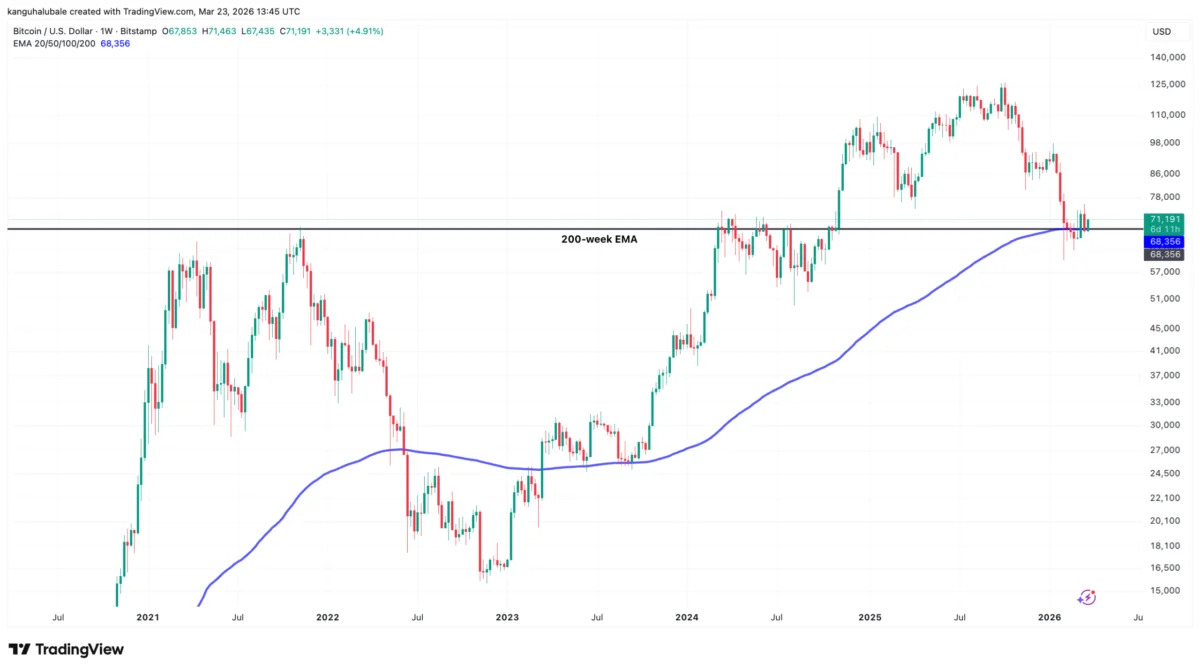
Bitcoin’s inability to secure a weekly closing price above the critical 200-week exponential moving average (EMA) on Sunday has ignited concerns among market analysts, pointing to a heightened risk of a renewed downward trajectory in the coming weeks and months. This technical signal, a closely watched indicator of long-term market sentiment, suggests that recent upward price action may have been a temporary "bull trap," leaving the digital asset vulnerable to further price erosion.
Key Takeaways:
- Bitcoin failed to achieve a weekly close above the 200-week EMA, a significant technical benchmark.
- This failure raises the possibility that the recent rally to $76,000 was a bull trap.
- Analysts are flagging potential downside targets, with some projecting a return to sub-$50,000 levels.
- Profit-taking behavior is evident at key accumulation levels, signaling potential selling pressure.
- "Deep structural" support for Bitcoin is identified around the $47,000 mark, though its significance hinges on a broader market regime shift.
Technical Weakness Sparks Sub-$50,000 Targets
As of recent trading sessions, the BTC/USD pair was observed trading around $71,190, reflecting a notable recovery from an intraday low of $67,300, a move of approximately 6%. However, this recovery did little to assuage the concerns stemming from the missed weekly close above the 200-week EMA, which stood at approximately $68,300. This technical hurdle’s persistence above the price has led many to re-evaluate the sustainability of the recent surge to $76,000, with the prevailing sentiment leaning towards it being a deceptive rally designed to lure unsuspecting buyers into a deteriorating market.
Data from trading platforms, including TradingView, illustrates the ongoing battle for Bitcoin around this crucial long-term indicator. The weekly chart reveals repeated attempts to break and hold above the 200-week EMA, with each failure increasing the probability of a bearish continuation. This pattern has historically preceded significant price corrections, prompting a cautious outlook from market participants.

Evidence of Profit-Taking and Snowballing Downside Risks
The market has exhibited a consistent pattern of profit-taking whenever Bitcoin approaches key accumulation levels. This behavior, where holders lock in gains rather than extending their positions, suggests a lack of conviction for a sustained upward move. Commenting on the current market dynamics, several traders have voiced concerns that any significant downturn could rapidly accelerate, leading to a cascading effect of selling pressure.
This sentiment is amplified by the broader macroeconomic environment, which continues to present a complex backdrop for risk assets like Bitcoin. Increased correlation with traditional stock markets, as previously reported, means that geopolitical uncertainties and shifts in monetary policy in major economies can have a pronounced impact on cryptocurrency valuations.
Analyst Perspectives on Potential Downside
Market analysts are closely monitoring Bitcoin’s price action, with several articulating bearish outlooks based on the recent technical breakdown. Analyst Jelle, in a post on the social media platform X (formerly Twitter), highlighted Bitcoin’s failure to maintain its position within a rising wedge formation. "BTC broke down from the rising wedge over the weekend," Jelle stated on Monday, adding, "Consolidate here for a day or two, and those untapped lows look ripe for the taking."
Jelle’s reference to "untapped lows" points to a significant price zone between the local low of $65,500 and the range low of $59,930, which was established on February 6th. This area represents potential targets for a downward correction, should current support levels fail to hold. The visual representation of this breakdown on daily charts further underscores the bearish technical signal.

Another analyst, operating under the pseudonym Stockmoney Lizards, echoed these concerns, noting Bitcoin’s repeated loss of the 50-day EMA. "BTC has lost the EMA50 once again, and the global crisis feels more insecure today than it did 2 weeks ago," the analyst remarked in a recent Bitcoin analysis shared on X. This technical observation, coupled with perceived global instability, suggests a potential retreat towards the sub-$60,000 region.
Adding to the bearish outlook, analyst Michael J. Kramer projected a more significant decline, suggesting that "Bitcoin is getting close to taking that next leg lower into the mid-$40Ks." Kramer’s target of around $46,600 is derived from the measured move of a bear flag pattern, a widely recognized technical formation that often signals the continuation of a downtrend. The accompanying chart analysis visually supports this projection, illustrating the potential downside from current levels.
Prediction Markets Weigh in on Future Price Action
The concerns voiced by individual analysts are mirrored in the sentiment of prediction market traders. These platforms, which allow participants to bet on the future outcome of events, indicate a substantial probability of a significant price drop for Bitcoin. Traders are pricing in a 70% chance that Bitcoin will fall below $55,000 in 2026. Furthermore, the odds of a decline below $45,000 are assessed at 46%, underscoring a widespread expectation of considerable downward pressure on the cryptocurrency’s price.
Structural Support Levels Under Scrutiny
While the immediate outlook appears challenging, market analysts also identify key structural support levels that could potentially cushion any further decline. Axel Adler Jr., an analyst at CryptoQuant, highlighted that Bitcoin is currently trading near the 200-week EMA at $68,300. This level coincides with the realized price of the "largest holder cohort (100-1K BTC)," a group of significant investors whose cost basis often acts as a psychological support.

"As long as the price holds above $68K, the largest cohort remains near its cost basis and maintains a more resilient position," Adler Jr. stated in a Bitcoin analysis on Monday. He further elaborated that a move below this threshold "would signal deteriorating structure and increase the likelihood of a more nervous reaction from large holders." This indicates that the $68,000 level is not just a technical average but also a critical point for a substantial segment of large Bitcoin holders.
In contrast, the realized price for the 10-100 BTC holder cohort is situated considerably lower, around $46,700. This level is described as a "deep structural threshold that would become meaningful only in the event of a full-scale deterioration in market regime." This implies that while $47,000 represents a more profound support level, it is likely to be tested only under severe market distress, suggesting that the $68,000 level is the more immediate and relevant point of defense for Bitcoin’s current market structure.
Broader Implications and Historical Context
The current price action of Bitcoin and the ensuing analyst commentary are situated within a broader narrative of the cryptocurrency market’s evolution. The 200-week EMA has historically served as a pivotal indicator of long-term trends. A failure to maintain this average, especially after a period of significant upward momentum, has often preceded extended bear markets.
The digital asset has experienced several boom-and-bust cycles since its inception. Following the highs of late 2021, Bitcoin underwent a substantial correction throughout 2022, testing previous all-time lows. The subsequent recovery in 2023 and early 2024 was fueled by a combination of factors, including the anticipation and subsequent approval of spot Bitcoin Exchange-Traded Funds (ETFs) in the United States, which brought new institutional capital into the market. However, the recent price action suggests that the market may be facing a period of consolidation or potential retracement as it digests these inflows and navigates broader economic uncertainties.
The increasing correlation between Bitcoin and traditional equity markets, particularly the S&P 500 and Nasdaq Composite, is another significant development. This trend, which has become more pronounced in recent years, suggests that Bitcoin may be increasingly treated as a risk-on asset, subject to the same macro-economic forces that influence stocks. This dynamic can amplify volatility, as seen during periods of heightened market uncertainty or shifts in global liquidity.

The phenomenon of "profit-taking" at key levels is a natural part of market cycles. However, when it consistently prevents the price from breaking above critical resistance, it signals a lack of broad-based buying conviction. This can lead to a situation where the market becomes more susceptible to downward pressure, as evidenced by the current bearish technical signals.
The identification of "structural support" levels, such as the realized prices of different holder cohorts, provides valuable insights into the potential price floors that could emerge during a downturn. These levels represent the average cost basis of specific investor groups, and their breach can trigger panic selling as these holders face unrealized losses. The distinction between the immediate support around the 200-week EMA and the deeper structural support at lower levels underscores the layered nature of market defense mechanisms.
Looking Ahead
The coming weeks and months will be crucial for Bitcoin’s price trajectory. The ability of the digital asset to reclaim and sustain a position above the 200-week EMA will be a key determinant of whether the market can regain bullish momentum. Conversely, a continued struggle to overcome this resistance, coupled with a break below immediate support levels, could signal a more protracted period of price discovery downwards. Investors and traders will be closely watching for further technical developments, as well as any shifts in the macroeconomic landscape and institutional interest, to gauge the future direction of this leading cryptocurrency. The current technical indicators and analyst sentiment suggest a cautious approach is warranted, with the potential for further downside remaining a significant consideration.