Sisilia Frederika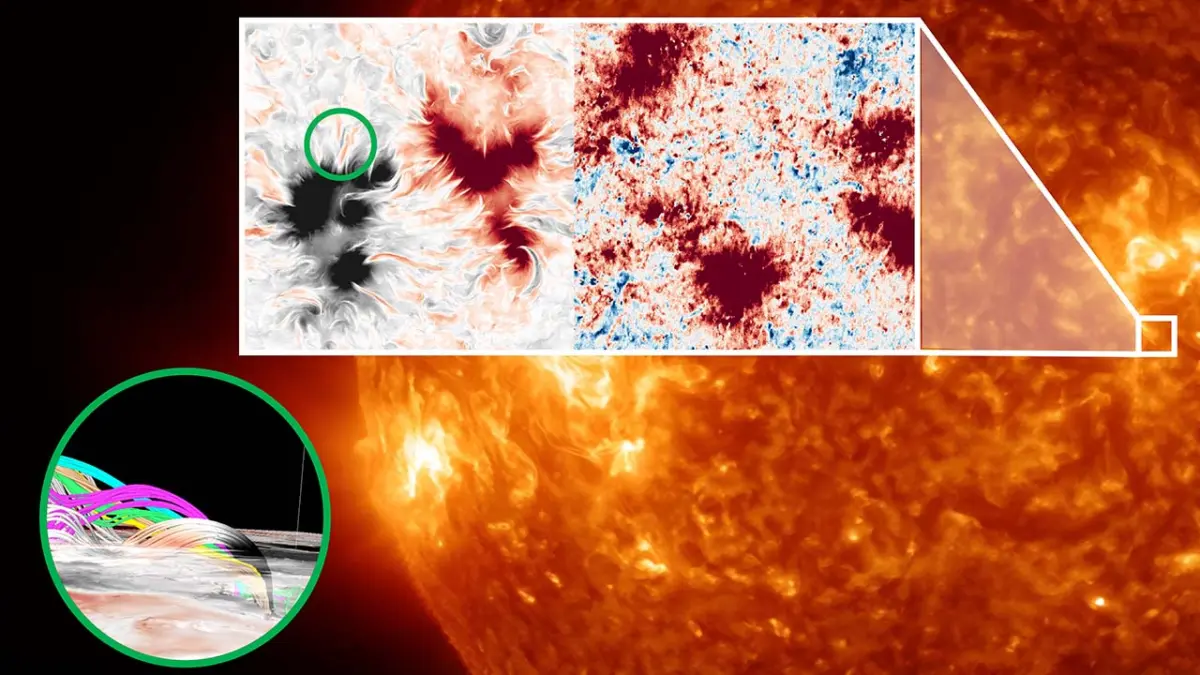
The SUNRISE III mission, a sophisticated international solar observatory suspended from a stratospheric balloon, has provided a transformative look at the Sun’s magnetic architecture, challenging long-held assumptions about the nature of the solar atmosphere. In a series of three comprehensive scientific papers recently published in the Astrophysical Journal Letters, researchers have detailed findings that suggest even the seemingly "quiet" regions of the Sun are teeming with intricate, high-energy magnetic structures. By lifting a one-meter solar telescope to an altitude of 35 kilometers—well above the turbulent layers of Earth’s lower atmosphere—the mission achieved a level of clarity and detail that ground-based observatories struggle to match. These results offer a new perspective on how energy is transported and released in the solar chromosphere, providing critical clues to solving the long-standing mystery of why the Sun’s outer atmosphere is significantly hotter than its surface.
The Stratospheric Advantage: Overcoming Atmospheric Turbulence
To understand the significance of the SUNRISE III mission, one must first consider the limitations of traditional ground-based solar astronomy. The Earth’s atmosphere acts as a thick, undulating lens; air currents, temperature fluctuations, and moisture create "seeing" conditions that smear the fine details of solar features. While adaptive optics have improved ground-based observations, the most delicate magnetic structures—some measuring only a few hundred kilometers across—often remain blurred.
A balloon-borne observatory offers a strategic middle ground between expensive, rigid satellite missions and ground-based telescopes. By ascending to the stratosphere, SUNRISE III escaped 99% of the Earth’s atmospheric mass. At 35 kilometers (approximately 115,000 feet), the telescope operates in a near-vacuum environment where the air is stable and thin, allowing for diffraction-limited imaging. Furthermore, unlike rockets, which provide only minutes of data-gathering time, or satellites, which are constrained by fixed hardware that cannot be easily serviced, a stratospheric balloon can stay aloft for days or weeks. This provides a stable, long-duration platform for instruments like the Sunrise Chromospheric Infrared spectroPolarimeter (SCIP), which is designed to measure the full Stokes polarimetry of solar light. This technique allows astronomers to reconstruct the three-dimensional direction and strength of magnetic fields across multiple layers of the solar atmosphere simultaneously.
Chronology of the SUNRISE III Mission and Data Analysis
The SUNRISE III mission is the third iteration of a program led by the Max Planck Institute for Solar System Research (MPS) in Germany, in collaboration with the National Astronomical Observatory of Japan (NAOJ), the Johns Hopkins Applied Physics Laboratory, and various Spanish research institutions. The mission launched in mid-2024 from the Esrange Space Center in Kiruna, Sweden. Carried by a massive helium balloon, the six-ton gondola drifted westward over the Atlantic toward Northern Canada, taking advantage of the stable "midnight sun" of the Arctic summer to maintain 24-hour solar visibility.
Following the successful recovery of the gondola and its data storage units, an international team of scientists spent nearly two years processing the raw observations and correlating them with advanced computer simulations. The culmination of this effort is the trio of papers published in 2026, which focus on different aspects of the solar magnetic field: the three-dimensional structure of the quiet-sun regions, the cause of "opposite-polarity intrusions," and the magnetic properties of polar spicules.
Redefining the Quiet Sun: From Canopy to Complex Threads
For decades, the standard model of the "Quiet Sun"—the regions away from the volatile, dark sunspots—depicted the chromosphere as being dominated by a "magnetic canopy." In this model, vertical tubes of magnetic flux originate in the photosphere and expand outward as they rise, eventually bending over to form a horizontal ceiling of magnetism. However, the data from the SCIP instrument on SUNRISE III has revealed a much more chaotic reality.
Researchers discovered that this canopy is not a uniform structure but is instead woven with narrow magnetic threads. These threads are approximately 725 kilometers in diameter—a scale that is relatively tiny in solar terms but immense in terms of the energy they can carry. The magnetic strength of these threads was measured between 10 and 20 Gauss, fluctuating in patterns that resemble the complex penumbrae typically only seen around massive sunspots.
Most surprisingly, the SUNRISE III data identified "opposite-polarity intrusions" (OPIs). These are localized areas within the magnetic canopy where the magnetic field direction is completely reversed compared to the surrounding environment. The research team noted that these findings suggest the canopy field is not a simple expansion of magnetic flux from the solar network but a complex, three-dimensional configuration containing numerous localized sub-structures.
Validating Discoveries through MURaM-ChE Simulations
To confirm the nature of these OPIs, scientists turned to the MURaM-ChE (Max Planck University of Chicago Radiative Magnetohydrodynamics) simulation algorithm. This 3D radiative-magnetohydrodynamic tool allows researchers to input physical parameters and observe how plasma and magnetic fields interact over time.
When the specific observational data from SUNRISE III was fed into the simulation, the results matched the OPI structures with remarkable precision. The simulations revealed that these intrusions are actually "twisted magnetic flux ropes." These ropes, ranging from 2,000 to 7,000 kilometers in length, are essentially bundles of magnetic field lines that have become tangled and twisted by the turbulent motion of the Sun’s plasma.
The presence of these twisted ropes in the Quiet Sun is a significant discovery. In active regions, the "reconnection" of such ropes—where magnetic field lines break and snap back together in a lower-energy state—is the primary engine behind massive solar flares and coronal mass ejections. Finding them in the calmer regions of the Sun suggests that small-scale magnetic reconnections are happening constantly across the entire solar surface. This continuous release of energy, though less dramatic than a flare, may be the primary mechanism that heats the surrounding plasma to millions of degrees.
Probing the Polar Spicules: Magnetic Strength and Visibility
The third major finding of the SUNRISE III mission concerns spicules—colossal jets of plasma that shoot upward from the Sun’s poles at speeds of nearly 100 kilometers per second. While these jets have long been suspected of transporting energy into the corona, measuring their magnetic strength has proven notoriously difficult.
Using the SCIP instrument to observe spicules at the "solar limb" (the apparent edge of the Sun), scientists were able to calculate magnetic values with unprecedented accuracy. The study found that in the lower canopy, the magnetic field strength of these spicules resides between 10 and 20 Gauss. This was actually lower than many theoretical models had predicted. However, as the instruments looked higher above the limb, the recorded strength jumped to approximately 40 Gauss.
The researchers analyzed this discrepancy and concluded it was likely an effect of observational density rather than a physical surge in magnetism. At lower altitudes, the "thicket" of spicules is so dense that telescopes cannot see through the forest of plasma jets; they only measure the outermost, weaker spicules. At higher altitudes, the canopy thins out, allowing the SCIP instrument to penetrate the structures and measure the true, stronger magnetic core of the individual spicules. This nuanced understanding of spicule magnetism is vital for calculating how much energy these jets actually contribute to the solar wind.
Broader Implications and Official Perspectives
The results from SUNRISE III have been met with enthusiasm across the global astrophysical community. In statements following the publication of the papers, representatives from the National Astronomical Observatory of Japan emphasized that these findings provide a "missing link" in our understanding of the solar atmosphere’s energy cycle. By proving that the Quiet Sun is far more magnetically active than previously thought, the mission has provided a new framework for studying stellar atmospheres across the galaxy.
The success of SUNRISE III also validates the continued use of stratospheric platforms for high-resolution science. As space agencies look toward the next generation of solar missions, such as the upcoming SOLAR-C (EUVST) mission led by JAXA, the data from SUNRISE III serves as a foundational roadmap.
The analysis suggests that the solar corona—the Sun’s outermost layer, which is visible during a total eclipse—is not heated by a single massive source, but by millions of tiny, localized magnetic "explosions" caused by the twisting and snapping of these newly discovered flux ropes. This shift from a macro-scale to a micro-scale understanding of solar physics could eventually improve space weather forecasting, helping to protect satellite communications and power grids on Earth from the effects of solar activity.
Conclusion: Scratching the Surface of a Local Star
As the scientific community digests the wealth of data provided by SUNRISE III, it is clear that our understanding of the Sun is undergoing a period of rapid evolution. The mission has demonstrated that even the most "peaceful" parts of our star are governed by a complex, three-dimensional web of magnetic forces. The discovery of twisted flux ropes and the precise measurement of spicule magnetism represent significant steps forward in the quest to understand the Sun’s influence on the heliosphere.
While SUNRISE III has concluded its primary flight, the three papers published in the Astrophysical Journal Letters are likely only the beginning of a long tail of research. As future missions prepare to launch, they will do so with the knowledge that the Sun’s "quiet" face is merely a mask for a restless and intricate magnetic engine that scientists are only just beginning to decode. The stratospheric view has once again proven that to see the Sun clearly, one must first rise above the clouds.