Sisilia Frederika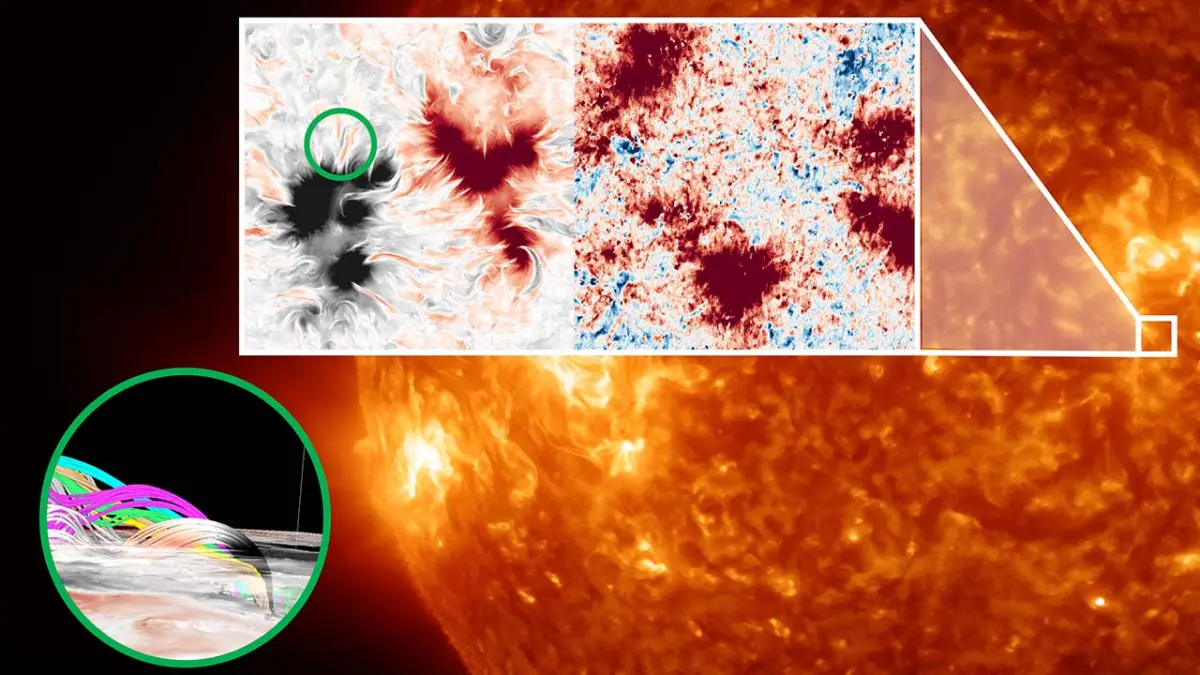
The Sun, while seemingly a constant and serene orb from our terrestrial perspective, is a crucible of complex magnetic activity that dictates the environment of the entire solar system. In a significant leap for heliophysics, the SUNRISE III mission has provided a wealth of new data that challenges long-held assumptions about the "Quiet Sun"—the regions of the solar surface away from the volatile, high-energy activity of sunspots. Following the successful flight of the observatory in 2024, an international team of researchers has published a comprehensive suite of three scientific papers in the Astrophysical Journal Letters. These findings, derived from high-altitude stratospheric observations, reveal an intricate web of magnetic threads and twisted flux ropes that suggest even the calmest parts of our local star are far more dynamic than previously understood.
The Stratospheric Advantage: Overcoming Earth’s Atmospheric Veil
The primary challenge in solar observation from the ground is the Earth’s atmosphere. The air surrounding our planet is inherently turbulent; the mixing of warm and cool air layers causes "seeing" issues, where fine details are blurred or smeared. For solar physicists attempting to resolve the smallest magnetic features—some of which are less than 1,000 kilometers across—this turbulence is an insurmountable barrier for ground-based telescopes. While space-based observatories like the Solar Dynamics Observatory (SDO) or the Parker Solar Probe offer a solution, they are governed by rigid mechanical constraints, high costs, and lengthy development cycles.
The SUNRISE III mission utilized a middle-ground approach: a stratospheric balloon. By suspending a sophisticated gondola beneath a massive helium balloon and lofting it to an altitude of approximately 35 kilometers (roughly 115,000 feet), the mission positioned its instruments above 99% of the Earth’s atmosphere. At this height, the "seeing" is nearly as clear as in a vacuum, but the mission retains the flexibility of a suborbital flight. This allowed the SUNRISE III team to deploy a 1-meter solar telescope, the largest of its kind ever to fly in the stratosphere, providing unprecedented clarity of the solar chromosphere and photosphere.
The SCIP Instrument and the Science of Polarimetry
At the heart of the SUNRISE III mission’s success was the Sunrise Chromospheric Infrared spectroPolarimeter (SCIP). This instrument is designed to measure the full Stokes polarimetry of solar light. Polarimetry is the study of the polarization of light, which, in a solar context, serves as a direct proxy for magnetic field activity. When light passes through a magnetic field, it undergoes the Zeeman effect, where spectral lines are split and polarized in specific ways. By measuring these polarizations across multiple wavelengths, SCIP allowed astronomers to reconstruct the three-dimensional direction and strength of magnetic fields across various layers of the solar atmosphere.
The data gathered by SCIP provided a high-resolution map of the magnetic "canopy." Historically, scientists envisioned the solar chromosphere as being dominated by a relatively simple canopy of vertical magnetic flux tubes that expand outward from the network regions of the photosphere. However, the SUNRISE III data has effectively dismantled this simplistic model, replacing it with a far more nuanced and "thread-like" reality.
Discovering the Intricate Threads of the Quiet Sun
The "Quiet Sun" refers to the vast majority of the solar surface that is not occupied by active regions or sunspots. Despite its name, the SUNRISE III data shows that this region is teeming with magnetic complexity. The SCIP instrument identified narrow magnetic threads measuring approximately 725 kilometers in width. To put this in perspective, while 725 kilometers sounds vast, it is a minute fraction of the Sun’s 1.39 million-kilometer diameter—akin to spotting a single strand of hair on a basketball.
These threads exhibit magnetic strengths fluctuating between 10 and 20 Gauss. More importantly, they demonstrate an alternating pattern of polarity that mimics the structures found in the penumbrae (the outer, lighter regions) of sunspots. The researchers observed "opposite-polarity intrusions" (OPIs), where localized magnetic fields flipped their orientation entirely relative to the surrounding canopy.
In their published findings, the researchers noted: "These findings suggest that the canopy field is not simply an expanding structure originating from network regions, but instead has a complex three-dimensional configuration containing numerous localized sub-structures." This complexity is vital because these small-scale magnetic configurations are prime candidates for magnetic reconnection—a process where magnetic field lines snap and realign, releasing bursts of energy that heat the surrounding plasma.
Validating Observations through MURaM-ChE Simulations
To confirm the physical nature of these OPIs, a companion study utilized advanced computational modeling. The team employed a 3D radiative-magnetohydrodynamic (MHD) simulation algorithm known as MURaM-ChE. By inputting the raw observational data from SUNRISE III into the simulation, the researchers were able to recreate the observed structures with startling accuracy.
The simulations revealed that these magnetic intrusions are actually "twisted flux ropes." In solar physics, twisted flux ropes are well-known as the primary drivers of large-scale solar flares and coronal mass ejections (CMEs) when they occur in active regions. Finding them in the "Quiet Sun" suggests that the mechanism for energy storage and release is universal across the solar surface, though it occurs on a much smaller and less violent scale in quiet regions. These ropes, ranging from 2,000 to 7,000 kilometers in length, act as conduits for energy, threading through the solar atmosphere and contributing to the overall thermal budget of the corona.
Spicules and the Coronal Heating Mystery
The third major finding from the SUNRISE III mission concerns spicules—long, thin jets of plasma that erupt from the Sun’s poles and shoot upward into the corona at speeds of up to 100 kilometers per second. For decades, spicules have been suspected of playing a key role in the "coronal heating problem"—the mystery of why the Sun’s outer atmosphere (the corona) is millions of degrees hotter than its surface (the photosphere).
Using SCIP, scientists were able to measure the magnetic strength of these plasma jets with new precision. The data indicated that in the lower canopy, magnetic field strengths reside between 10 and 20 Gauss, which is lower than some theoretical models had predicted. However, as the observations moved higher above the solar limb (the edge of the Sun as seen from Earth), the measured field strength jumped to approximately 40 Gauss.
While a jump in magnetic strength might seem counterintuitive as one moves further from the Sun, the researchers believe this is an observational effect rather than a physical anomaly. At lower altitudes, the density of spicules is so high that they create a "forest" that is difficult for instruments to penetrate. Consequently, telescopes only measure the average values of the outermost layers. At higher altitudes, the canopy thins out, allowing SCIP to isolate and measure individual spicules more directly, revealing their true, higher magnetic intensity.
Chronology of the SUNRISE Program
The success of SUNRISE III is the culmination of nearly two decades of international collaboration. The program is a joint effort involving the Max Planck Institute for Solar System Research (MPS) in Germany, the National Astronomical Observatory of Japan (NAOJ), the Johns Hopkins Applied Physics Laboratory (APL), and various Spanish research institutions.
- SUNRISE I (2009): The first mission launched from Kiruna, Sweden, and landed in Canada. it provided the first high-resolution ultraviolet images of the solar photosphere and chromosphere.
- SUNRISE II (2013): This mission focused on the emergence of small magnetic loops on the solar surface, further refining our understanding of the solar cycle.
- SUNRISE III (2024): The most recent flight, which utilized the advanced SCIP instrument and the MURaM-ChE simulation data to provide the first three-dimensional look at the Quiet Sun’s magnetic architecture.
The 2024 mission was launched from the Esrange Space Center in Sweden, taking advantage of the "Midnight Sun" to maintain constant solar observation for several days as the balloon drifted across the Atlantic toward the Arctic regions of North America.
Implications for Space Weather and Future Missions
The findings from SUNRISE III have significant implications for our understanding of space weather. The discovery of twisted flux ropes and complex magnetic reconnections in the Quiet Sun suggests that the "baseline" energy output of the Sun is more volatile than previously modeled. Understanding these small-scale processes is essential for improving the accuracy of long-term space weather forecasts, which protect satellite communications, power grids on Earth, and astronauts in orbit.
Furthermore, these results set the stage for upcoming flagship missions. The Japan Aerospace Exploration Agency (JAXA) is currently developing the SOLAR-C (EUVST) mission, which will investigate how the solar atmosphere is heated and how the solar wind is accelerated. The high-resolution magnetic maps provided by SUNRISE III will serve as a critical reference point for SOLAR-C’s observations.
The three papers published in the Astrophysical Journal Letters underscore a fundamental truth in modern astronomy: the more closely we look at "empty" or "quiet" space, the more complexity we find. The SUNRISE III mission has demonstrated that stratospheric balloons remain a vital, cost-effective tool for cutting-edge science, allowing us to scratch the surface of our home star and peer into the magnetic engine that drives our solar system. As researchers continue to analyze the terabytes of data returned from the 2024 flight, the "Quiet Sun" is unlikely to ever be viewed as truly quiet again.