admin
admin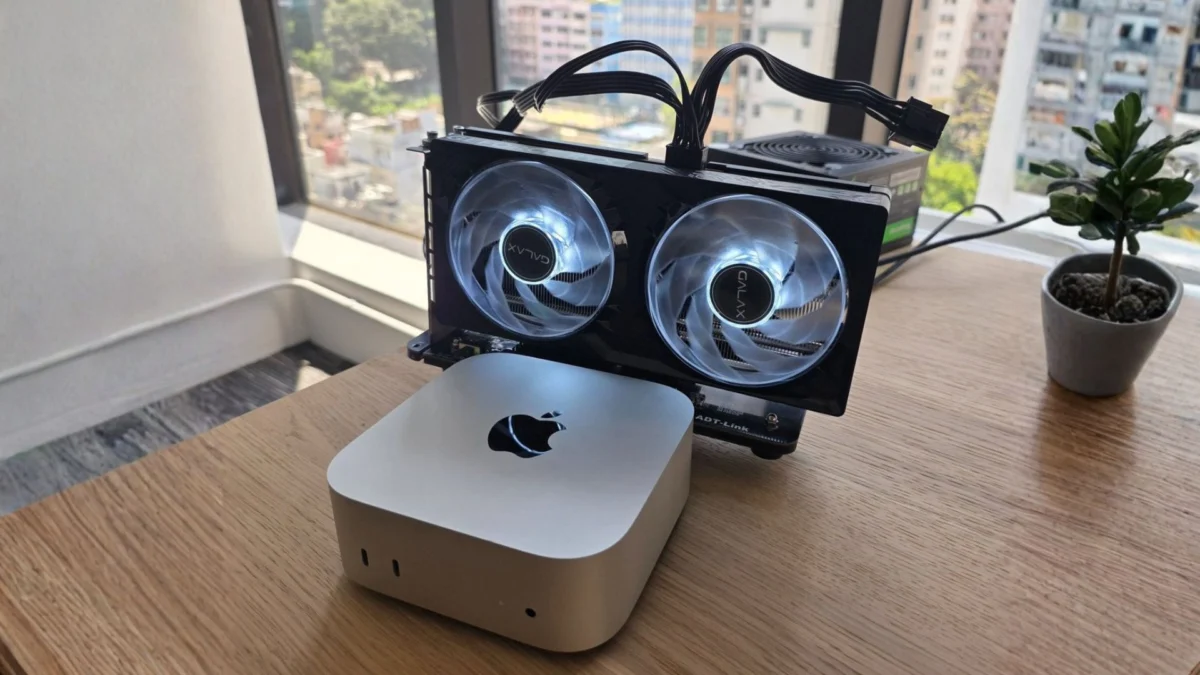
The landscape of compact computing has undergone a seismic shift with the recent release of Apple’s M4-series Mac Mini, a device that has rapidly ascended to become one of the most coveted pieces of hardware in the tech industry. This surge in demand, often referred to as "OpenClaw-fever," is driven by a growing community of developers and AI researchers seeking efficient, small-form-factor devices for agentic AI workloads. However, despite the impressive performance of Apple’s unified memory architecture, the platform has long been hamstrung by its lack of support for external graphics processing units (eGPUs), particularly those from NVIDIA. In a significant technical breakthrough, the AI startup TinyCorp has demonstrated a method to connect an NVIDIA GeForce RTX 5060 to an Apple Mac Mini, specifically optimized for compute-heavy tasks such as Large Language Model (LLM) inference.
This development marks a pivotal moment for the macOS ecosystem, which has been largely isolated from the NVIDIA "CUDA moat" since Apple transitioned from Intel processors to its proprietary Apple Silicon. By successfully interfacing a modern consumer NVIDIA GPU with a Mac Mini, TinyCorp is offering a glimpse into a future where the hardware limitations of the Mac platform can be bypassed through innovative software and hardware engineering.
The Technical Framework: Thunderbolt 4 and PCIe Bridging
The primary challenge in connecting an external NVIDIA GPU to a modern Mac Mini lies in both physical connectivity and software compatibility. Since the introduction of the M1 chip, Apple has removed native support for external GPUs in macOS, leaving the Thunderbolt ports primarily for storage, displays, and low-bandwidth peripherals. TinyCorp’s solution utilizes an ADT-Link adapter, a specialized piece of hardware designed to convert a Thunderbolt 4 connection into a standard PCIe bus.
Thunderbolt 4 provides a theoretical maximum bandwidth of 40 Gbps. In TinyCorp’s implementation, this translates to approximately 5 GB/s of bidirectional throughput. While this bandwidth is significantly lower than the internal PCIe 4.0 or 5.0 lanes found on high-end PC motherboards, it is remarkably sufficient for specific types of AI workloads. For LLM inference, where the primary bottleneck is often the speed at which data can be moved into the GPU’s VRAM rather than the real-time rendering of complex geometry, the 40 Gbps threshold represents a functional, albeit narrow, pipe for data processing.
However, the hardware connection is only half the battle. Because macOS does not include drivers for modern NVIDIA architectures—and NVIDIA does not provide them for the Mac—TinyCorp had to engineer a custom software solution. They developed dedicated Python-based userspace drivers that allow the operating system to interact with the GPU as a raw compute device. This bypasses the need for traditional kernel-level graphics drivers, treating the NVIDIA card not as a display output device, but as a massive parallel processor accessible via its memory-mapped PCIe interface.
A Strategic Shift: From Graphics to Compute-Only Workloads
It is essential to distinguish between a traditional eGPU setup and the TinyCorp implementation. In a standard Windows-based eGPU configuration, the external card handles both graphical rendering and compute tasks, often outputting video directly to a monitor. TinyCorp’s solution is strictly "compute-only." This means the NVIDIA GeForce RTX 5060, likely a variant from GALAX based on early visual identification, cannot be used to play video games on macOS or accelerate video editing in Final Cut Pro.
Instead, the GPU is utilized as an accelerator for AI models. This approach is tailored for the "edge AI" movement, where developers run models like Llama 3 or Mistral locally rather than relying on cloud-based APIs. By offloading the mathematical heavy lifting of neural networks to the NVIDIA card, the Mac Mini’s internal M4 or M4 Pro chip is freed up to handle general system tasks and data management. This hybrid approach combines the power efficiency and high-speed unified memory of Apple Silicon with the massive library of AI-optimized kernels available for NVIDIA hardware.
Background and Chronology: The Evolution of the Mac Mini as an AI Hub
The trajectory of the Mac Mini has changed dramatically over the last three years. Once considered a "budget" entry point into the Mac ecosystem, the introduction of Apple Silicon transformed it into a power-efficient workstation.
- November 2020: Apple launches the M1 Mac Mini, showcasing high performance-per-watt but lacking eGPU support.
- Early 2023: The M2 and M2 Pro Mac Mini models arrive, further cementing the device’s reputation for local development.
- Late 2023 – Early 2024: The rise of "OpenClaw" and other open-source AI frameworks creates a demand for local inference machines. Developers begin flocking to the Mac Mini due to its large unified memory pools (up to 64GB or more on Pro models).
- Mid-2024: TinyCorp, led by industry figures interested in democratizing AI hardware, begins experimenting with ways to break the Apple-NVIDIA barrier.
- Current Status: TinyCorp successfully mounts the RTX 5060, proving that modern NVIDIA hardware can communicate with macOS for compute tasks through userspace drivers.
This chronology highlights a growing friction between Apple’s "walled garden" hardware philosophy and the needs of the global AI research community, which is heavily reliant on NVIDIA’s software ecosystem.

Supporting Data: Comparing Performance and Bandwidth
To understand the impact of this achievement, one must look at the data surrounding data transfer and GPU utilization. The 40 Gbps limit of Thunderbolt 4 is the most significant constraint. In a typical desktop environment, an RTX 5060 would operate on a PCIe 4.0 x8 or x16 interface, offering between 16 GB/s and 32 GB/s of bandwidth. The 5 GB/s provided by the TinyCorp setup is roughly 15-30% of the card’s native potential for data movement.
However, in the context of LLM inference, once the model weights are loaded into the GPU’s VRAM, the primary performance metric is the GPU’s internal memory bandwidth and its CUDA core efficiency. For many AI researchers, the tradeoff—slower loading times for the model in exchange for the ability to run NVIDIA-optimized code on a Mac—is a price worth paying.
Furthermore, the choice of the RTX 5060 is strategic. As a mid-range consumer card, it offers a high balance of CUDA cores to power consumption, making it an ideal candidate for an external chassis that may have power delivery limitations.
Official Responses and Future Roadmap
TinyCorp has been transparent about the current state of their project, noting that while the proof of concept is successful, it is not yet a consumer-ready "plug-and-play" product. The startup has indicated that they are currently refining the software to ensure stability across different versions of macOS and various NVIDIA architectures.
A significant part of their future strategy involves the release of a dedicated eGPU board, slated for shipment in Q2. This board is expected to feature:
- Advanced Power Management: Built-in hardware controls to scale power delivery based on the GPU’s load, allowing for energy savings during idle periods.
- Hardware Reset Mechanisms: A critical feature for experimental setups, this will allow users to reset the GPU if it "weirdly hangs" during a complex compute job without needing to restart the entire Mac Mini.
- Expanded Compatibility: While the focus is currently on NVIDIA for its AI dominance, TinyCorp has expressed interest in providing similar userspace driver support for AMD GPUs, which could open up even more options for Mac users.
Industry analysts suggest that if TinyCorp can successfully productize this board, it could see massive adoption among academic researchers and small AI startups who prefer the macOS user experience but require NVIDIA hardware for their codebases.
Analysis of Broader Implications: Breaking the "CUDA Moat"
The implications of this development extend far beyond a simple hardware hack. For years, the "CUDA moat"—the fact that most AI software is written specifically for NVIDIA’s proprietary CUDA platform—has forced developers to choose between the Apple ecosystem and the AI development ecosystem. Those who wanted to work in AI were largely forced onto Windows or Linux workstations.
TinyCorp’s solution effectively builds a bridge over that moat. By allowing a Mac Mini to serve as the host for NVIDIA compute workloads, it enables a "best of both worlds" scenario. A developer can use the Mac Mini for its superior UI, battery efficiency (if using a laptop), and software development environment, while still having access to a local NVIDIA GPU for training and inference.
Moreover, this project challenges Apple’s current hardware trajectory. If third-party companies can successfully bring NVIDIA support back to the Mac through the userspace, it may pressure Apple to reconsider its stance on external PCIe support or, at the very least, improve its own Metal-based AI performance to compete more aggressively with NVIDIA’s dominance.
Conclusion: A New Era for the Mac Mini
The Apple Mac Mini has evolved from a simple desktop computer into a potential cornerstone of the decentralized AI movement. TinyCorp’s achievement in mounting an RTX 5060 to the device is more than a technical curiosity; it is a functional response to the limitations of current hardware ecosystems. As we move toward Q2 and the anticipated release of TinyCorp’s dedicated eGPU hardware, the tech community will be watching closely. If this implementation proves stable and scalable, the Mac Mini could very well become the standard-issue workstation for the next generation of AI engineers, finally uniting the world’s most popular development platform with the world’s most powerful AI hardware.