Lina Irawan
The current state of enterprise AI is defined by a sharp contrast: an AI assistant can build a sophisticated React component with accessible markup in seconds, yet it frequently fails to comprehend a company’s internal authentication protocols or the historical reasons behind a specific architectural deprecation. Without access to the community-vetted, institutional wisdom that governs a specific business, AI assistants operate with a "dangerous confidence," often recommending patterns that are explicitly forbidden by internal security policies or suggesting endpoints that do not exist within a private API ecosystem.
The Architecture of Institutional Knowledge
The fundamental issue lies in the training data of Large Language Models (LLMs). These models are trained on billions of parameters derived from open-source repositories, public engineering blogs, and documentation. However, they have never been exposed to the private codebases, internal Slack discussions, or Architectural Decision Records (ADRs) that define a specific company’s technical landscape. This lack of visibility results in an "enterprise AI paradox" where the models know everything about the world at large but nearly nothing about the specific environment in which they are deployed.
Context, in this professional framework, is defined as the accumulated collective wisdom of an organization. It includes microservices architecture, internal coding standards, security requirements specific to a vertical—such as HIPAA in healthcare or PCI-DSS in finance—and the subtle nuances of legacy systems. For instance, an AI might suggest a "best practice" for a greenfield project that is entirely incompatible with a decade-old billing system that a company is still transitioning away from. The "why" behind technical decisions—the historical justification for choosing one library over another two years ago—is rarely captured in public data, yet it is essential for preventing the repetition of past mistakes.
Chronology of the Shift Toward Contextual AI
The evolution of AI integration within the enterprise has followed a distinct timeline over the last several years:
- Late 2022 – Mid 2023: The Era of Experimentation. Following the public release of ChatGPT, enterprises began "shadow AI" usage and limited pilots. Developers used generic interfaces to troubleshoot public libraries, but organizations quickly realized the risks of data leakage and the frequency of hallucinations regarding internal systems.
- Late 2023: The Rise of RAG. Retrieval-Augmented Generation (RAG) emerged as the primary technical solution. Instead of retraining models—which is prohibitively expensive and quickly becomes outdated—companies began building pipelines to "feed" relevant internal documents into the AI’s prompt window at the moment of inquiry.
- 2024 – Early 2025: Integration with Verified Repositories. Organizations recognized that RAG is only as good as the source material. This led to a surge in demand for structured internal knowledge bases. Stack Overflow for Teams (Stack Internal) reported a significant spike in API usage as companies sought to connect their AI assistants to human-verified Q&A data.
- Present: The Move Toward Autonomous Context. Large tech firms like Uber and IBM have moved beyond simple RAG to create "contextual assistants" that live within communication tools like Slack, proactively resolving tickets and answering technical queries by synthesizing internal documentation with real-time system status.
Data Analysis: The Value of Grounded Intelligence
Recent industry surveys and internal metrics from major tech providers suggest that the "trust gap" is the primary barrier to AI adoption among senior developers. According to Stack Overflow’s research, while AI tools are viewed as "promising," they are often treated like junior developers who require constant supervision.
Statistical evidence suggests that when AI is grounded in verified internal knowledge, the following improvements occur:
- Reduction in "Noise": Companies like Uber have reported that contextual AI assistants can resolve recurring support tickets automatically, allowing senior engineers to focus on high-order architectural work rather than repetitive troubleshooting.
- Accuracy Rates: Generic LLMs often have a hallucination rate that can exceed 15-20% on niche technical topics. When integrated with a verified internal knowledge base via RAG, this rate can drop significantly, as the model is forced to cite its sources.
- Efficiency Gains: Preliminary data indicates that contextual AI can save an average of 200 engineering hours per month in mid-to-large sized organizations by providing immediate answers to "how-to" questions regarding internal APIs.
Case Study: Uber’s "Genie" and the Slack Integration Model
A prominent example of contextual AI in practice is Uber’s "Genie," an internal AI assistant deployed within the company’s Slack channels. Genie represents a sophisticated application of the Stack Overflow-OpenAI partnership. When an Uber engineer asks a technical question, Genie does not rely solely on its pre-trained data. Instead, it queries the company’s internal Stack Overflow instance—a repository of thousands of questions and answers verified by Uber’s own subject matter experts.
The assistant monitors support channels and, when it identifies a question with a high-confidence match in the knowledge base, it provides an automated response. This system addresses two universal problems in large engineering organizations: information overload and the "lost knowledge" phenomenon, where solutions are buried in ephemeral chat threads. By providing consistent, verified answers with clear attribution, the system builds trust among the developer staff, who can see exactly where the information originated.
Official Responses and Strategic Partnerships
The industry’s move toward context-driven AI is further evidenced by strategic alliances between knowledge providers and model developers. Prashanth Chandrasekar, CEO of Stack Overflow, has noted that the company’s internal product became "very, very hot" as enterprises realized they needed a way to ground AI responses in verified truth.
The partnership between Stack Overflow and OpenAI is a direct response to this market demand. By combining OpenAI’s natural language capabilities with Stack Overflow’s human-curated content, the two entities are attempting to bridge the gap between "mostly right" and "production-ready." This collaboration allows for outputs that are conversational yet anchored in a repository of human expertise, providing a "best-of-both-worlds" scenario for enterprise users.
Overcoming Implementation Hurdles: The "Cold Start" and Maintenance
Despite the clear benefits, building a contextual AI layer is not without significant challenges. Experts identify three primary hurdles that organizations must clear to achieve success:
1. The Cold Start Problem
Organizations starting from scratch often struggle with a lack of documented knowledge. The recommended strategy is not to document everything at once, but to follow the "80/20 rule"—identifying the 20% of questions that account for 80% of internal inquiries. Mining existing Slack channels and support tickets is a common tactic for building the initial knowledge base.
2. The Maintenance Burden
Technical knowledge is perishable; APIs change and libraries are deprecated. Features like "Content Health" are now being integrated into internal platforms to prompt subject matter experts to review and update stale information. Assigning ownership of specific knowledge domains to the teams that manage the corresponding services ensures that documentation evolves alongside the code.
3. Cultural Resistance
The "cultural challenge" remains the most difficult to solve. Engineers are often incentivized to write code rather than documentation. Successful organizations are those that gamify knowledge sharing or include it as a key performance indicator (KPI) for career progression. When developers see that contributing to the knowledge base reduces their own "interruption load" from junior staff, adoption typically increases.
Security, Governance, and the Path Forward
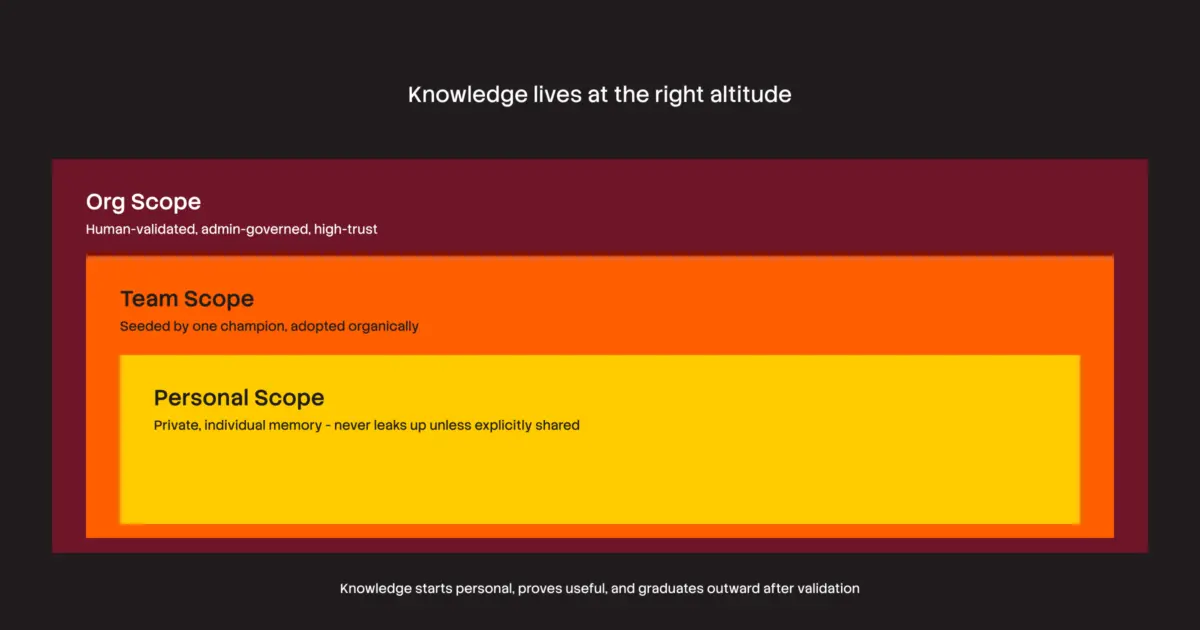
For highly regulated industries, the context problem is inextricably linked to security. Generic AI tools pose a risk of leaking proprietary logic to external models. A private, contextual AI layer allows organizations to enforce strict access controls. Sensitive information can be compartmentalized, ensuring that a junior developer’s AI assistant only has access to the documentation appropriate for their clearance level.
As enterprise AI matures, the focus is shifting from the "magic" of the demo to the "utility" of the production environment. The investment required to build a robust context layer—including technical infrastructure, organizational commitment, and continuous human oversight—is substantial. However, for organizations looking to scale responsibly, context is no longer an optional add-on; it is the fundamental requirement for transforming AI from a novelty into a core component of the modern enterprise tech stack.
In conclusion, the difference between AI that impresses in a boardroom and AI that drives value on the factory floor or in the data center is the depth of its institutional grounding. By solving the context problem, enterprises can finally close the "trust gap," reduce developer burnout, and move toward a future where AI acts as a truly informed partner in the engineering process.