Metty Iskandar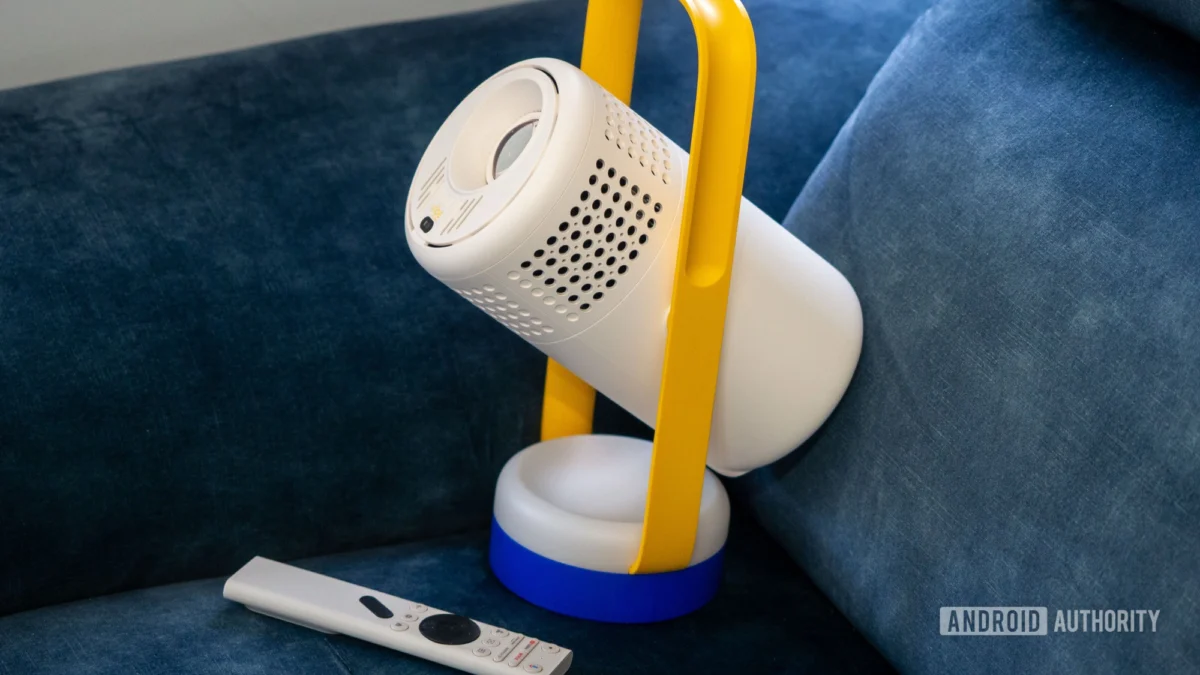
The XGIMI Vibe One, an affordable all-in-one Google TV projector, has emerged as a surprisingly capable alternative for consumers facing the often frustrating and costly realities of modern television ownership. This compact device, featuring built-in speakers, a battery, and a versatile stand, offers a compelling proposition for those seeking a flexible and accessible viewing experience. The recent surge in interest for such portable solutions has been amplified by a growing number of reports detailing issues with premium television sets, leaving consumers searching for reliable, albeit less conventional, entertainment options.
The impetus for this review stems from a personal experience with a high-end Samsung The Frame Pro television, purchased less than a year prior for a significant investment of $2,200. This premium display, intended to blend seamlessly into home decor, has been plagued by persistent technical glitches. Issues ranging from frequent and random Consumer Electronics Control (CEC) problems with connected devices, including a Google TV streamer and Samsung’s own soundbar, to arbitrary power-offs during critical viewing moments, have marred the ownership experience. The situation escalated dramatically a few weeks ago when the television completely failed. Upon powering on, it would operate for a mere five seconds before shutting down, rendering it unusable. The subsequent support experience with Samsung in France proved to be exceptionally slow, with a two-week delay in collecting the unit for repair, leaving the owner without a primary display for an extended period.
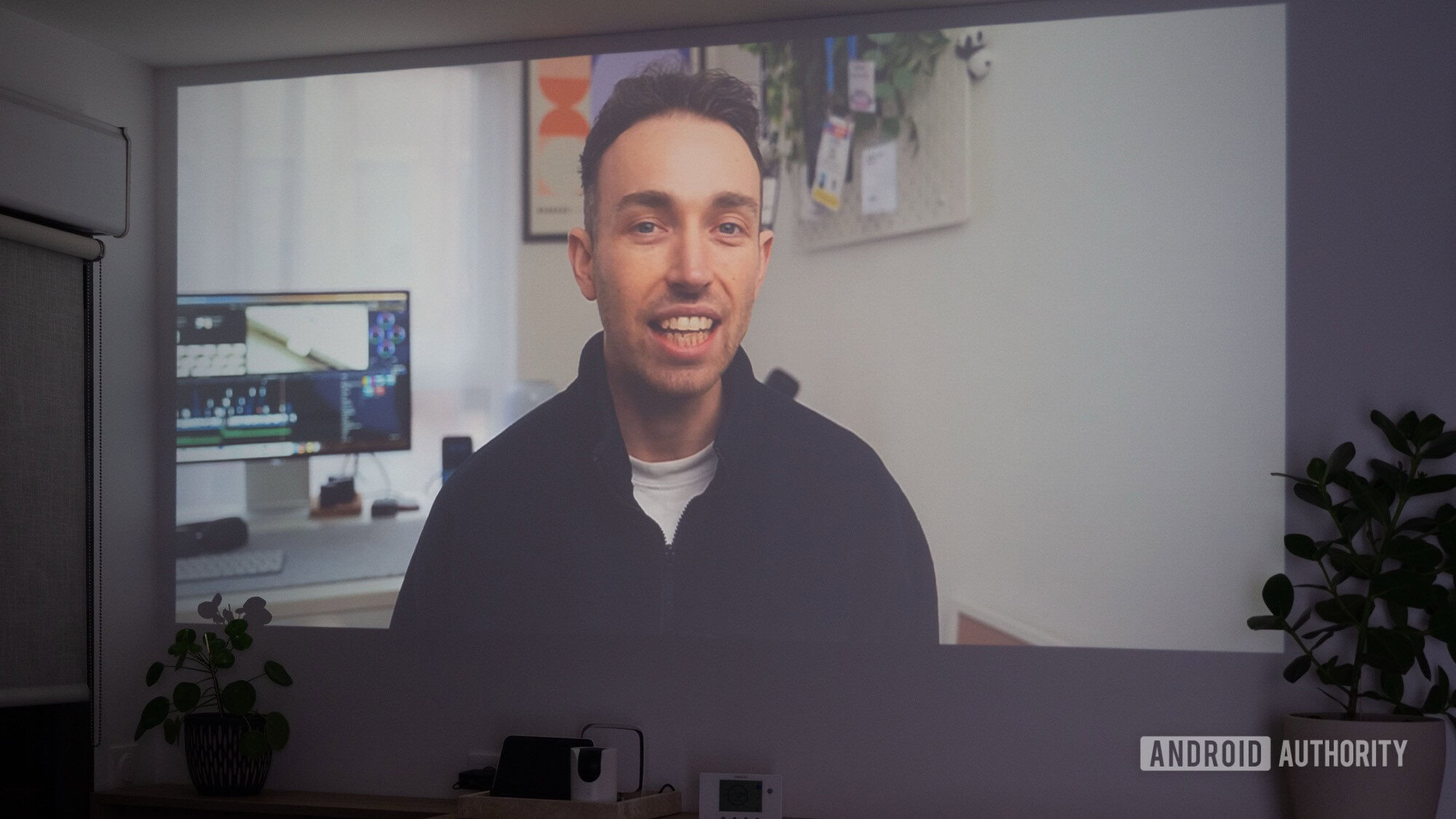
It was during this inconvenient blackout of home entertainment, precisely when a crucial UEFA Champions League second-leg tie between Real Madrid and Benfica was unfolding, that the XGIMI Vibe One projector was repurposed from a secondary bedroom device to a living room solution. The projector was swiftly set up, projecting an image onto the living room wall, just in time to witness a pivotal goal. This unexpected turn of events led to the projector being used as the primary television for several weeks, prompting a re-evaluation of its capabilities and value, particularly given its accessible price point of $250.
A $250 Google TV Experience, Anywhere, Anytime
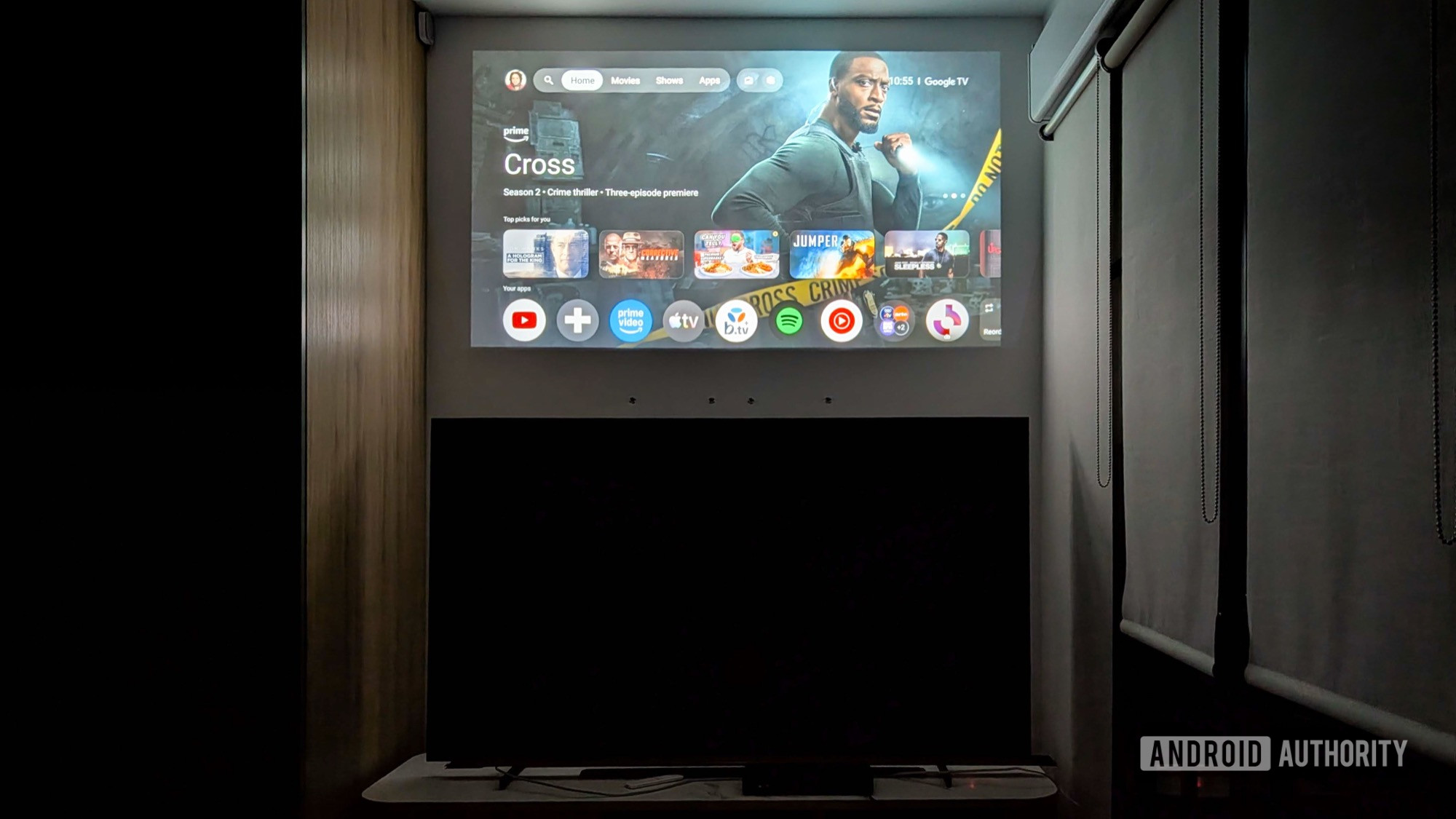
The XGIMI Vibe One presents itself as a portable Google TV, capable of delivering a viewing experience virtually anywhere. While acknowledging that its 1080p resolution and 250 ISO Lumens are not on par with the superior luminosity and contrast of a 4K Neo QLED TV, the projector performs admirably under specific conditions. To achieve optimal viewing, a completely darkened room, with all shutters and curtains closed, is recommended. In such an environment, the distinction between a projected image and a traditional TV screen can become remarkably blurred, allowing viewers to immerse themselves in the content.
However, in environments with ambient light, such as a room with daylight streaming through windows, the projected image appears significantly more washed out. Despite this limitation, the content remains watchable, and the projector effectively serves its purpose as a secondary, portable television solution. The dual 3W built-in JBL speakers, enhanced by Dolby Audio, provide a satisfactory audio experience for casual viewing, music videos, YouTube, sports matches, and television series. While not replicating the fidelity of a dedicated soundbar, the audio output is considered competent for the device’s price and form factor. This all-in-one functionality, coupled with its portability, allows for easy movement between rooms, transforming any wall into a screen of 65 inches or larger.
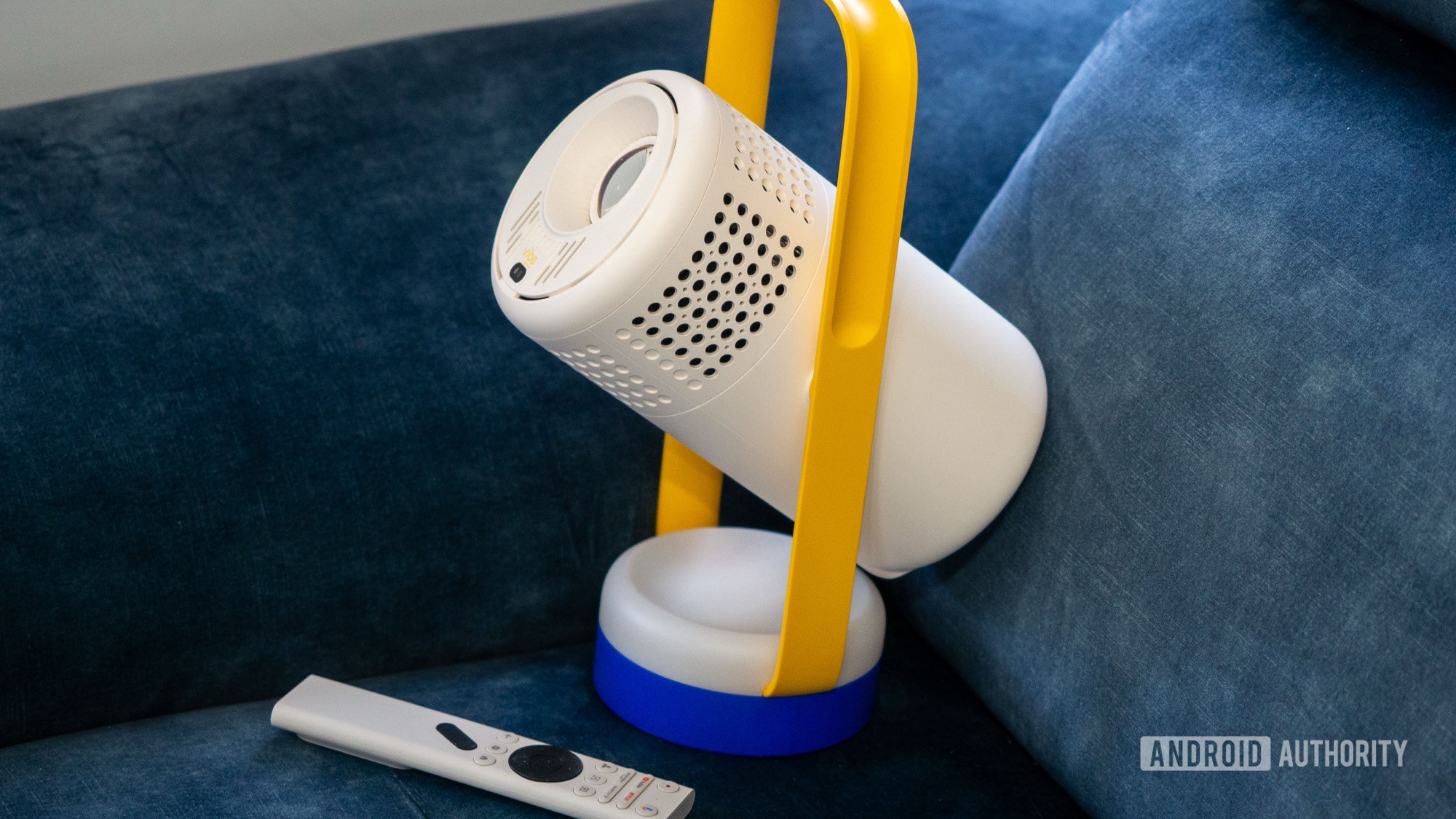
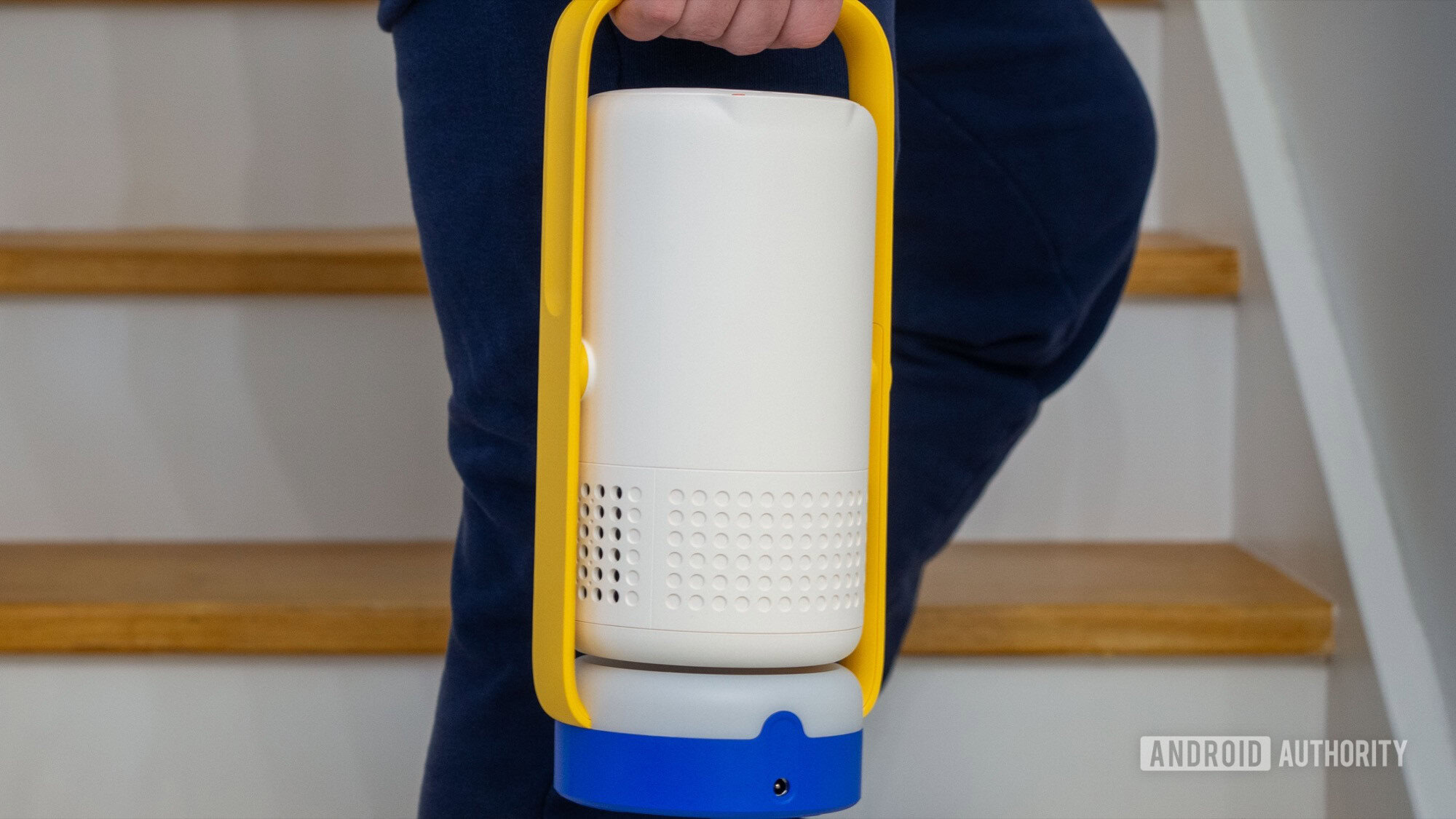
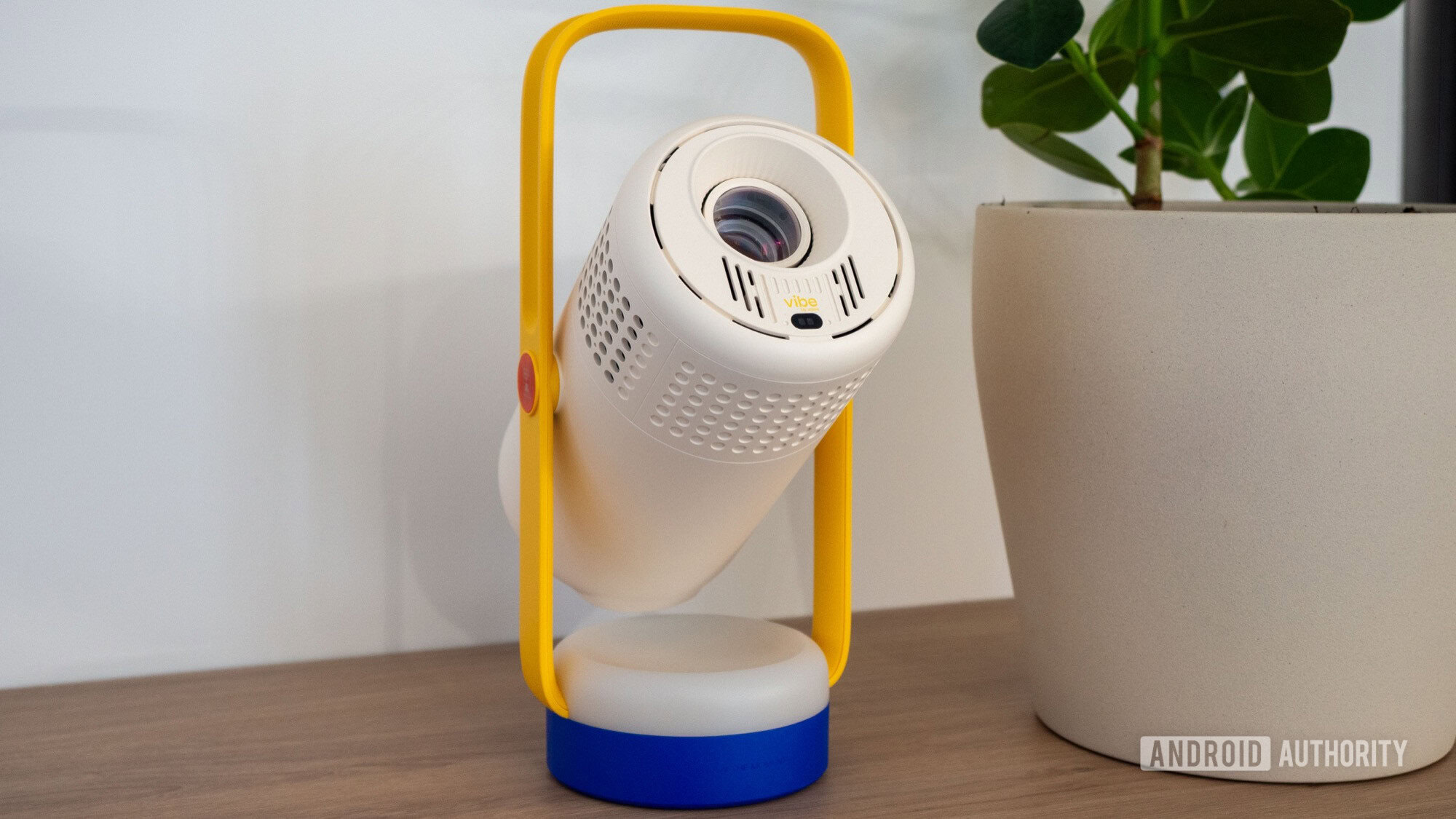
The practicality of the XGIMI Vibe One is further underscored by its integrated design. It features a built-in handle and a pivoting stand, eliminating the need for external tripods or mounting solutions often required by other projectors. This inherent portability means no additional equipment is necessary for basic setup. The device runs Google TV out of the box, requiring only a suitable white surface for projection. The projector’s ability to rotate 160 degrees around its vertical axis (80 degrees in either direction) provides considerable flexibility in positioning the image on various surfaces, including walls, slanted ceilings, and even angled walls, making it an ideal solution for rooms with unconventional architecture.
The built-in keystone correction feature proves effective in adapting the projection to skewed walls and varied angles, ensuring a relatively distortion-free image. The accompanying remote control includes an auto-focus button, which is useful for quickly achieving a sharp image, and manual settings are also available, including a ceiling projection mode that enhances usability in bedroom environments.
Design, Features, and Performance: A Closer Examination
The XGIMI Vibe One’s design is geared towards portability and user-friendliness. Its integrated handle and a stand that allows for a 160-degree pivot are key selling points, offering immediate adjustability without the need for additional accessories. This convenience is particularly valuable for users who anticipate frequent repositioning of the projector. The device runs on Google TV, providing access to a vast library of streaming applications and services. This integrated operating system simplifies the user experience, eliminating the need for external streaming devices in most cases.
The projector’s internal specifications include a 1.5GHz MT9630 processor and 2GB of RAM. While these specifications are adequate for smooth operation once the projector is running, the initial startup can be somewhat slow, with a lag of around 10 seconds before the interface becomes fully responsive. However, post-boot, performance is generally stable, with no significant hiccups or drops in performance observed during extended use. The device offers 32GB of internal storage, a generous amount for a projector in this price bracket, allowing users to install a substantial number of applications without storage concerns, a notable advantage over some lower-end Google TV devices that often feature less storage.
The user interface remains largely uncustomized Google TV, which is a positive aspect for users familiar with the platform on other devices like Google TV streamers. This consistency ensures a smooth transition and an intuitive user experience. XGIMI has, however, added projector-specific settings, including image and power management options, particularly for battery mode. The remote control is also a standout feature, offering a dedicated user profile button, which is highly beneficial for households with multiple users, allowing for seamless switching between individual accounts. Additionally, a quick settings button provides immediate access to essential adjustments without interrupting the viewing experience.
Connectivity and Power: Areas for Improvement
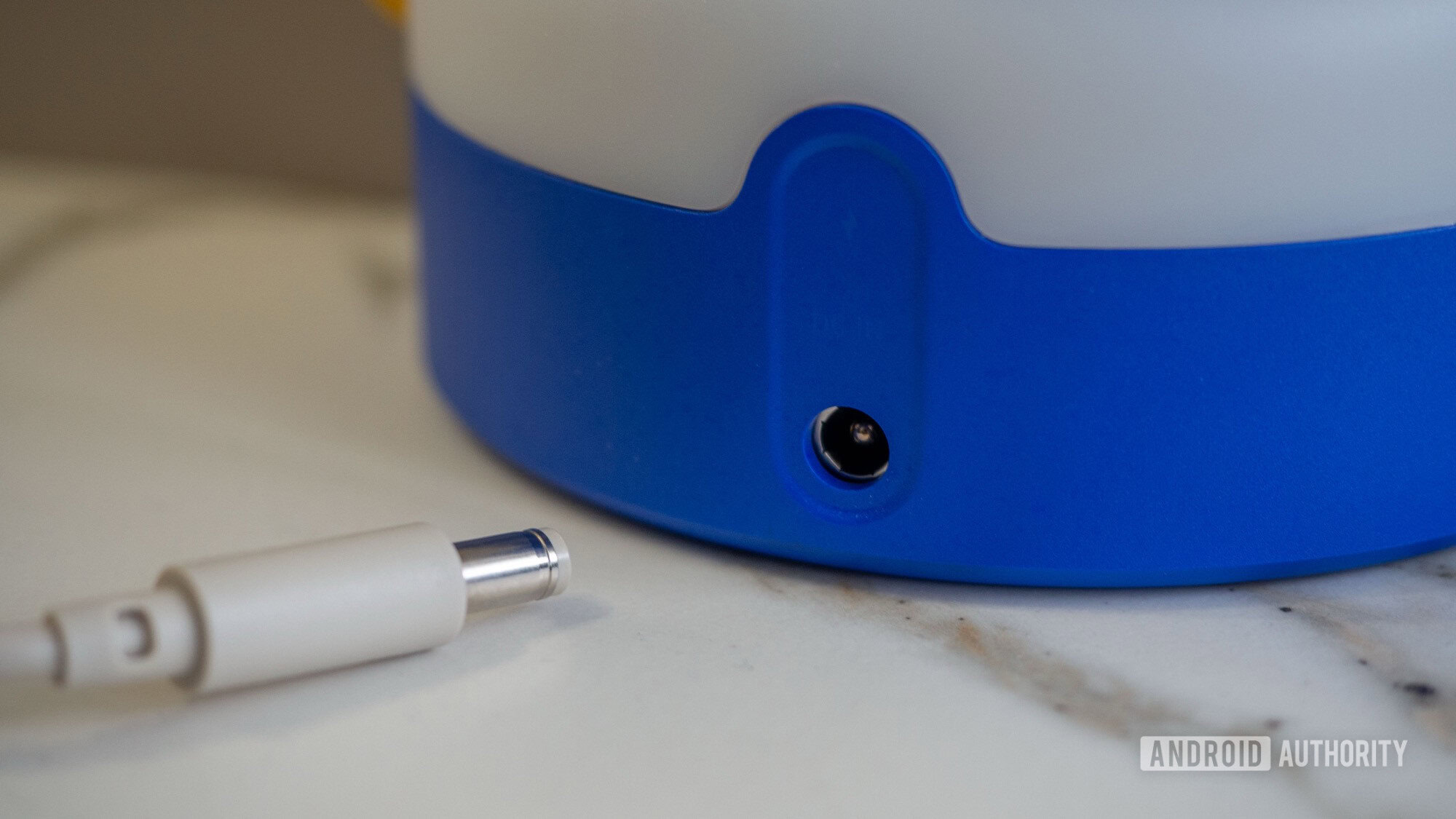
A significant point of contention for the XGIMI Vibe One is its reliance on a DC charging port rather than the increasingly ubiquitous USB-C standard. This choice is particularly perplexing given that XGIMI has adopted USB-C on its higher-end projectors. The inconvenience of needing a specific DC barrel charger, especially in an environment increasingly dominated by USB-C, is a notable drawback. While a workaround exists in the form of a $12 DC to USB-C cable that allows charging from USB-C power banks or wall adapters, it highlights a design choice that could have been more forward-thinking.
The battery life is another area where the Vibe One falls short of expectations. With a stated playback time of approximately 96 minutes on a good run, and this significantly reduced brightness, it is insufficient to complete a full-length movie or an entire football match without requiring a recharge. This limitation effectively negates the projector’s primary advantage as a battery-powered device for extended viewing sessions, necessitating it to be plugged in for most practical uses.
XGIMI’s justification for this design choice appears to be its positioning of the Vibe One as a more casual, youth-oriented device. The projector features a translucent base that emits colored light when in Bluetooth speaker mode, creating a light show synchronized with music. While this feature adds a degree of novelty, it feels like a gimmick that detracts from more practical considerations, such as battery capacity. A larger battery would undoubtedly offer greater utility than the light show, enhancing the device’s core functionality.
Market Context and Alternatives
The XGIMI Vibe One occupies a competitive segment of the portable projector market, where price-performance is a critical factor. For consumers seeking an affordable entry into portable projection with smart TV capabilities, the Vibe One presents a compelling, albeit imperfect, option. However, a broader analysis of the market reveals several alternatives that cater to different priorities and budgets.
For those prioritizing a smart TV interface over battery power, the TCL C1, a Google TV projector priced at $225, offers a similar feature set but omits the built-in battery. The marginal cost savings may not justify the loss of portability for many users.
A more robust alternative in terms of projection quality and features is the Aurzen BOOM Air, priced at $299.99. This projector boasts a brighter 300 ANSI projection, a 110-degree rotatable stand, a more powerful 10W speaker, and crucially, USB-C power delivery. While it lacks a built-in battery, its improved visual and audio performance, coupled with modern charging capabilities, makes it a strong contender, especially when available at discounted prices like $210.
For users who require longer battery life and USB-C charging, the JMGO Play, priced at $349, emerges as a noteworthy option. It offers a three-hour battery life, a 400 ISO Lumens projection, and an adjustable 88-degree gimbal. It also includes a Bluetooth speaker mode with a light show, mirroring one of the Vibe One’s more whimsical features.
Several other Google TV-powered projectors, including the Aurzen BOOM Mini, XGIMI MoGo 3 Pro, and Nebula Capsule 3 GTV, often see price drops to the $300-$320 range, making them realistic alternatives to the Vibe One. However, at their original MSRPs of around $400, they exceed the budget of consumers typically looking for more economical projection solutions.
For users who do not require Google TV, the Aurzen EAZZE D1R, a Roku TV projector priced at $199.99, offers a more budget-friendly smart TV experience. However, it necessitates the purchase of a separate stand for optimal positioning. Projectors running on Linux-based operating systems, such as the Dangbei N2 Mini and Yaber T2, are generally advised against due to potential limitations in app availability and long-term software support.
Conclusion: A Practical, If Flawed, Portable Entertainment Hub
The XGIMI Vibe One projector stands out as a practical and affordable solution for consumers seeking a portable, versatile entertainment hub. Its integrated Google TV platform, built-in battery, speakers, and adaptable stand make it an appealing choice for various use cases, from secondary viewing in bedrooms to temporary replacements for malfunctioning primary televisions. The projector’s ability to project large images on almost any surface, coupled with effective keystone correction, enhances its adaptability to different environments.
Despite its commendable portability and smart features, the Vibe One is not without its shortcomings. The reliance on a DC charging port instead of USB-C and the relatively short battery life are significant drawbacks that detract from its overall convenience. The initial lag in performance and the mid-range brightness of the projection are also factors to consider.
However, when weighed against its $250 price point and the critical role it played in providing entertainment during a period of technical adversity, the XGIMI Vibe One earns a qualified recommendation. It represents a viable entry point into the world of portable projectors, offering a host of features that deliver considerable value for money. For those who can overlook its power and charging limitations, the Vibe One provides a flexible and accessible gateway to a larger-than-life viewing experience, proving that sometimes, the most practical solutions come in the most unexpected packages.