Sisilia Frederika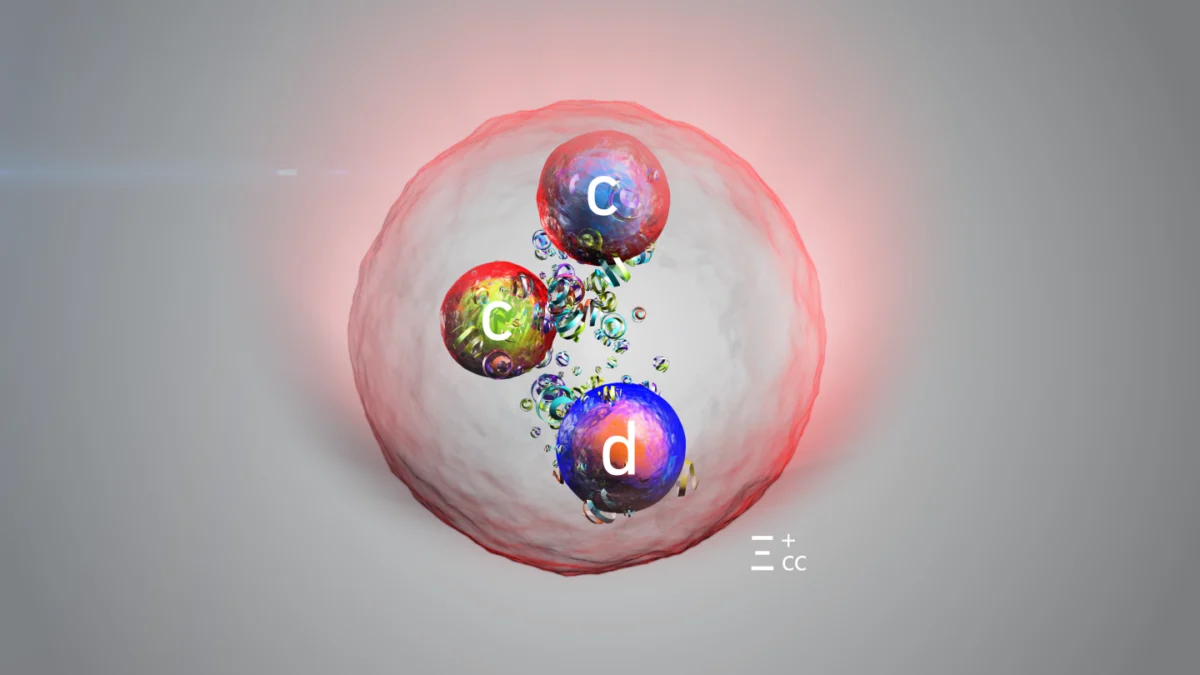
The scientific community at the European Organization for Nuclear Research, known globally as CERN, has announced a landmark achievement in particle physics with the detection of a new subatomic particle at the Large Hadron Collider (LHC). Identified as the $Xi_cc^+$ (Xi-cc-plus), this doubly charmed baryon represents a significant leap in our understanding of the strong nuclear force, the fundamental interaction that holds matter together at its most basic level. The discovery, made by the LHCb (Large Hadron Collider beauty) collaboration, marks the first new particle identified following a comprehensive multi-year upgrade to the experiment’s detection systems, signaling a high-performance era for the world’s most powerful particle accelerator.
The $Xicc^+$ is a member of the baryon family—the same class of particles that includes protons and neutrons. However, while a standard proton is composed of two "up" quarks and one "down" quark, the $Xicc^+$ is far more exotic and massive. It contains two "charm" quarks and one "down" quark. Because charm quarks are significantly heavier than the up and down quarks that make up everyday matter, the $Xi_cc^+$ is approximately four times as heavy as a proton. This discovery provides physicists with a unique "laboratory" in which to study the complex dynamics of the strong force, particularly in systems where heavy quarks dominate the internal structure.
The Anatomy of a Heavyweight Particle
To understand the significance of the $Xi_cc^+$, one must look at the standard model of particle physics, which describes the fundamental building blocks of the universe. Quarks come in six "flavors": up, down, charm, strange, top, and bottom. Most matter in the visible universe is composed of the lightest flavors, up and down. Charm quarks are much more elusive, typically only appearing in high-energy environments like those created within the LHC’s 27-kilometer ring of superconducting magnets.
The $Xi_cc^+$ is classified as a "doubly charmed" baryon because it contains two of these heavy charm quarks. In a standard proton, the three light quarks dance around one another in a complex, symmetric fashion. However, in a doubly charmed baryon, the two heavy charm quarks are expected to behave like a binary star system, with the third, lighter quark (the down quark) orbiting this heavy core. This configuration allows scientists to test the predictions of Quantum Chromodynamics (QCD), the theory that describes the strong interaction.
Despite its mass, the $Xi_cc^+$ is incredibly short-lived. It exists for only a fraction of a second—vanishing in less than the time it takes for light to cross a human hair—before decaying into lighter, more stable particles. Detecting such a fleeting entity requires not only immense collision energy but also the extreme precision of the LHCb’s newly upgraded sensors.
A Two-Decade Mystery Resolved
The confirmation of the $Xicc^+$ resolves a long-standing discrepancy in the field of high-energy physics that dates back more than twenty years. In 2002, researchers at the SELEX experiment, conducted at the Fermilab facility in Illinois, reported seeing hints of a particle that appeared to be the $Xicc^+$. However, the Fermilab observations presented a significant problem: the particle they detected was much lighter than theoretical models predicted. Furthermore, the statistical significance of the SELEX data did not reach the "5-sigma" threshold, the gold standard required to claim a formal discovery in particle physics.
For two decades, the "SELEX mystery" remained a point of contention and curiosity. The scientific community was divided on whether the 2002 signal was a genuine discovery or a statistical fluke. The new data from CERN provides a definitive answer. The LHCb team’s discovery of the $Xicc^+$ shows a mass that aligns perfectly with modern theoretical expectations and sits in a similar mass range to its sibling particle, the $Xicc^++$ (Xi-cc-plus-plus), which was discovered by the same team in 2017.
Crucially, the LHCb’s observation has reached a confidence level of 7-sigma. In the world of physics, a 5-sigma result indicates a one-in-3.5 million chance that the signal is a fluke. A 7-sigma result is even more robust, effectively confirming the particle’s existence beyond any reasonable doubt. The mass measured by the LHCb is significantly different from the 2002 SELEX report, suggesting that the earlier hints may have been misinterpreted or were the result of different physical phenomena.
Technological Evolution: The LHCb Upgrade
The discovery of the $Xi_cc^+$ is the first major fruit of the "Upgrade I" phase of the LHCb detector. The LHCb is one of four massive detectors situated along the Large Hadron Collider, specifically designed to study particles containing charm and beauty (bottom) quarks. Between 2019 and 2023, the detector underwent a massive overhaul to increase its data-collection rate and sensitivity.
Key to this upgrade was the installation of the Upstream Tracker and a new "trigger-less" readout system. Previously, the detector’s electronics could only select a small fraction of collision events to save for analysis, potentially discarding rare events. The new system allows the experiment to process every single collision in real-time using advanced software algorithms.
Vincenzo Vagnoni, the spokesperson for the LHCb collaboration, emphasized the importance of this technological leap. "This is the first new particle identified after the upgrades to the LHCb detector that were completed in 2023," Vagnoni stated. He noted that the $Xicc^+$ is particularly difficult to observe because its predicted lifetime is up to six times shorter than that of the $Xicc^++$. The ability to catch such a brief signal is a testament to the increased precision of the detector’s vertexing and tracking systems.
Implications for Quantum Chromodynamics
The primary value of the $Xi_cc^+$ discovery lies in its role as a stress test for Quantum Chromodynamics (QCD). While the strong force is well-understood in simple systems, calculating the interactions within a baryon containing two heavy quarks is mathematically grueling. Theorists use "Lattice QCD"—a method of simulating these interactions on high-performance supercomputers—to predict particle properties.
The $Xicc^+$ provides a concrete data point that theorists can use to calibrate their models. By comparing the measured mass and decay patterns of the $Xicc^+$ to their simulations, scientists can determine if their understanding of the strong force is accurate or if there are "cracks" in the current theory.
Vagnoni explained that these results will help theorists test models of the strong force that binds quarks not only into conventional baryons and mesons but also into more exotic configurations. "The result will help theorists test models of quantum chromodynamics, the theory of the strong force that binds quarks into not only conventional baryons and mesons but also more exotic hadrons such as tetraquarks and pentaquarks," he said.
The Growing Bestiary of Hadrons
With the addition of the $Xi_cc^+$, the total number of new hadrons discovered by experiments at the Large Hadron Collider has reached 80. This "bestiary" of particles includes various mesons (made of one quark and one antiquark) and baryons (made of three quarks), as well as exotic four-quark and five-quark states.
While the Higgs boson, discovered at CERN in 2012, remains the most famous discovery of the LHC era, the ongoing identification of new hadrons is equally vital. The Higgs boson explains how particles acquire mass, but the study of hadrons like the $Xi_cc^+$ explains how that mass is organized into the matter that forms stars, planets, and people.
The discovery also highlights the collaborative nature of modern science. The LHCb collaboration consists of more than 1,000 scientists from dozens of countries, all working together to analyze petabytes of data generated by the collider. This collective effort is what allows for the identification of a single particle type hidden among trillions of proton-proton collisions.
Looking Ahead: The High-Luminosity LHC
The discovery of the $Xi_cc^+$ is likely only the beginning of a new chapter in particle discovery. The Large Hadron Collider is currently operating in its third major run, but plans are already well underway for the next phase of the facility’s life: the High-Luminosity Large Hadron Collider (HL-LHC).
Scheduled to begin operations around 2030, the HL-LHC project aims to increase the "luminosity"—a measure of the number of potential collisions—by a factor of ten compared to the original design. This will allow physicists to study even rarer processes and perhaps discover particles that are currently beyond our reach.
Jorgen D’Hondt, director of the Dutch National Institute for Subatomic Physics, noted that every new discovery provides better tools for exploring the unknown. "We are looking for where the cracks are in our theory," D’Hondt told VRT NWS. "We are beginning to understand our collisions better, our method of simulation, and in doing so, we are getting better tools to explore uncharted territory."
The exploration of "uncharted territory" includes the search for Dark Matter, the investigation of why the universe is made of matter rather than antimatter, and the search for extra dimensions. While the $Xi_cc^+$ is a particle predicted by the Standard Model, its precise measurement is a necessary step toward finding "New Physics"—phenomena that cannot be explained by our current theories.
Conclusion
The detection of the $Xicc^+$ doubly charmed baryon is a triumph of both theoretical prediction and experimental engineering. By resolving a 20-year-old mystery and providing a rigorous test for the theory of the strong nuclear force, the LHCb team has reinforced the Large Hadron Collider’s status as the frontier of human knowledge. As CERN continues to push the boundaries of energy and intensity, the "charmed" discoveries made today will serve as the foundation for the revolutionary physics of tomorrow. The $Xicc^+$ may flash in and out of existence in an instant, but its impact on the field of physics will be felt for decades to come.