Vera Intan Clara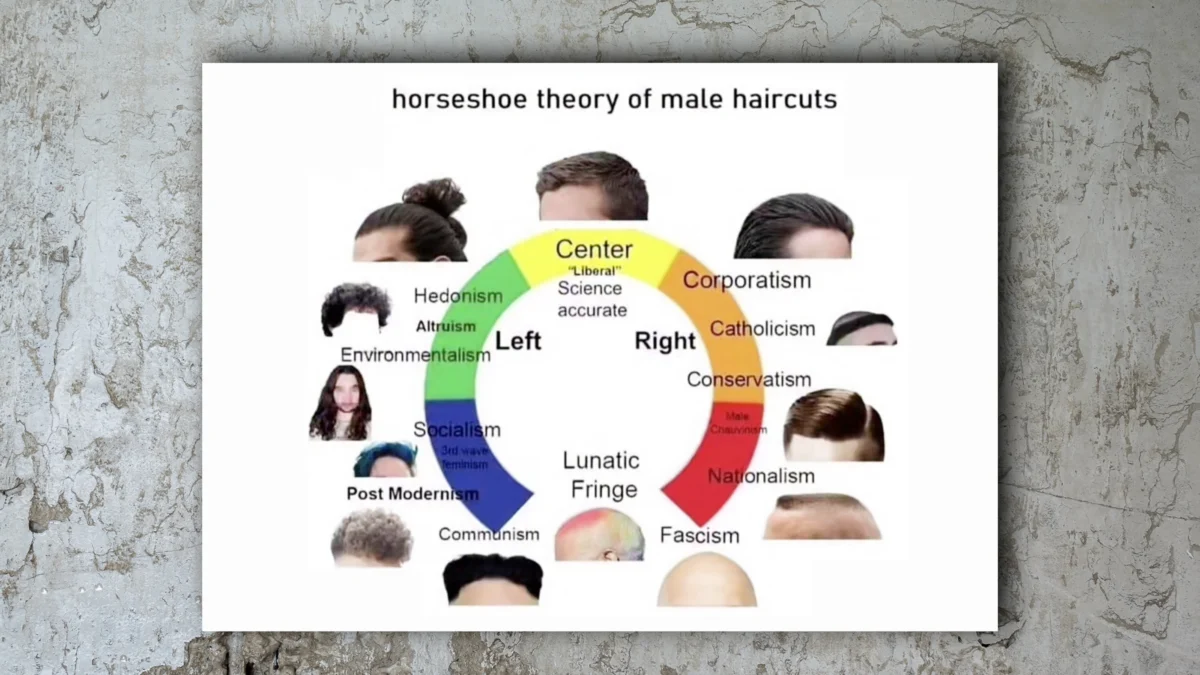
A new digital chart, rapidly gaining traction across TikTok, purports to assign male haircuts to specific points on the political spectrum, from the far-right ideologies of fascism to the far-left tenets of communism. This unconventional "horseshoe theory of male haircuts," as dubbed by its creator, has triggered a wave of reactions, particularly from bald men who find themselves unexpectedly positioned at the extreme right end of the political compass. The video, which went viral last weekend, has become a focal point for discussion on social media, prompting questions about the accuracy, intent, and implications of categorizing personal appearance with political affiliation.
The Genesis of the "Horseshoe Theory of Male Haircuts"
The viral content originated from the TikTok account @trustdcritics, which on a recent Sunday, posted a video featuring a graphic chart. The creator boldly claimed the chart to be "75 percent accurate," proposing a visual representation of how various male hairstyles correspond to political leanings. The underlying framework for this chart is the "horseshoe theory," a concept in political science suggesting that the extreme left and extreme right, rather than being at opposite ends of a linear spectrum, actually resemble each other in certain ways, much like the two ends of a horseshoe. This theory often posits that radical elements from both extremes share authoritarian tendencies or a disdain for mainstream liberal democracy.
In applying this complex political theory to something as seemingly innocuous as men’s haircuts, @trustdcritics positioned "liberal" or centrist styles in the middle, with the political spectrum curving outwards towards the radical left and right. The creator invited viewers to identify their own place on the chart, encouraging further engagement by offering to categorize any missing haircuts in the comments section. This interactive element, combined with the provocative nature of the claims, undoubtedly contributed to its rapid dissemination across the platform.
Mapping the Political Hairscape: A Stylistic Spectrum
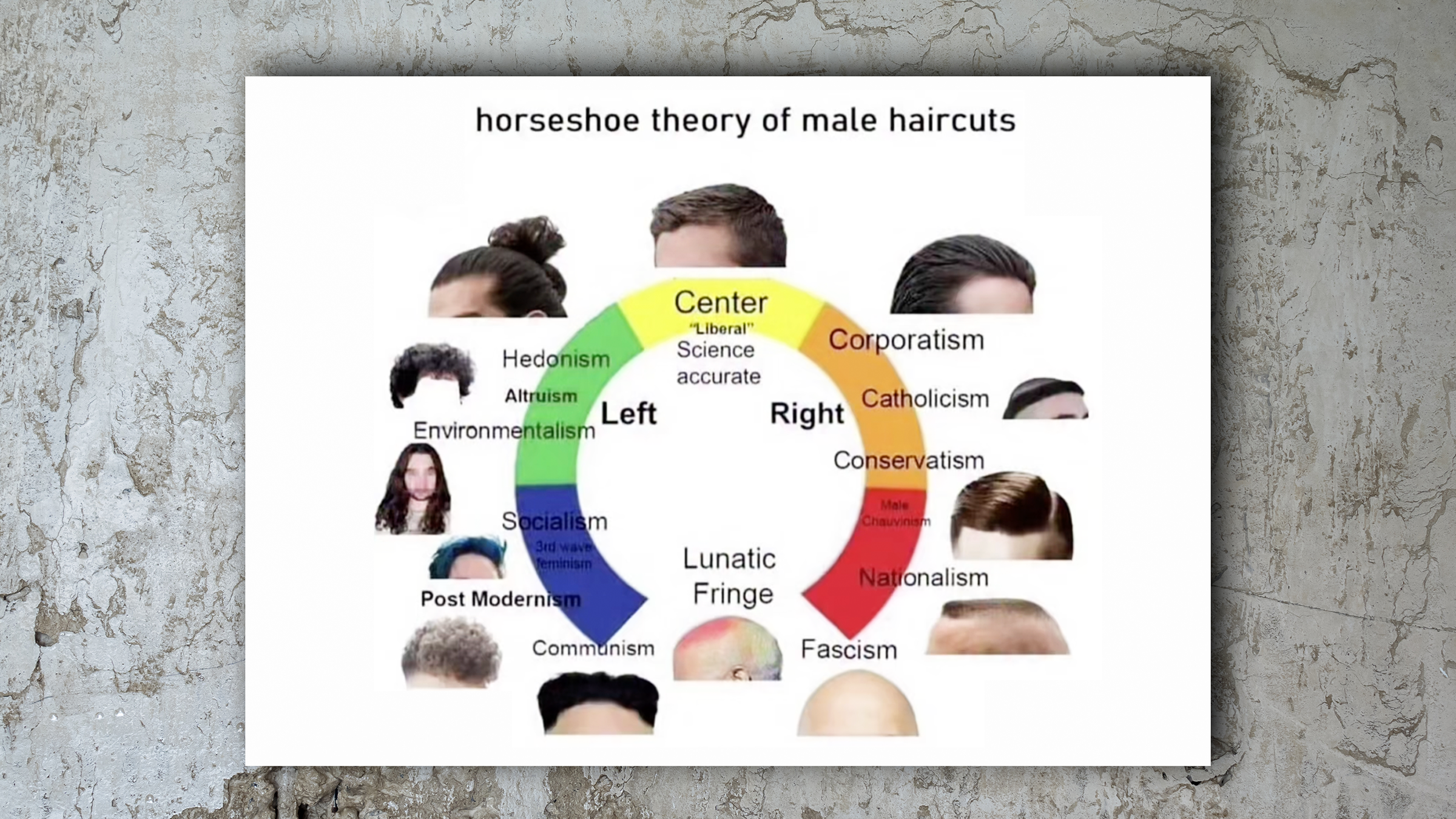
According to the chart’s visual breakdown, the "liberal" or centrist section features what many (particularly white, American) men might consider a conventional, unstyled, short haircut—a representation of mainstream acceptability. As the chart moves towards the left, hairstyles transition into longer hair, contemporary "man buns," and even distinctly colored hair, such as blue dye, suggesting a progressive or counter-cultural aesthetic. At the very extreme left, symbolizing communism, the chart surprisingly places the "Mao Zedong look," a historical reference that contemporary political adherents are unlikely to emulate. This particular assignment immediately raised eyebrows, highlighting the creator’s potentially anachronistic or satirical intent.
Conversely, moving from the center towards the right, the chart illustrates a progression from slicked-back styles, associated with "corporate capitalists," to more severe cuts like buzz cuts and the "Hitler Youth" style. The latter, with its stark historical connotations, clearly aims to link specific aesthetics with far-right extremist movements. The chart culminates at the extreme right, where fascism resides, depicted by the complete absence of hair—baldness. This dramatic and unsubtle placement became the primary flashpoint of contention. The creator’s additional, seemingly facetious remark, "Maybe hair is woke," further underscored the satirical, yet potentially inflammatory, nature of the entire exercise.
The Firestorm of Reaction: Baldness and Beyond
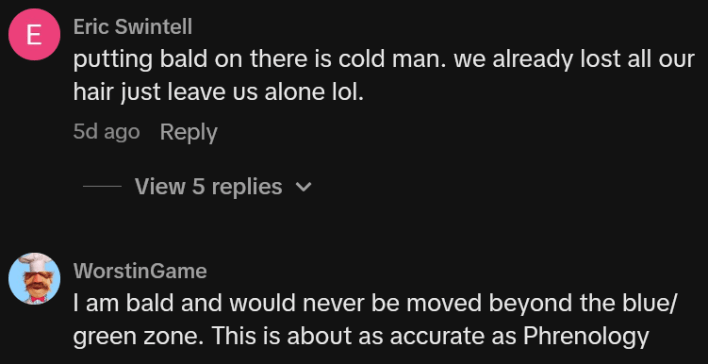
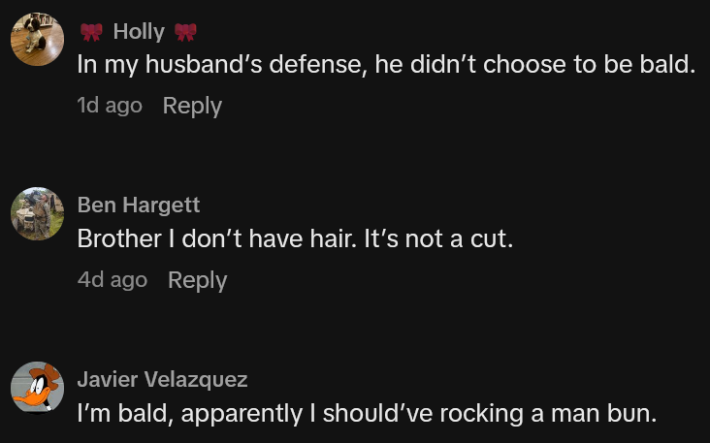
Predictably, a chart making such sweeping and often unflattering generalizations was met with a torrent of strong opinions. The most vociferous backlash came from the sizable demographic of bald men, many of whom expressed outrage at being arbitrarily assigned to the fascist end of the political spectrum. Their arguments were consistent and clear: baldness is often a natural biological process, not a deliberate stylistic choice, and certainly not an indicator of political ideology.
Comments poured in, articulating this indignation. One TikTok user, @worstingame, retorted, "I am bald and would never be moved beyond the blue/green zone. This is about as accurate as Phrenology." This comparison to phrenology, a discredited 19th-century pseudoscience that attempted to link skull shape to character and mental faculties, served as a powerful indictment of the chart’s scientific validity. Another user, @kylepilling7, sarcastically griped, "Acting like I woke up one day and chose baldness," highlighting the involuntary nature of hair loss for many. @benhargett echoed this sentiment, stating simply, "Brother, I don’t have hair. It’s not a cut." The collective sentiment was that equating a physical characteristic beyond one’s control with an extreme political ideology was not only inaccurate but also deeply unfair and potentially offensive.
Beyond baldness, many other commenters expressed disagreement with their assigned political values based on their haircuts, finding the chart’s declarations unreflective of their actual beliefs. This widespread dissonance further undermined the creator’s "75 percent accurate" claim, suggesting a significant disconnect between the chart’s premise and lived realities.
Underlying Assumptions and Creator’s Bias
A closer examination of the chart reveals several elements that suggest the creator’s own political leanings and a less-than-serious analytical approach. The inclusion of a "12th-century monk cut" on the left, humorously noted as "not actually part of the Catholic Church dress code," hints at a playful, almost absurd, attempt at historical referencing. The chart also places "hedonism" near the progressive area, a label that some critics quickly pointed out as misdirected, arguing that hedonism is more typically associated with the ultra-wealthy, citing figures from the Epstein files as a counter-example. These subtle inclusions, along with the strategic placement of "accurate" at the center and "lunatic fringe" in the gap between the extremes, paint a picture of a creator engaging in satirical commentary, albeit one cloaked in a veneer of pseudo-scientific accuracy.
The very premise of the "horseshoe theory of male haircuts" appears to be a satirical deconstruction of identity politics and the tendency to categorize individuals based on superficial traits. However, even satire can carry unintended consequences, especially when presented with a claim of accuracy. The chart’s inherent biases, reflecting a particular socio-cultural lens, became a significant talking point.
The Broader Critique: Representational Gaps
A fatal flaw in the chart’s universality, as pointed out by several discerning commenters, was its glaring lack of demographic inclusivity. The hairstyles depicted overwhelmingly cater to a specific, predominantly white, Western male aesthetic. This oversight was succinctly highlighted by a user named @shrek.disciple, who simply commented, "I’m black." This single statement underscored the chart’s failure to account for the rich diversity of male hairstyles across different ethnicities and cultures, rendering its claims of broad applicability moot.
Hair, particularly for men of color, carries profound cultural, historical, and personal significance that goes far beyond a mere aesthetic choice or a reflection of political leanings. Styles like fades, braids, locs, and afros are integral to identity, heritage, and self-expression for countless individuals. By omitting these, the chart not only demonstrates a narrow perspective but also inadvertently reinforces a dominant cultural viewpoint, failing to engage with the complexities of global male aesthetics.
Sociological and Psychological Dimensions of Appearance and Identity
The viral chart, despite its satirical intent, inadvertently touches upon deeper sociological and psychological dimensions related to appearance and identity. While it is true that hairstyles can sometimes be markers of subculture, group affiliation, or personal expression – think punk rock mohawks, beatnik long hair, or corporate short back and sides – they rarely serve as direct, reliable indicators of an individual’s specific political ideology. Research in social psychology often explores how appearance influences perception and judgment, but such studies typically focus on broader traits like trustworthiness or competence, not granular political alignment.
The core of the outrage, particularly from bald men, stems from the chart’s conflation of chosen identity markers with unchosen physical attributes. A hairstyle can be a deliberate choice to signal affiliation or rebellion, but natural hair loss is an entirely different phenomenon. Male pattern baldness, affecting a significant portion of the male population, is primarily genetic and hormonal, not a lifestyle or political statement. To assign a specific, often stigmatized, political label to an involuntary physical characteristic crosses a line, trivializing complex political identities and personal experiences. The comparison to phrenology is apt because both attempt to draw serious, unfounded conclusions about inner character or ideology from superficial, often involuntary, physical traits.
The Digital Echo Chamber: TikTok’s Role in Virality
The rapid virality of @trustdcritics’ chart is a testament to the powerful, often unpredictable, dynamics of social media platforms like TikTok. The platform’s algorithm is specifically designed to amplify content that generates high levels of engagement—likes, shares, and, crucially, comments. Provocative, humorous, or controversial content, even if satirical, is highly effective at sparking such reactions, creating a feedback loop that propels it into wider circulation.
TikTok has become a significant arena for cultural commentary, memes, and the rapid spread of trends, some of which are genuinely insightful, while others are purely for entertainment or, as in this case, social experimentation. The platform’s democratized content creation allows individuals to publish ideas that might not pass traditional journalistic muster, leading to a vibrant but often chaotic landscape of information and opinion. This "horseshoe theory of male haircuts" perfectly encapsulates this phenomenon: a low-fidelity, high-impact piece of content that leverages a known political concept and applies it humorously (or controversially) to everyday life, ensuring maximum shareability and debate.
Implications for Online Discourse and Stereotyping
The "horseshoe theory of male haircuts" chart, while likely intended as a form of lighthearted satire, carries several broader implications for online discourse and the perpetuation of stereotypes. Firstly, it highlights the increasing tendency on social media to reduce complex identities and ideologies to simplistic, often visual, categories. In an era of rapid information consumption, nuanced political positions are often distilled into easily digestible, shareable memes or charts, which can inadvertently contribute to a superficial understanding of diverse viewpoints.
Secondly, even as satire, content that assigns negative or extreme labels to physical traits, especially those that are not chosen, risks reinforcing harmful stereotypes. While the creator’s intent might have been humorous, the widespread offense, particularly from bald men, demonstrates how such content can be misinterpreted or felt as a personal affront. It underscores the delicate balance between freedom of expression, satire, and the potential for causing genuine offense or contributing to social division.
Finally, this incident serves as a reminder of the power of algorithms in shaping public conversation. Content that sparks strong reactions, regardless of its factual basis or ethical implications, often gains the most traction. This raises ongoing questions about platform responsibility, content moderation, and media literacy in navigating an increasingly polarized and algorithm-driven online environment.
In conclusion, the viral TikTok chart linking male haircuts to political ideologies stands as a fascinating, albeit controversial, cultural artifact of the digital age. It exemplifies the blend of satire, social commentary, and unexpected outrage that characterizes online discourse. While presented with a dubious claim of accuracy, its true impact lies not in its scientific validity, but in its ability to spark widespread conversation about identity, appearance, political stereotyping, and the often-absurd nature of how we categorize ourselves and others in the vast, chaotic landscape of social media.