Evan Lee Salim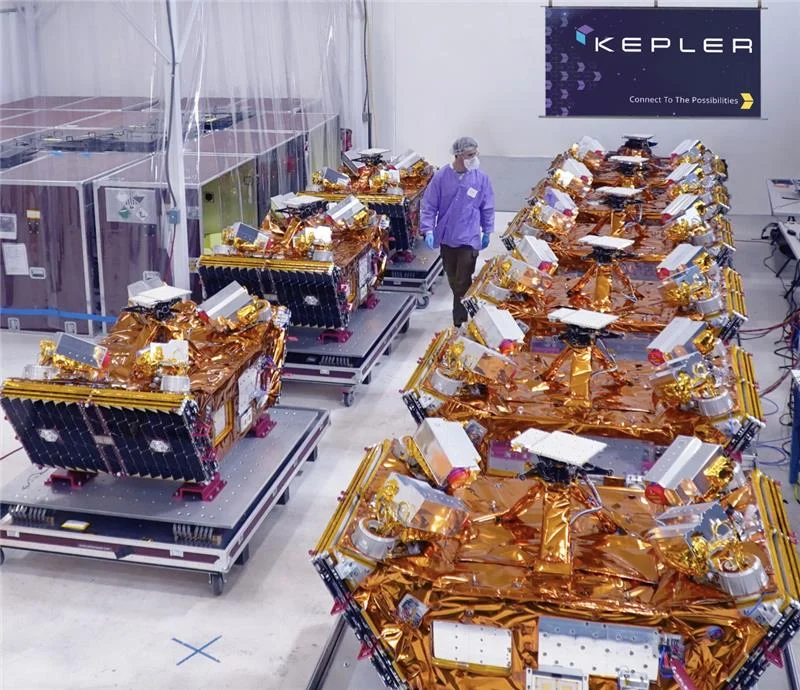
The landscape of space-based computation is rapidly evolving, moving beyond speculative visions to tangible implementations, as evidenced by the recent partnership between Canadian satellite operator Kepler Communications and orbital computing startup Sophia Space. This collaboration marks a significant step towards proving the viability of in-orbit data processing, particularly for edge computing applications, setting the stage for a new era of space infrastructure. While the grander ambition of large-scale, terrestrial-style data centers in orbit remains a target for the 2030s, the immediate focus is on processing data where it is collected, enhancing the capabilities of space-based sensors for both commercial and governmental entities.
Kepler’s Pioneering Orbital Compute Cluster
Kepler Communications, a Canadian firm specializing in satellite communications, has emerged as a frontrunner in establishing an operational in-orbit compute cluster. In January, the company successfully launched a constellation featuring approximately 40 Nvidia Orin edge processors distributed across 10 operational satellites. These satellites are interconnected via high-bandwidth laser communication links, creating the largest known computational network currently active in Earth orbit. This infrastructure represents a foundational layer for space-based applications, a vision articulated by Kepler CEO Mina Mitry, who positions the company not as a data center provider, but as essential infrastructure providing network services for other satellites, as well as drones and aircraft in the atmosphere below.
Kepler’s existing network already serves 18 customers, demonstrating a growing demand for in-space processing capabilities. Its model currently involves carrying and processing data uploaded from ground stations or collected by hosted payloads on its own spacecraft. As the sector matures, Kepler anticipates expanding its services to link with third-party satellites, offering comprehensive networking and processing solutions directly in orbit. This approach is gaining traction among satellite companies, which are now designing future assets around the benefits of offloading processing for power-intensive sensors, such as synthetic aperture radar (SAR). The U.S. military, a critical customer in this domain, is actively developing a new missile defense system reliant on satellites for detecting and tracking threats, a mission that significantly benefits from in-orbit processing to reduce latency and enhance responsiveness. Kepler has already demonstrated its capabilities for the U.S. government, including a successful space-to-air laser link demo.
Sophia Space and the Challenge of Orbital Cooling
Sophia Space, a startup focused on developing unique orbital computers, is tackling one of the most formidable challenges facing large-scale space data centers: thermal management. High-performance processors, particularly graphics processing units (GPUs), generate substantial heat. On Earth, this is managed through complex and energy-intensive active cooling systems. In the vacuum of space, with its extreme temperature fluctuations and lack of convection, dissipating heat without adding prohibitive weight and cost is a monumental task. Sophia’s innovation lies in its development of passively cooled space computers, which could unlock the potential for more powerful and sustainable computing in orbit.
The newly announced partnership will see Sophia Space test its proprietary operating system on Kepler’s constellation. This groundbreaking experiment involves uploading Sophia’s software to one of Kepler’s satellites and attempting to launch and configure it across six GPUs distributed on two separate spacecraft. While such an operation is routine in terrestrial data centers, it marks an unprecedented endeavor in orbit. The successful execution of this software deployment and configuration will serve as a crucial de-risking exercise for Sophia, validating its technology ahead of its first planned satellite launch in late 2027. For Kepler, this collaboration provides concrete proof of concept for the utility and flexibility of its network, attracting further interest and demonstrating its capacity to host advanced computational payloads.
The Strategic Imperative: Edge Processing in Space
The immediate value proposition of orbital data centers, as championed by Kepler and Sophia, lies squarely in edge processing. This paradigm involves processing data at or near the source of collection, significantly reducing the latency associated with transmitting raw data down to Earth for analysis. This is particularly critical for applications demanding real-time or near real-time insights, such as military intelligence, disaster response, environmental monitoring, and advanced Earth observation.
Kepler CEO Mina Mitry emphasizes this distinction: "Because we have the belief it’s more inference than training, we want more distributed GPUs that do inference, rather than one superpower GPU that has the training workload capacity." This highlights a fundamental difference in approach compared to companies like SpaceX, Blue Origin, Starcloud, and Aetherflux, which are raising substantial capital to pursue large-scale data centers with data center-style processors, primarily for intensive AI training workloads. Mitry further elaborated on the practical economics, stating, "If this thing consumes kilowatts of power and you’re only running at 10% of the time, then that’s not super helpful. In our case, our GPUs are running 100% of the time." This efficiency argument underscores the viability of distributed, continuously operating edge processors for specific, high-value tasks in space.
Market Dynamics and Future Projections
The burgeoning space economy is a significant driver for orbital compute. Reports from firms like BryceTech and Euroconsult project the global space economy to exceed $1 trillion by the early 2030s, with satellite services and launch segments being primary contributors. Within this growth, the demand for sophisticated data processing capabilities in orbit is expected to surge. The current global satellite market, valued at approximately $300 billion, is increasingly shifting towards services that leverage advanced analytics and AI, making in-orbit processing an attractive solution for reducing bandwidth bottlenecks and enhancing data utility.
While the current focus is on edge computing, experts anticipate that the vision of large-scale data centers resembling their terrestrial counterparts will materialize in the 2030s. These future orbital data centers would likely host more complex AI training models and massive data storage, requiring breakthroughs in power generation, advanced cooling systems, and autonomous maintenance. The current developments by Kepler and Sophia are crucial stepping stones, demonstrating the feasibility of key technologies and operational models.
Timeline of Key Developments:
- January 2026: Kepler Communications launches its constellation featuring 40 Nvidia Orin edge processors across 10 satellites, forming the largest in-orbit compute cluster.
- March 2026 (approximate): Kepler demonstrates space-to-air laser link capabilities for the U.S. government.
- April 2026: Kepler Communications announces Sophia Space as its newest customer, solidifying a partnership to test Sophia’s orbital computing software.
- Late 2027: Sophia Space plans its first satellite launch, following the successful validation of its software on Kepler’s constellation.
- 2030s: Industry experts project the emergence of large-scale, high-density data centers in orbit, building upon current edge computing advancements.
Implications and Broader Impact
The success of ventures like Kepler and Sophia carries profound implications across several sectors:
- National Security: For defense applications, the ability to process sensor data in orbit translates to faster threat detection and tracking, critical for missile defense systems and battlefield awareness. Reduced reliance on ground stations for initial processing also enhances resilience and autonomy.
- Earth Observation and Environmental Monitoring: Real-time analysis of satellite imagery can drastically improve responses to natural disasters, track climate change indicators, and optimize resource management.
- Internet of Things (IoT) and Global Connectivity: Orbital compute can support a vast network of IoT devices, processing data closer to the source and enabling more efficient communication for remote sensors and autonomous systems.
- Economic Advantage: By reducing the need to downlink massive volumes of raw data, companies can save on bandwidth costs and accelerate time-to-insight, offering a competitive edge in data-intensive industries.
- Technological Advancement: The extreme environment of space pushes the boundaries of hardware design, software resilience, and autonomous operations, fostering innovation that could eventually benefit terrestrial applications.
The partnership also highlights a growing divergence in the space computing industry. While established players and well-funded startups aim for high-power, centralized orbital data centers, companies like Kepler and Sophia are carving out a niche in distributed, efficient edge processing. This "inference-first" approach focuses on maximizing the utility of available power and cooling by running smaller, more efficient GPUs continuously for immediate data analysis.
Terrestrial Constraints as a Space Catalyst
Intriguingly, terrestrial developments are also beginning to influence the attractiveness of space-based alternatives. Sophia CEO Rob DeMillo points to a recent ban on data center construction in a Wisconsin city, and similar pushes by some lawmakers in Congress, as indicators of growing challenges for ground-based computing infrastructure. These challenges, driven by concerns over energy consumption, land use, and environmental impact, could inadvertently accelerate the shift towards orbital solutions. "There’s no more data centers in this [city]," DeMillo mused, adding, "It’s gonna get weird from here."
This perspective suggests that as terrestrial resources become scarcer or more regulated, the unique environment of space, with its seemingly boundless capacity for energy (solar) and efficient heat dissipation (passive cooling into the vacuum), could become an increasingly appealing frontier for computation. While significant hurdles remain, the tangible progress demonstrated by Kepler and Sophia indicates that the future of computing is not just expanding across the globe, but also reaching for the stars. The journey from hype to hardware is underway, and orbital compute is steadily transitioning from a distant dream to an operational reality.