Sisilia Frederika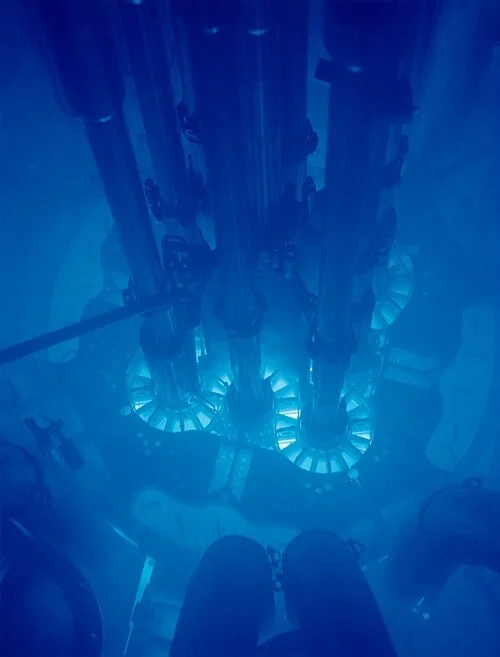
Cherenkov radiation represents a fundamental phenomenon in particle physics, occurring when a charged particle, such as an electron, passes through a dielectric (insulating) medium at a speed exceeding the phase velocity of light in that specific environment. While Albert Einstein’s theory of special relativity dictates that nothing can exceed the speed of light in a vacuum ($c$), the speed of light is significantly reduced when traveling through transparent media like water, glass, or plastic. In these environments, high-energy particles can indeed outpace photons, creating a luminous electromagnetic shockwave that is functionally analogous to a sonic boom produced by a supersonic aircraft. This effect, characterized by an eerie blue glow often seen in the cooling pools of nuclear reactors, was first systematically characterized by Soviet physicist Pavel Cherenkov in 1934 and remains a cornerstone of modern experimental physics.
The Physical Mechanism of the Electromagnetic Shockwave
To understand the generation of Cherenkov radiation, one must analyze the interaction between a charged particle and the atoms of the medium through which it travels. As a charged particle, such as a high-speed electron, moves through a dielectric material, it exerts an electromagnetic force on the nearby atoms, causing them to become temporarily polarized. The electrons within these atoms are displaced by the passing charge, stretching the atomic structure. Once the particle has passed, the electrons snap back to their original equilibrium positions, releasing a brief pulse of electromagnetic radiation in the form of photons.
In scenarios where the particle is moving at a relatively low velocity—specifically, slower than the speed of light in that medium—the disturbances to the surrounding atoms are symmetrical. The photons emitted as the atoms return to equilibrium propagate in all directions. Because these waves are emitted at different times and locations, they tend to interfere destructively, effectively canceling each other out. To an outside observer, there is no visible light or coherent radiation.
However, the physics changes fundamentally when the particle’s velocity ($v$) exceeds the phase velocity of light ($c_n$) in the medium, defined as $c_n = c/n$, where $n$ is the refractive index of the material. In this "superluminal" state, the particle is traveling faster than the information of its own presence can propagate through the medium via light. Consequently, the waves of electromagnetic disturbance cannot move ahead of the particle. Instead, they pile up behind it, interfering constructively to form a coherent wavefront. This creates a cone of light, known as the Cherenkov cone, which radiates outward from the path of the particle.
The Geometry of the Light Boom
The geometry of Cherenkov radiation is highly predictable and is defined by the Mach angle, similar to the cone of sound produced by a supersonic jet. The angle ($theta$) at which the light is emitted relative to the particle’s trajectory is determined by the relationship between the particle’s velocity and the refractive index of the medium. This is expressed by the formula:
$$cos(theta) = frac1nbeta$$
In this equation, $beta$ represents the ratio of the particle’s velocity to the speed of light in a vacuum ($v/c$). For radiation to occur, the value of $nbeta$ must be greater than one. This geometric precision allows scientists to use Cherenkov radiation as a diagnostic tool; by measuring the angle of the emitted light, researchers can calculate the exact velocity of the particle that produced it.
Historical Chronology and the 1958 Nobel Prize
The discovery of this radiation was not the result of a single "eureka" moment but rather a meticulous investigation into unexplained luminescence.
- Early Observations (1900–1920): Scientists, including Marie Curie, had previously noted a faint blue light emanating from bottles containing highly radioactive substances. However, this was largely dismissed as a form of fluorescence or a secondary effect of radioactivity that was not yet understood.
- Cherenkov’s Systematic Study (1934): Working under the supervision of Sergey Vavilov, Pavel Cherenkov conducted a series of experiments to determine the nature of the blue glow. He observed that the light was produced by gamma rays hitting various liquids. Crucially, he proved that the light was not fluorescence, as it did not depend on the chemical composition of the liquid, but rather on its refractive index.
- Theoretical Framework (1937): Physicists Ilya Frank and Igor Tamm provided the mathematical explanation for Cherenkov’s observations. They derived the Frank-Tamm formula, which describes the energy emitted per unit length of the particle’s path. Their work confirmed that the radiation was a collective effect of the medium’s atoms being polarized by the passing charge.
- Nobel Recognition (1958): Twenty-four years after the initial discovery, Pavel Cherenkov, Ilya Frank, and Igor Tamm were jointly awarded the Nobel Prize in Physics "for the discovery and the interpretation of the Cherenkov effect." The Nobel Committee recognized that the discovery provided a vital new method for detecting and measuring the speed of high-energy particles.
Spectral Characteristics: Why the Glow is Blue
One of the most distinctive features of Cherenkov radiation is its color. While the radiation is emitted across a broad spectrum of frequencies, including ultraviolet, it appears as a brilliant, ghostly blue to the human eye. This is explained by the Frank-Tamm formula, which shows that the intensity of the radiation is proportional to the frequency of the light.
In simpler terms, shorter wavelengths (higher frequencies) are produced more efficiently and with greater intensity than longer wavelengths. Since blue and violet light have shorter wavelengths than red or orange light, they dominate the visible portion of the Cherenkov spectrum. Furthermore, a significant portion of Cherenkov radiation is emitted in the ultraviolet range, which, while invisible to humans, can be detected by specialized sensors. The blue color seen in nuclear reactor pools is the visible "tail" of this intense ultraviolet emission.
Supporting Data: Refractive Indices and Thresholds
The occurrence of Cherenkov radiation depends entirely on the medium’s refractive index ($n$). The higher the refractive index, the lower the speed of light in that medium, and the easier it is for a particle to exceed that threshold.
- Water ($n approx 1.33$): Light travels at approximately 75% of its vacuum speed ($0.75c$). Electrons must exceed this speed to produce the blue glow.
- Heavy Water ($n approx 1.33$): Used in certain nuclear reactors (like CANDU reactors), heavy water exhibits the same Cherenkov properties as light water.
- Ice ($n approx 1.31$): Large-scale detectors at the South Pole use deep Antarctic ice as a medium for detecting cosmic neutrinos.
- Glass/Lead Glass ($n approx 1.5$ to $1.9$): Often used in electromagnetic calorimeters to measure the energy of particles in accelerator experiments.
Scientific and Industrial Applications
The ability to detect and analyze Cherenkov radiation has led to several critical applications in science and safety.
Nuclear Reactor Monitoring
In nuclear fission reactors, the "Cherenkov glow" is a primary indicator of reactor activity. The intensity of the blue light is directly proportional to the rate of fission occurring in the core, as more fission events release more high-speed electrons (beta particles) and gamma rays. Inspectors from the International Atomic Energy Agency (IAEA) use Cherenkov viewing devices to verify that nuclear fuel is being used for peaceful purposes and to monitor the cooling of spent fuel rods.
Particle Astrophysics
The IceCube Neutrino Observatory, located at the Amundsen–Scott South Pole Station, utilizes a cubic kilometer of clear Antarctic ice as a Cherenkov detector. When nearly massless neutrinos collide with atoms in the ice, they produce high-speed muons. These muons travel faster than light in ice, creating Cherenkov radiation. Thousands of optical sensors frozen deep in the ice detect these flashes, allowing scientists to trace the neutrino’s origin back to distant supernovae or black holes.
Medical Imaging and Therapy
Cherenkov Luminescence Imaging (CLI) is an emerging field in medical technology. Some radioisotopes used in cancer treatment emit particles fast enough to produce Cherenkov radiation within the patient’s tissue. By capturing this light with sensitive cameras, doctors can monitor the precise location and dose of radiation being delivered to a tumor in real-time, improving the accuracy of treatments.
Analysis of Implications
The discovery of Cherenkov radiation fundamentally changed the way physicists view the "speed limit" of the universe. It serves as a practical reminder that while $c$ is an absolute constant in a vacuum, the behavior of light is highly dependent on its environment.
The "light boom" is more than just a visual curiosity; it is a tool of measurement. Because the light is emitted in a very specific cone, it allows for "particle identification." By placing two detectors with different refractive indices (threshold detectors), scientists can distinguish between different types of particles—such as pions and kaons—that might have the same momentum but different velocities.
Furthermore, the study of Cherenkov radiation has paved the way for understanding other types of "shock" phenomena in plasma physics and electromagnetism. It remains one of the most cost-effective and reliable ways to detect high-energy radiation, requiring no power source other than the kinetic energy of the particles themselves.
Conclusion
Pavel Cherenkov’s observation of a faint blue glow in a simple bottle of water in 1934 serves as a testament to the power of basic scientific inquiry. By investigating a phenomenon that others had ignored as a mere side effect, Cherenkov and his colleagues Frank and Tamm uncovered a fundamental principle of nature. Today, from the depths of the Antarctic ice to the cores of the world’s most powerful reactors, the "light boom" continues to provide a window into the subatomic world, turning the invisible passage of high-speed particles into a brilliant, measurable reality.