Lina Irawan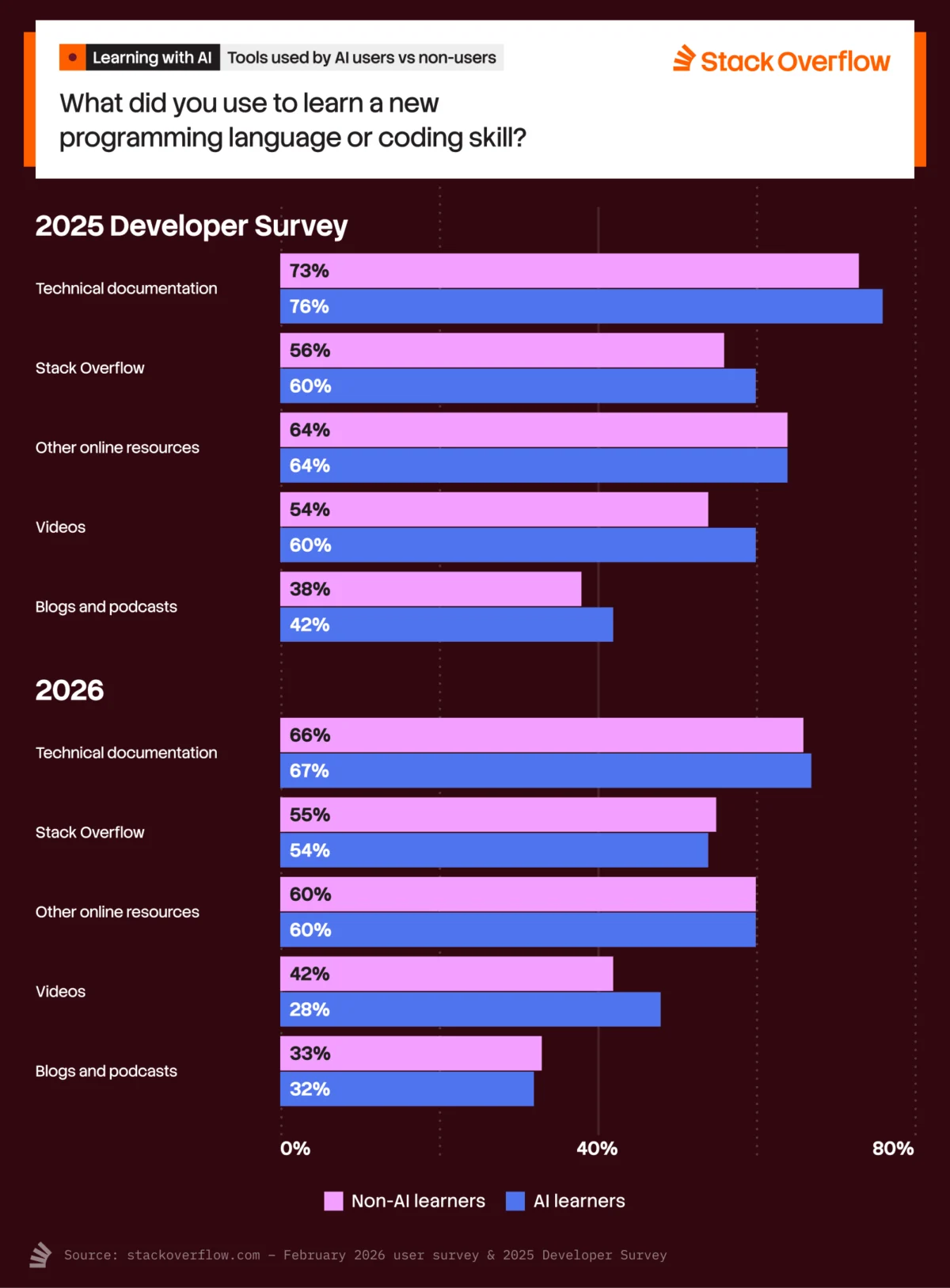
Learning is currently undergoing a fundamental transformation as artificial intelligence integrates into the professional and educational sectors, marking one of the most significant shifts in knowledge acquisition since the advent of the internet. Recent data suggests that the developer community, often the vanguard of technological adoption, is increasingly leveraging AI not only to optimize their current workflows but to fundamentally change how they learn to code and solve complex problems. However, this rapid adoption is accompanied by a growing concern regarding "cognitive offloading"—a phenomenon where over-reliance on automated tools may inadvertently hamper the long-term retention of knowledge and the development of critical thinking skills.
In February, a comprehensive pulse survey conducted by Stack Overflow, in partnership with OpenAI, revealed that the landscape of technical education is shifting toward a consolidated, AI-centric model. With responses from nearly 900 developers, the data highlights a complex relationship between efficiency, trust, and the traditional pathways of learning that have defined the industry for decades. As AI tools become more sophisticated, the "trust gap" remains a significant hurdle, forcing a hybrid approach where human-curated resources like technical documentation and community-driven platforms like Stack Overflow remain essential for validation.
The Rapid Acceleration of AI Adoption in Learning
The trajectory of AI adoption among developers has been remarkably steep over the last three years. According to the 2024 and 2025 Developer Surveys, the percentage of developers using AI as a primary learning tool has surged from 37% in 2024 to 44% in 2025, reaching a staggering 64% in the most recent pulse survey. This upward trend is driven by two primary factors: the desire for a "clean slate" when starting new projects and the pursuit of raw efficiency.

The survey found that 28.2% of respondents use AI to help them "start from scratch," effectively using the technology to overcome the paralysis of a blank page. Another 26.3% cited efficiency as their main driver. For the modern developer, the ability to generate a boilerplate or understand a new syntax in seconds outweighs the traditional method of scouring multiple manuals or tutorials. This shift suggests that the "just-in-time" learning model—where information is acquired at the moment of need rather than through comprehensive study—is becoming the industry standard.
The Consolidation of the Learning Ecosystem
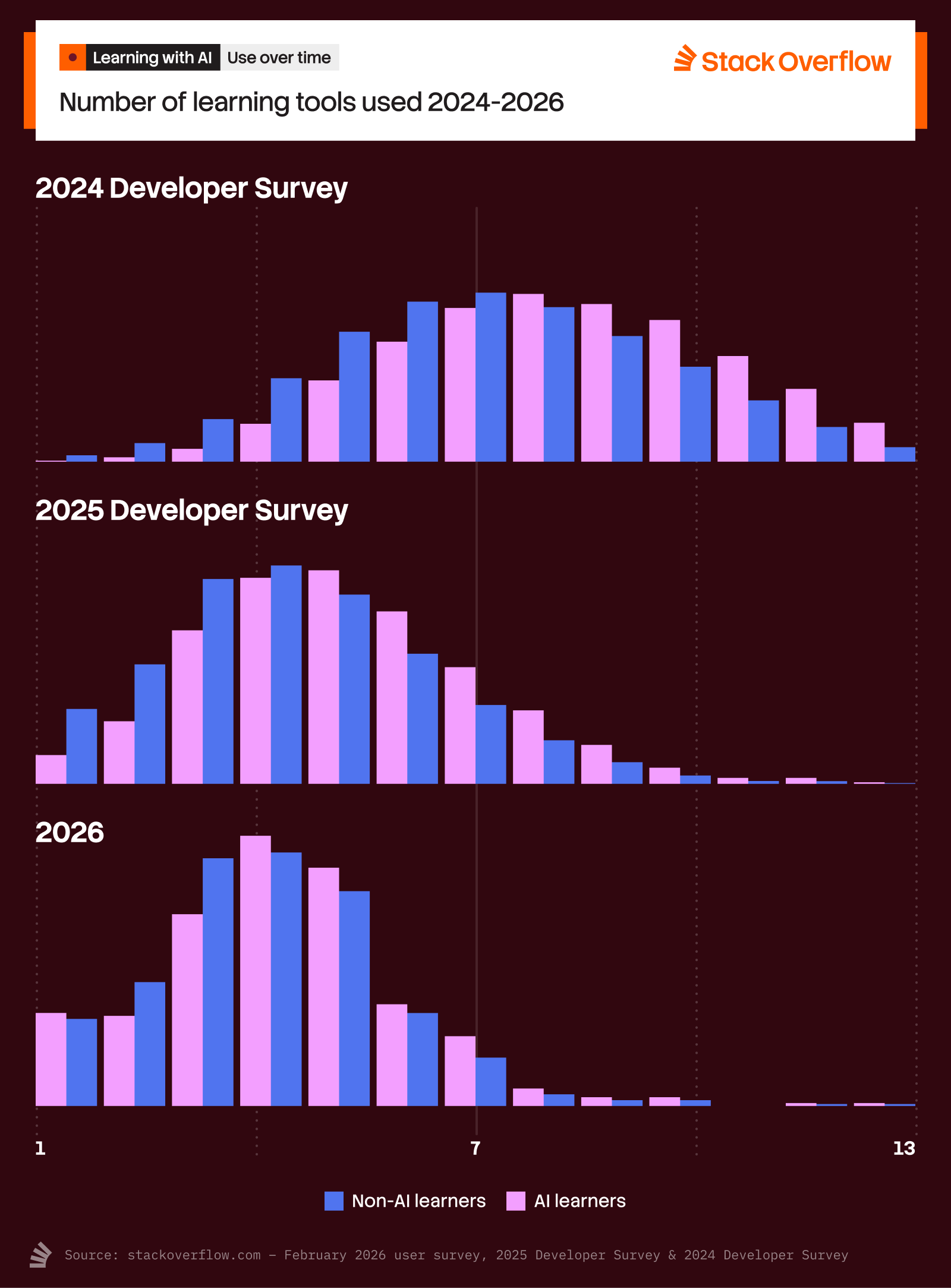
One of the most striking findings in the recent data is the drastic reduction in the number of tools developers use to learn. In 2024, approximately 49% of developers reported using eight or more different learning resources, ranging from online courses and books to forums and documentation. By 2025, that number plummeted to 9%, and the current pulse survey shows it has further declined to just 7%.
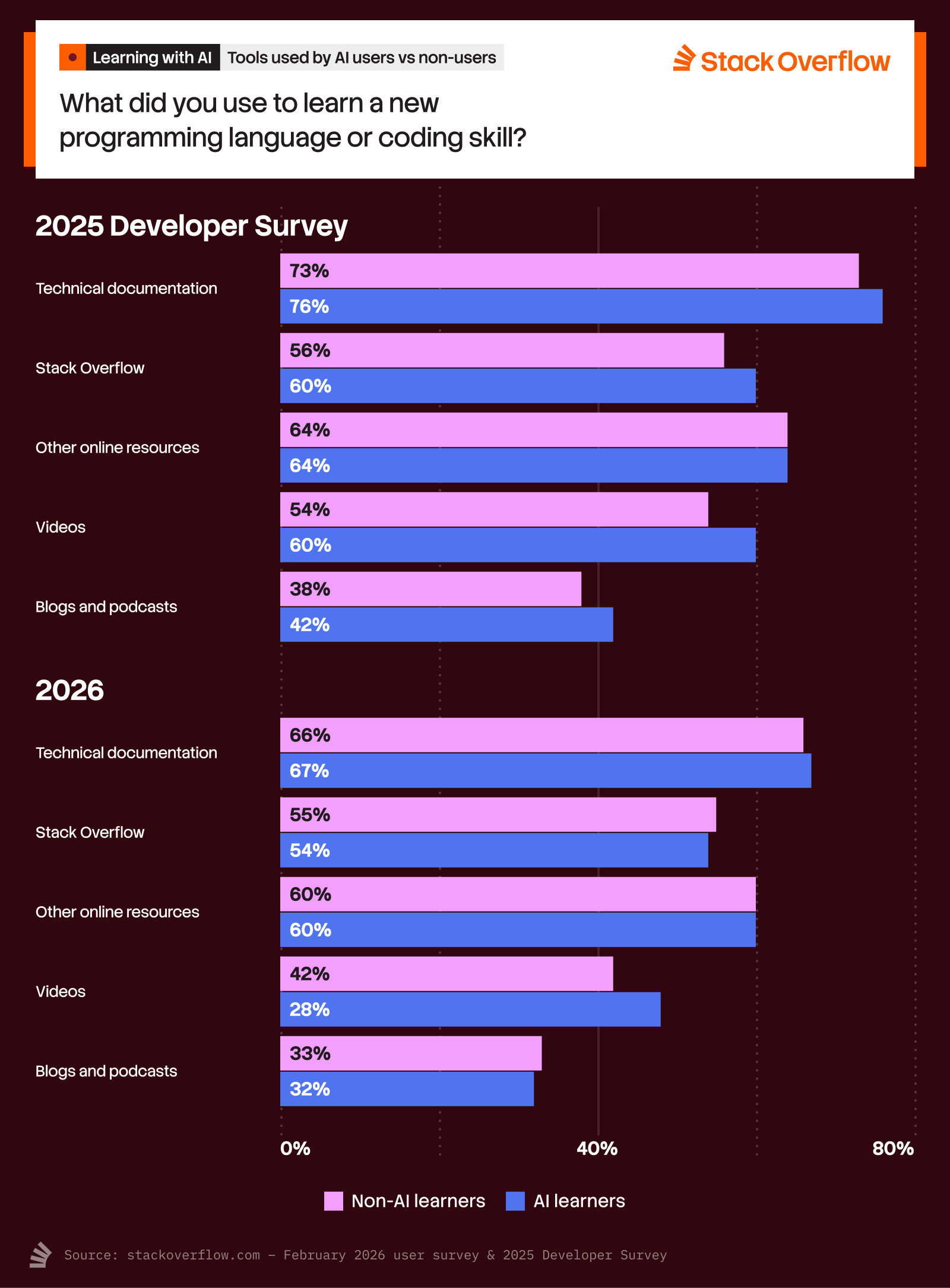
This consolidation indicates that AI is acting as a centralized hub for information. Rather than navigating a fragmented landscape of various websites and platforms, developers are increasingly turning to a single AI interface to aggregate and synthesize information. However, this trend is not exclusive to AI users. Even those who do not use AI are reporting a decrease in the number of tools they employ, suggesting a broader industry movement toward streamlined, high-density information sources.
This "less is more" trend is particularly prevalent among younger developers (aged 18-34). This demographic appears more comfortable with centralized AI platforms, whereas older, more experienced developers continue to maintain a broader diet of technical documentation and legacy resources.
Experience Levels and the Hierarchy of AI Usage
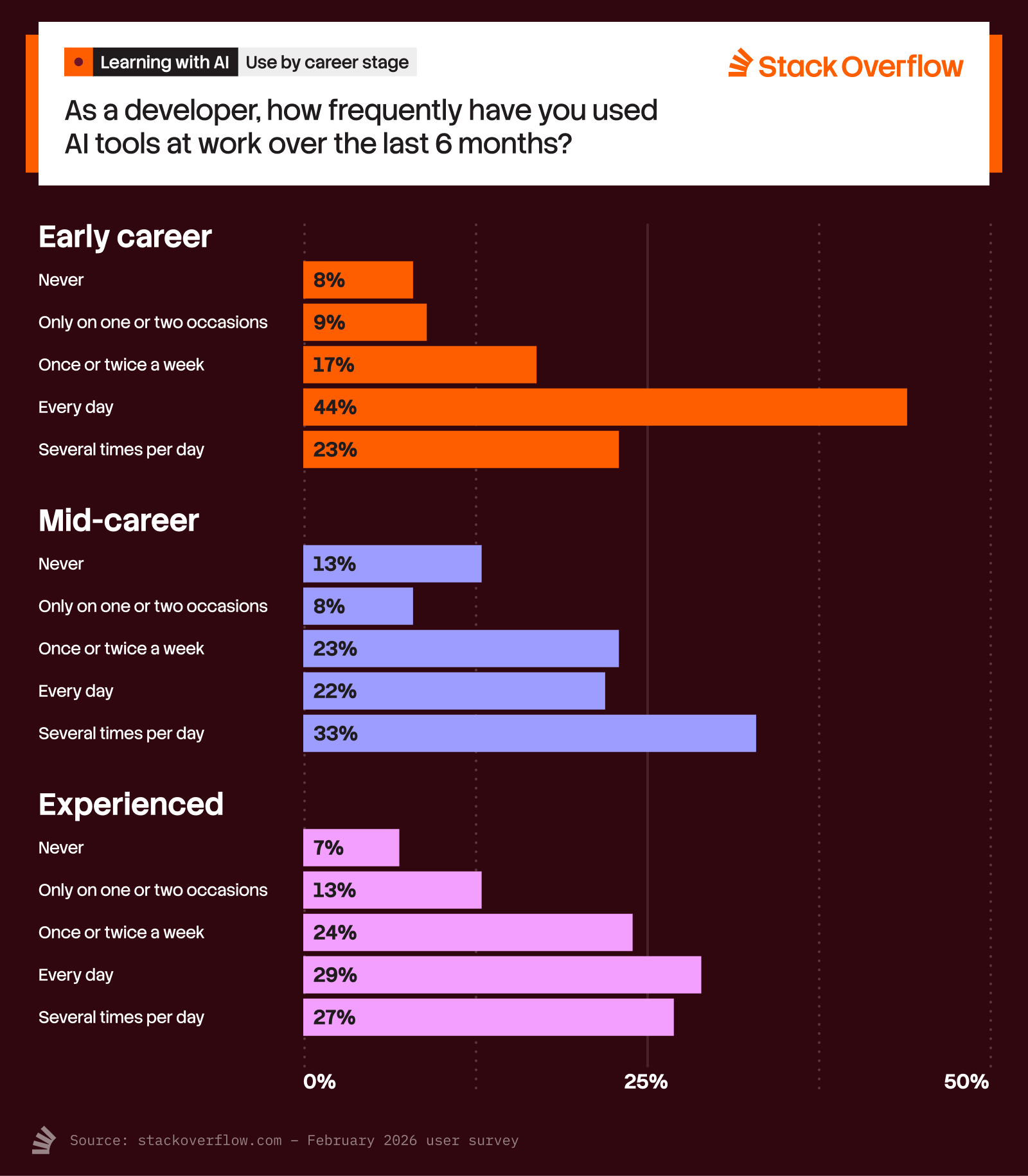
The integration of AI at work also shows a clear correlation with professional experience and career stage. Daily usage of AI at work has grown from 47% in the 2025 Developer Survey to 58% in the current reporting period. Interestingly, the data reveals that mid-career and early-career developers are the heaviest users of these tools.
- Early-career developers: 68% report using AI at work every day.
- Mid-career developers: 59% report daily usage.
- Experienced developers: 56% report daily usage.
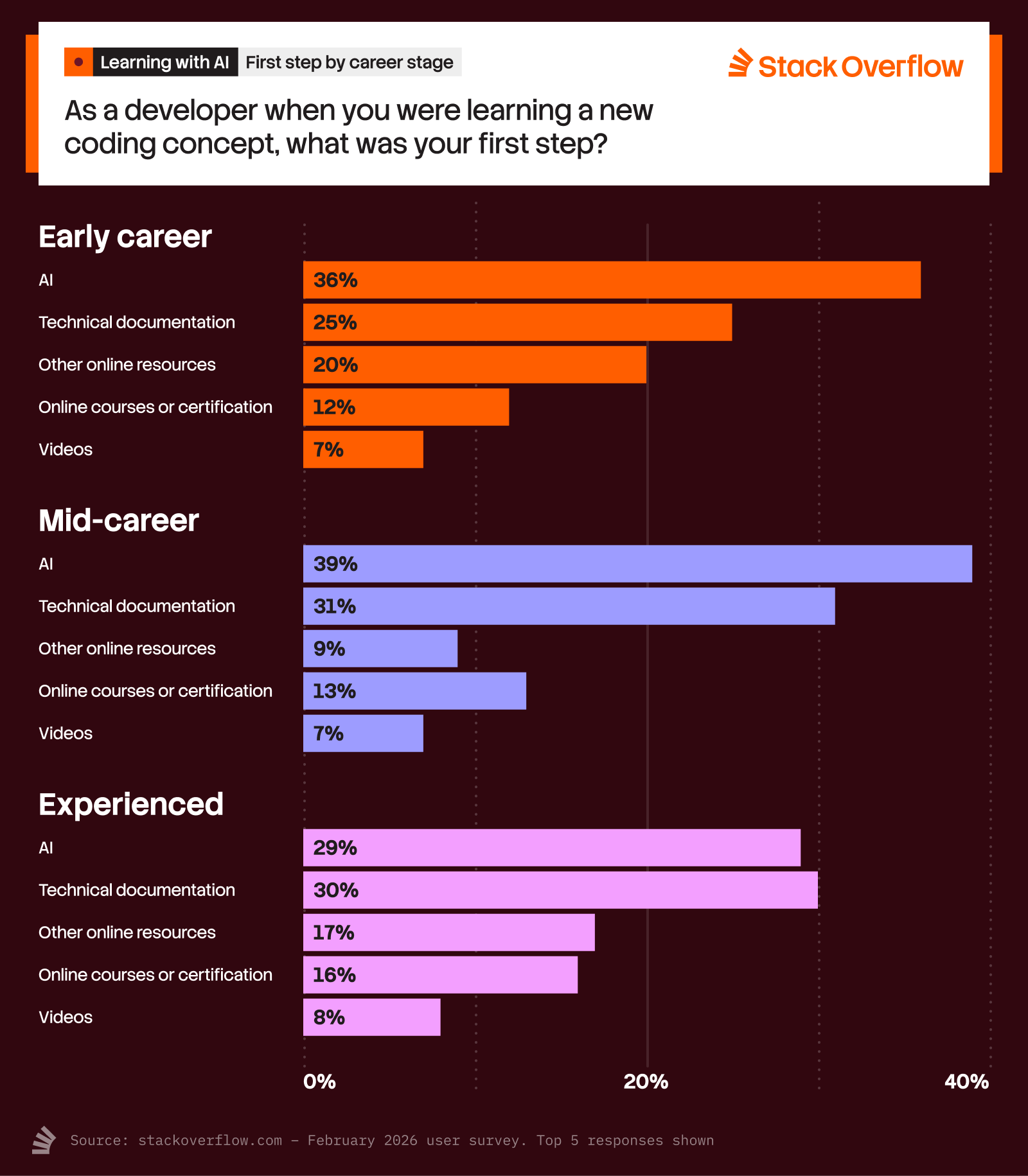
When it comes to the "first step" in a learning journey, a clear generational divide emerges. Early-career (36%) and mid-career (39%) developers are most likely to turn to AI as their first resource. In contrast, experienced developers are at a point of parity, with 30% favoring technical documentation and 29% choosing AI. This suggests that while veterans value the precision and authority of official documentation, the convenience of AI is beginning to win over even the most seasoned professionals.
For those not using AI, the primary barrier is not a lack of interest, but a lack of time. Roughly 35% of non-AI users cited time constraints as the reason they haven’t integrated these tools into their learning process, far outstripping low motivation (11%) or not knowing where to start (10%). Conversely, only 7% of AI users cited time as a barrier, suggesting that AI may indeed be fulfilling its promise of saving time for busy professionals.
The Trust Gap and the "AI Tax"
Despite the efficiency gains, AI tools face a persistent "trust gap." Approximately 38% of respondents identified a lack of trust in AI-generated results as a primary barrier to adoption. This distrust is highest among experienced developers, who are more likely to have encountered the "hallucinations" or inaccuracies that can plague large language models (LLMs).
This phenomenon has led to the emergence of what some experts call the "AI Tax." Jessica Talisman, an information architect, describes this as a decay of knowledge caused by the lack of provenance in AI outputs. LLMs often mimic the structure of citations and footnotes without actually maintaining a verifiable record of where the information originated. In technical fields, where the "why" and "how" are just as important as the "what," this lack of an auditable trail creates an additional cognitive burden on the user.
To combat this, developers are adopting a "trust but verify" workflow. Only 1% of developers use AI in isolation. The vast majority use AI in conjunction with other sources to validate the output:
- 58% use AI alongside technical documentation.
- 54% use AI with other online resources (search, forums, communities).
- 50% use AI specifically with Stack Overflow.
This validation step is the "tax" paid for the speed of AI. While the answer is provided instantly, the developer must then spend time ensuring that the code is secure, efficient, and accurate by cross-referencing it with human-curated data.
The Human Factor in Technical Education
The rise of AI has sparked a renewed debate over the importance of human intervention in learning. A recent study of Chinese university students during and after the COVID-19 pandemic found that despite the availability of advanced online tools, 63% of students still found face-to-face courses more effective. Follow-up interviews revealed that "humorous teachers" and the ability of a human instructor to hold a classroom’s attention were key factors in improved memorization and learning.
This sentiment is echoed in the professional world. Owl Labs surveys from 2025 across the U.S., U.K., France, and Germany indicate that many employees believe hybrid or in-office environments are superior for maintaining leadership visibility and team cohesion. The consensus emerging in the developer community is that while AI is an excellent tool for "just-in-time" solutions, it lacks the captivating personality and contextual nuance required for deep, long-term competency.
The Future of AI in the Job Market and Certification
As AI continues to mature, its role in career development is also being scrutinized. While 57% of developers agree that AI has become significantly better at facilitating learning, they remain skeptical of its role in the recruitment process. Only 44% of respondents would find a certification for skills learned via an AI platform to be valuable.
The prospect of "agentic" job searches—where AI agents represent a candidate to potential employers—is met with even more caution. Only 16.9% of developers would "absolutely" use such a platform. The majority (23.8%) would only consider it if strict conditions were met, including:
- Human intervention at every step (46.2%)
- Transparent data usage policies (42.2%)
- Low or no cost (40%)
This data suggests that while developers are happy to use AI as a co-pilot for coding and learning, they are not yet ready to hand over the reins of their professional identities to an algorithm.
Broader Implications for the Tech Industry
The shift toward AI-first learning represents a double-edged sword for the tech industry. On one hand, it lowers the barrier to entry for new developers and allows for unprecedented speed in problem-solving. On the other hand, the consolidation of learning resources and the "AI tax" of verification could lead to a superficial understanding of core concepts if not managed carefully.
The Brookings poll cited in the research highlights that students, parents, and teachers all rate the "undermining of cognitive development" as the number one risk of AI in education. For the developer community, the challenge will be to maintain the rigor of traditional learning pathways while embracing the efficiency of modern tools.
Ultimately, the data from Stack Overflow and its partners suggests that the future of technical learning is not a zero-sum game between humans and machines. Instead, it is an evolving ecosystem where AI serves as the initial entry point, but human-curated knowledge, technical documentation, and peer-to-peer validation remain the bedrock of professional authority. As AI tools continue to permeate the workplace, the ability to critically evaluate and verify machine-generated content will likely become as important a skill as coding itself.