Chandra Wibowo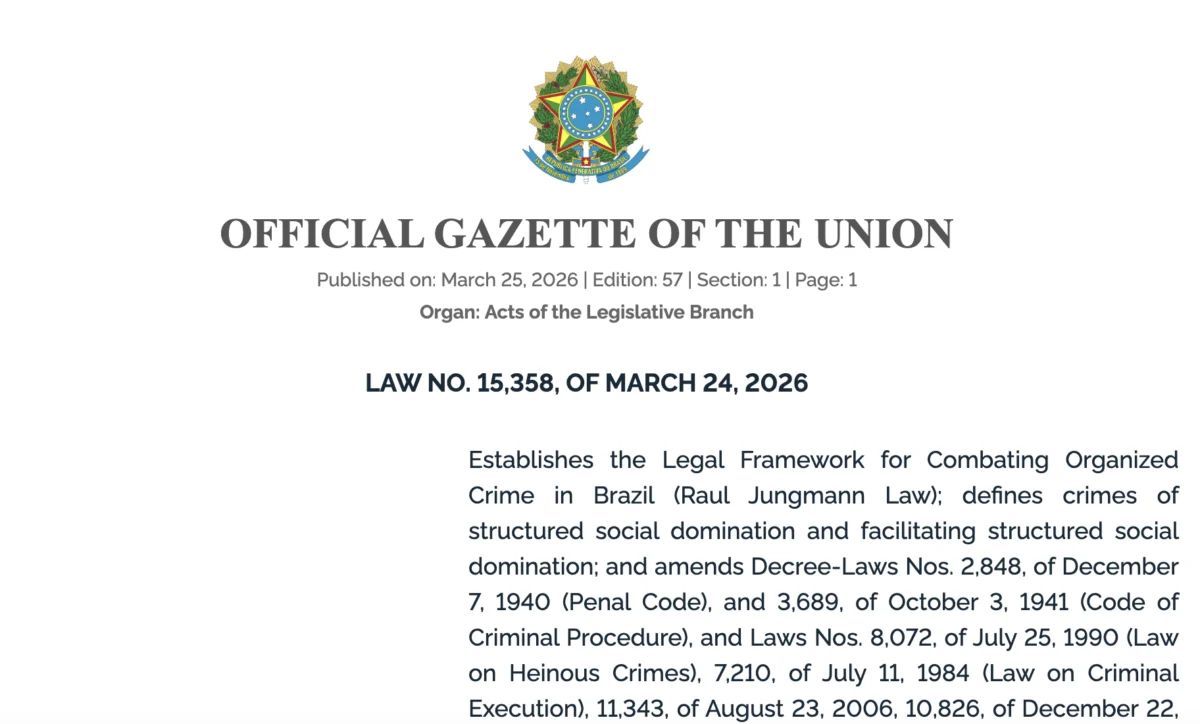
Brazil’s legislative branch has enacted a landmark law, Law No. 15.358, published on Wednesday, March 24, 2026, which empowers public security agencies to deploy confiscated cryptocurrency assets in their ongoing battle against organized crime. This groundbreaking legislation establishes a comprehensive legal framework that allows authorities not only to prohibit illicit transactions on cryptocurrency exchanges by classifying digital assets as instruments of crime but also to confiscate these assets for the direct funding of public security initiatives.
The newly published law, translated from Portuguese, explicitly states, "For the purposes of forfeiture of assets, any asset that has been used to commit a crime shall be considered an instrument of the crime, even if it was not intended exclusively for that purpose." This broad definition encompasses a wide range of digital assets that have been implicated in criminal activities, providing law enforcement with a potent new tool.
Furthermore, the law outlines a clear directive for the utilization of these seized funds: "The forfeited assets and valuables may be used provisionally by public security agencies for police re-equipment, training, and special operations, subject to authorization from the judge overseeing the execution of the sentence." This provision ensures that the confiscated cryptocurrencies will be directly channeled back into strengthening the operational capabilities of Brazil’s security forces, thereby creating a self-sustaining mechanism for combating criminal enterprises.
The implications of this law are far-reaching, particularly for a nation with a population exceeding 213 million, a significant portion of whom are reported to be users of cryptocurrency. This legislation could substantially bolster the Brazilian government’s financial resources dedicated to national security, offering a novel approach to funding critical law enforcement operations.
Historical Context and Legislative Journey
The enactment of Law No. 15.358 is the culmination of a growing concern within Brazil regarding the increasing use of digital assets by criminal organizations for illicit activities, including money laundering, fraud, and the financing of illegal operations. While the specific date of the initial legislative proposal is not detailed in the provided text, the process of legalizing the use of confiscated crypto likely involved extensive deliberation and debate within the Brazilian Congress, reflecting the evolving nature of crime in the digital age.
The legislative branch’s decision to formally publish the law signifies its approval and formal adoption into Brazil’s legal code. The reference to the official publication date of March 24, 2026, suggests that the law was passed and enacted on or before this date, marking a significant moment in Brazil’s approach to digital asset regulation and law enforcement funding.
This development also comes at a time when Brazil’s Finance Minister, Dario Durigan, had reportedly shelved discussions on revising the country’s crypto tax policy. Reports indicated that Durigan aimed to avoid contentious tax policy changes leading up to Brazil’s presidential election in October. While this specific tax policy delay is a separate matter, it highlights the complex and multifaceted regulatory landscape surrounding cryptocurrencies in Brazil, with policymakers navigating both enforcement and financial implications.
The Scale of Crypto-Related Crime in Brazil
The need for such legislation is underscored by past law enforcement successes and the sheer scale of illicit financial flows involving cryptocurrencies. A notable example is the Brazilian Federal Police’s Operation Lusocoin in 2025. According to a report by TRM Labs, this operation targeted a vast money laundering and foreign exchange evasion scheme. Authorities estimated that this network facilitated the movement of tens of billions of Brazilian reais. The operational methods involved a complex web of shell companies, over-the-counter (OTC) crypto brokers, and non-custodial wallets, demonstrating the sophisticated tactics employed by criminal entities.
Operation Lusocoin served as a stark reminder of the challenges faced by law enforcement in tracing and recovering assets in the decentralized world of cryptocurrencies. The success of such operations, while significant, also highlighted the need for enhanced legal frameworks and financial resources to effectively dismantle these criminal networks. The new law directly addresses this by providing a mechanism to leverage confiscated assets for future investigative and operational endeavors.
International Cooperation and Asset Recovery

A critical component of Law No. 15.358 is its provision for international cooperation. The legislation explicitly authorizes Brazil to coordinate and collaborate with international authorities in criminal investigations and asset recovery efforts. This is particularly crucial in cases involving digital assets, which often transcend national borders, making international collaboration indispensable for effective enforcement.
The ability to work with foreign law enforcement agencies and financial intelligence units will enhance Brazil’s capacity to track down criminals who may attempt to hide illicitly obtained cryptocurrencies in offshore wallets or exchanges. This global approach is vital in dismantling transnational organized crime rings that exploit the anonymity and reach of digital currencies.
Broader Implications and Comparative Analysis
The decision by Brazil to allow the use of confiscated crypto for public security funding presents an interesting contrast to the approach taken by some other nations. In countries like the United States, for instance, seized cryptocurrency has been used to bolster national digital asset stockpiles, as seen in instances where the U.S. Marshals Service has sold confiscated Bitcoin. Brazil’s law, however, directs these funds specifically towards tangible improvements in public security infrastructure, training, and operations.
This strategic allocation of resources could lead to a more direct and immediate impact on crime reduction and law enforcement effectiveness. The ability to rapidly re-equip police forces, provide specialized training in cybercrime and digital forensics, and fund high-risk special operations could significantly alter the balance of power in the fight against organized crime.
Debate on a National Crypto Reserve
Interestingly, while Brazil is now prepared to utilize confiscated crypto for security, the country has also been actively discussing the possibility of establishing a national Bitcoin reserve. In August 2025, discussions were held regarding a proposal to create such a reserve, potentially allocating up to 5% of the nation’s treasury to purchase Bitcoin. This bill, initially introduced in 2024 and later reintroduced in February of the following year, was expanded to permit the purchase of up to one million BTC.
The prospect of a national Bitcoin reserve reflects a growing interest in digital assets not just as a tool for crime but also as a potential component of a nation’s financial strategy. However, as of March 2026, the legislative support for this reserve bill remained uncertain, indicating a divergence in policy discussions between leveraging crypto for security and incorporating it into national reserves.
The contrast between these two policy discussions – one focused on the punitive and instrumental use of confiscated crypto for security, and the other on the strategic acquisition of crypto as a national asset – highlights the evolving and often complex relationship between governments and digital currencies.
Analysis of Potential Impact
The implementation of Law No. 15.358 is poised to have several significant impacts:
- Enhanced Law Enforcement Capabilities: The direct funding from confiscated crypto can accelerate the modernization of police equipment, enabling officers to tackle sophisticated criminal operations more effectively. This includes investment in advanced surveillance technology, digital forensics tools, and secure communication systems.
- Specialized Training and Operations: Funds can be allocated to specialized training programs for law enforcement personnel in areas such as cybercrime investigation, cryptocurrency tracing, and financial intelligence analysis. This would also enable the execution of more complex and resource-intensive special operations against high-value targets.
- Deterrent Effect: The prospect of losing valuable digital assets used in criminal activities, which can then be repurposed to fund the very agencies designed to stop them, could serve as a significant deterrent to criminals contemplating the use of cryptocurrency for illicit purposes.
- Increased Transparency and Accountability: The law’s stipulation that the use of forfeited assets is subject to judicial authorization provides a layer of oversight and accountability, ensuring that funds are used appropriately and ethically.
- Potential for Economic Impact: While the primary goal is security, the infusion of funds into the public sector could have indirect positive economic effects by stimulating demand for technology and services.
Conclusion
Brazil’s Law No. 15.358 represents a forward-thinking and pragmatic approach to addressing the challenges posed by organized crime in the digital era. By empowering its public security agencies to utilize confiscated cryptocurrency, Brazil is not only creating a novel funding mechanism but also signaling a strong commitment to combating illicit financial activities. This legislation, coupled with its provisions for international cooperation, positions Brazil to be a more formidable adversary to criminal organizations that exploit the global reach of digital assets. As the country continues to navigate the complex landscape of cryptocurrency regulation, this law marks a crucial step in its ongoing efforts to ensure national security and uphold the rule of law. The effectiveness of this new tool will undoubtedly be closely watched, both domestically and internationally, as it unfolds.