Sisilia Frederika
Every second, approximately 100 trillion neutrinos stream through every square centimeter of your body, originating from the nuclear furnace of the Sun, the radioactive decay of elements within the Earth, and the distant remnants of cataclysmic supernovae. Despite their ubiquity, these "ghost particles" are notoriously difficult to detect because they interact with ordinary matter only via the weak nuclear force and gravity, effectively rendering the entire planet transparent to their passage. However, these nearly weightless particles hold the key to understanding the evolution of the large-scale structure of the universe. At the Karlsruhe Institute of Technology (KIT) in Germany, the Karlsruhe Tritium Neutrino (KATRIN) experiment has reached a historic milestone, successfully narrowing the upper bound of the neutrino’s mass to a level of precision previously thought unattainable.
By analyzing 259 days of data collected between 2019 and 2021, the international KATRIN collaboration has established that the mass of a neutrino cannot exceed 0.45 electron volts (eV) divided by the square of the speed of light. This value, which translates to roughly $8 times 10^-37$ kilograms, represents a landmark achievement in particle physics. To put this into perspective, an electron—the next lightest known particle with mass—is at least 500,000 times heavier than a neutrino. The latest findings effectively halve the previous upper limit of 0.8 eV set by the same experiment in 2022, marking the first time a direct laboratory measurement has pushed the sensitivity into the sub-eV range.
The Engineering Marvel of the KATRIN Apparatus
The KATRIN experiment is a triumph of high-precision engineering, stretching 70 meters in length—roughly the size of a Boeing 747. Located at the North Campus of KIT, the facility was designed to perform a task that borders on the impossible: measuring the infinitesimal "recoil" of energy left behind during the radioactive decay of tritium.
The apparatus consists of several critical components. At one end lies the Windowless Gaseous Tritium Source (WGTS), where high-purity tritium gas is maintained at a temperature of 30 Kelvin with a stability of 0.1%. Tritium, a radioactive isotope of hydrogen with two neutrons and one proton, is the ideal candidate for this study because it undergoes beta decay with a relatively low energy release and a convenient half-life of 12.3 years.
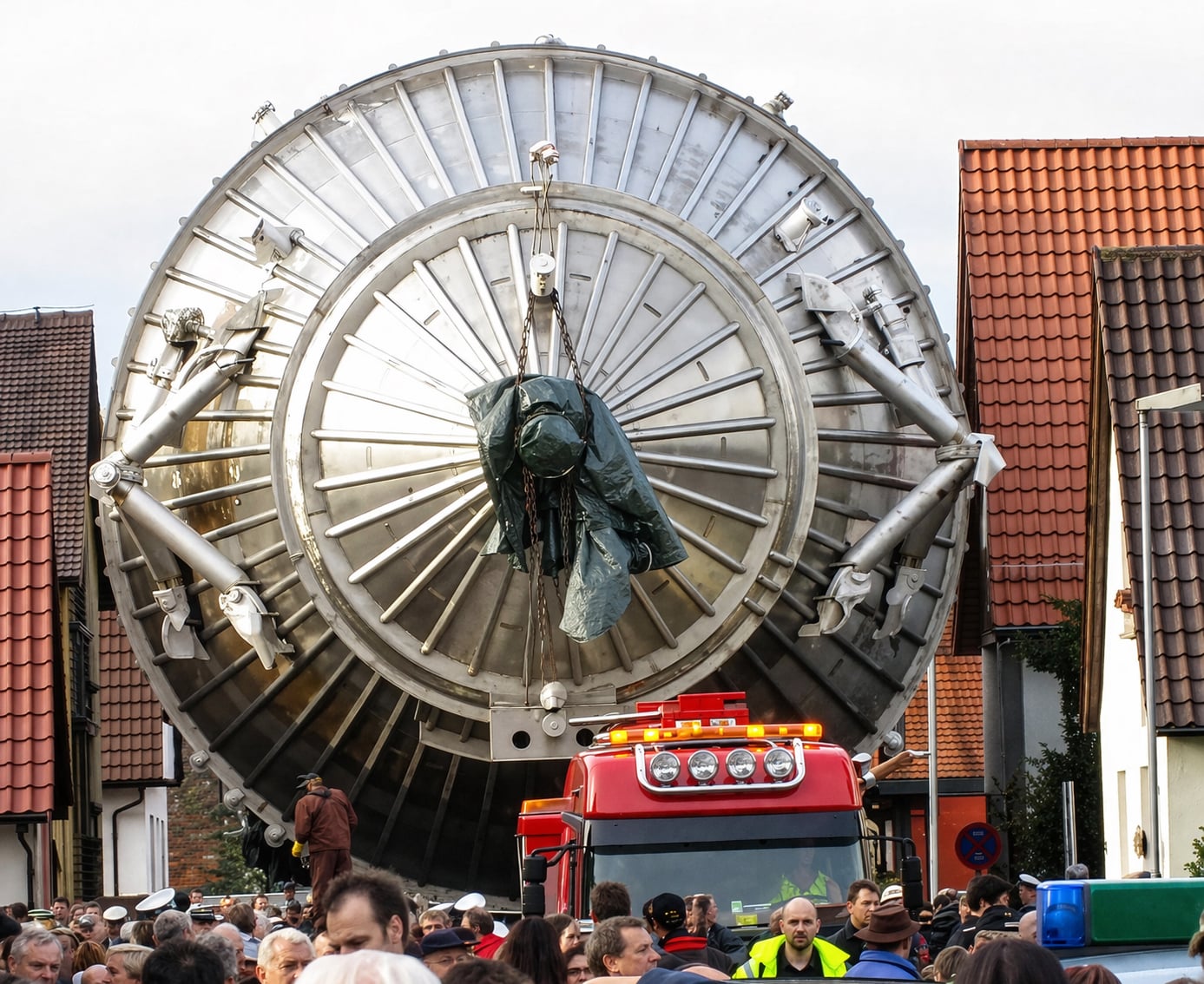
The heart of the experiment is the main spectrometer, a massive vessel measuring 10 meters in diameter and 24 meters in length. The journey of this spectrometer to Karlsruhe is a legendary chapter in modern physics history. Manufactured in Deggendorf, the vessel was too large to be transported by road directly to Karlsruhe. Instead, it was shipped via the Danube River, the Black Sea, the Mediterranean, and the Atlantic Ocean, eventually traveling up the Rhine. For the final kilometers, it had to be navigated through the narrow streets of the village of Leopoldshafen with only centimeters of clearance from residential buildings.
The spectrometer operates under an ultra-high vacuum—comparable to the pressure on the surface of the Moon—to ensure that electrons traveling through it do not scatter off air molecules. A complex system of superconducting magnets guides the electrons from the tritium source through the spectrometer to the detector at the far end, ensuring that only those with the highest kinetic energy are recorded.
The Physics of Beta Decay and the Endpoint Measurement
The methodology employed by KATRIN is based on the fundamental principles of energy conservation. When a tritium nucleus decays, it transforms into a helium-3 nucleus, emitting an electron and an electron antineutrino in the process. The total energy released in this decay is fixed at 18.6 kiloelectron volts (keV). This energy is shared between the electron and the neutrino as kinetic energy and rest mass energy.
According to Einstein’s famous equation, $E=mc^2$, if the neutrino has mass, it must "claim" a small portion of that total energy as its rest mass, even if it is not moving. Consequently, the electron is left with slightly less kinetic energy than it would have had if the neutrino were massless. By meticulously measuring the maximum energy (the "endpoint") that an electron can reach, physicists can determine how much energy was taken by the invisible neutrino.
This measurement requires extreme precision. The KATRIN spectrometer acts as a high-pass filter; by applying a precise retarding potential, it only allows electrons with energy above a certain threshold to pass through and reach the detector. By scanning this threshold near the 18.6 keV endpoint, the team can map the shape of the energy spectrum. A slight "missing" sliver of energy at the very end of the spectrum provides the mathematical signature of the neutrino’s mass.
A Chronology of Discovery
The path to the 0.45 eV limit has been one of steady refinement and technical perseverance. The KATRIN project was first conceived in 2001, following the realization that previous experiments in Mainz, Germany, and Troitsk, Russia, had reached their sensitivity limits.
- 2001–2015: Design and construction phase. This period involved the creation of the massive spectrometer and the development of the world’s most stable tritium source.
- 2016–2017: Commissioning and "first light." The system was tested using krypton-83m to calibrate the spectrometer’s resolution.
- 2018: The first tritium runs began, proving that the complex vacuum and magnetic systems could handle the radioactive gas.
- 2019: The collaboration released its first results based on just four weeks of data, setting an upper limit of 1.1 eV. This already surpassed the previous world record of 2 eV held for nearly two decades.
- 2022: With more data and improved systematic error management, the limit was lowered to 0.8 eV, the first time a direct measurement broke the 1 eV barrier.
- 2024: The current results, utilizing 259 days of "live time" and millions of tritium decays, have further lowered the limit to 0.45 eV.
The current analysis represents only about 25% of the total data the experiment intends to collect. The collaboration is expected to continue taking measurements until the end of 2025, with the ultimate goal of reaching a sensitivity of 0.2 eV.
Scientific Implications and the "New Physics" Frontier
The quest to weigh the neutrino is not merely an exercise in precision; it is a search for the fundamental laws that govern our existence. In the original Standard Model of particle physics, neutrinos were assumed to be completely massless. However, the discovery of "neutrino oscillations" in the late 1990s—which earned the 2015 Nobel Prize in Physics—proved that neutrinos can change flavors (electron, muon, and tau) as they travel. This phenomenon can only occur if neutrinos possess mass.
The fact that neutrinos are so much lighter than other particles suggests that their mass is generated by a mechanism different from the Higgs boson, which gives mass to quarks and electrons. One popular theory is the "See-saw Mechanism," which suggests that the lightness of observed neutrinos is linked to the existence of extremely heavy "right-handed" neutrinos that existed in the early universe.
Furthermore, the mass of the neutrino has profound cosmological implications. Because there are so many neutrinos in the universe, their collective gravity influenced how galaxies and large-scale structures formed over billions of years. If neutrinos were too heavy, their high speeds (as "hot dark matter") would have prevented matter from clumping together to form the galaxies we see today. The 0.45 eV limit provided by KATRIN helps cosmologists refine their models of the early universe and the distribution of dark matter.
Reactions from the Scientific Community
The KATRIN collaboration involves over 150 scientists from 20 institutions across six countries. Leading researchers have expressed that the current results are a testament to the stability of the machine. "The success of KATRIN is not just in the number we achieved, but in the fact that we have pushed the systematic uncertainties to a level that was previously thought impossible for a 70-meter vacuum vessel," noted one senior researcher involved in the data analysis.
External experts in the field of cosmology have also welcomed the result. While observations of the Cosmic Microwave Background (CMB) provide an indirect "sum of neutrino masses" that is even lower (around 0.12 eV), KATRIN’s result is crucial because it is a direct, model-independent laboratory measurement. If a discrepancy were found between KATRIN’s results and cosmological predictions, it would signal the presence of "new physics" that we do not yet understand.
The Future: TRISTAN and Sterile Neutrinos
The conclusion of the primary tritium runs in 2025 will not be the end for the KATRIN facility. Starting in 2026, the experiment will undergo a major upgrade with the installation of the TRISTAN (Tritium Beta Decay to Search for Sterile Neutrinos) detector system.
TRISTAN consists of a new focal plane detector with 3,500 Silicon Drift Detector (SDD) channels. This upgrade will allow the team to look for "sterile" neutrinos—hypothetical particles that do not interact via the weak force at all, but only through gravity. These particles are a leading candidate for "warm dark matter." By searching for small "kinks" in the entire energy spectrum of the tritium decay, rather than just the endpoint, TRISTAN could potentially solve the mystery of what constitutes the majority of the universe’s mass.
As KATRIN continues its final years of tritium measurements, it remains the world’s most sensitive scale for the universe’s lightest inhabitants. Each day of data brings us closer to understanding whether these ghostly particles are merely an outlier in the Standard Model or the gateway to a deeper, more complex reality of the physical world. Through the 0.45 eV milestone, KATRIN has demonstrated that even the most elusive aspects of nature can be weighed and measured with enough ingenuity and scientific persistence.