Chandra Wibowo
The digital asset ecosystem in Latin America is undergoing a significant transformation, with a notable shift observed in user behavior. For the first time, individuals across the region are converting their funds into stablecoins at a higher rate than into Bitcoin, a trend directly influenced by the prevailing economic conditions and a growing demand for currency stability. This evolution underscores a broader movement toward what industry observers are calling "digital dollarization," as residents increasingly seek refuge from local economic volatility.
Stablecoins Surge Ahead in Latin American Crypto Adoption
A comprehensive report on crypto adoption in Latin America for 2025, released by Bitso, a prominent cryptocurrency exchange, reveals a striking divergence in asset preference. The data indicates that 40% of all cryptocurrency purchases made on the platform throughout 2025 were allocated to US dollar-linked stablecoins, such as Tether’s USDt (USDT) and Circle’s USDC (USDC). In stark contrast, Bitcoin (BTC), historically the dominant digital asset, accounted for only 18% of these purchases. This marks a watershed moment, signifying the first instance where stablecoin acquisitions have surpassed those of Bitcoin in the region.
These findings are drawn from an extensive dataset encompassing the transactions of nearly 10 million retail users on the Bitso exchange platform. The report’s methodology emphasizes the real-time behavior of a substantial segment of the Latin American crypto market.
The Economic Imperative Behind Digital Dollarization
The ascendancy of stablecoins in Latin America is not an isolated phenomenon but rather a direct consequence of persistent economic challenges faced by many nations in the region. Countries grappling with high inflation rates, significant currency depreciation, and limited access to traditional financial services are finding stablecoins to be a practical and accessible solution. These digital assets, pegged to the US dollar, offer a means to preserve wealth and conduct transactions in a currency that, while not immune to global inflationary pressures, generally depreciates at a slower pace than many local currencies. The US dollar’s status as the world’s dominant medium of exchange further enhances its appeal as a benchmark for stability in an unstable economic climate.
The report highlights that this trend reflects a broader strategy for users to "digitally dollarize" their assets. By holding stablecoins, individuals can effectively safeguard their purchasing power against the erosion caused by local economic instability. This is particularly crucial for savings and for everyday transactions where the predictability of value is paramount.
Global Stablecoin Market Growth and Regional Impact

The global stablecoin market has seen substantial expansion, now valued at approximately $320 billion. This growth is evident across both developed and emerging economies, but its appeal in Latin America is particularly pronounced due to the region’s specific economic circumstances. The practical utility of stablecoins for preserving savings, facilitating everyday payments, and enabling cross-border remittances makes them an indispensable tool for many Latin Americans.
The rise of stablecoins has also spurred innovation and the development of regional digital currencies. In early April, Mercado Libre, a leading e-commerce and fintech giant in Latin America, launched a cross-border remittance product utilizing its Meli dollar stablecoin. This service is initially available to users in Brazil, Mexico, and Chile, according to reports from Cointelegraph Brasil. This move follows Mercado Libre’s earlier decision to discontinue its proprietary stablecoin, Mercado Coin, earlier this year, signaling a strategic pivot towards broader stablecoin integration.
Bitcoin’s Enduring Role as a Store of Value
Despite the surge in stablecoin adoption for transactional purposes, Bitcoin continues to play a crucial role in Latin American crypto portfolios, primarily as a long-term store of value. The Bitso report indicates that while Bitcoin’s share in total crypto purchases has decreased, it remains the dominant asset for long-term savings. In 2025, Bitcoin was held in 52% of crypto portfolios across the region, a figure that represents only a slight decrease from 53% in the preceding year.
Historically, Bitcoin has been recognized for its potential as a store of value, a narrative that persists despite periods of significant price volatility. The cryptocurrency experienced a notable surge, reaching above $126,000 in October, before undergoing a sharp correction and trading in the low $60,000 range. This price action, while demonstrating volatility, does not diminish its perceived long-term value proposition for many investors.
Recent research from index provider MarketVector has sought to reframe the narrative around Bitcoin as a store of value. This analysis posits that Bitcoin shares fundamental characteristics with gold, such as scarcity, decentralization, and resistance to supply manipulation. These inherent qualities, independent of short-term price fluctuations, are argued to underpin Bitcoin’s enduring long-term value proposition. The research suggests that these traits make Bitcoin a viable digital alternative to traditional safe-haven assets.
Historical Context and Evolving Adoption Patterns
The adoption of digital assets in Latin America has a history marked by a strong initial interest in Bitcoin, driven by its potential as an alternative to volatile local currencies and as a gateway to decentralized finance. Early adopters were often motivated by the prospect of significant capital appreciation and a desire to bypass traditional financial systems.
However, the economic landscape has evolved, and with it, the perceived utility of different digital assets. The period between 2020 and 2022 saw a significant increase in cryptocurrency adoption across the region, fueled by growing awareness, improved accessibility through local exchanges like Bitso, and continued economic instability in countries such as Argentina, Venezuela, and Colombia. During this phase, Bitcoin often served as the primary entry point for new users, drawn by its global recognition and perceived long-term growth potential.
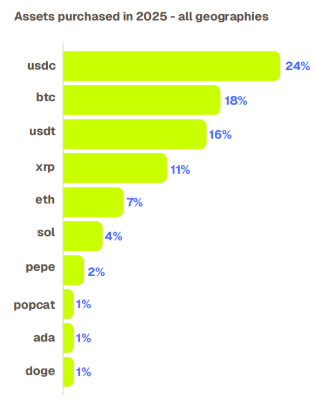
The shift towards stablecoins in 2025 represents a maturation of the market. As users become more sophisticated and their needs diversify, the focus has moved from pure speculative investment to practical applications like value preservation and everyday transactions. The increasing prevalence of high inflation and currency devaluation across several Latin American nations has amplified the need for stable, dollar-denominated assets. Stablecoins, with their ease of use and accessibility through existing crypto infrastructure, have filled this void effectively.
Broader Implications for the Latin American Digital Economy
The sustained growth of stablecoin adoption has several significant implications for the Latin American digital economy. Firstly, it facilitates greater financial inclusion by providing access to dollar-denominated assets and transaction capabilities for individuals who may be underserved by traditional banking systems. This can empower entrepreneurs, small businesses, and individuals to participate more fully in the global economy.
Secondly, the increasing use of stablecoins for remittances can significantly reduce transaction costs and improve the speed and efficiency of cross-border money transfers. This is particularly impactful in a region where remittances constitute a vital source of income for many households.
Thirdly, the trend could foster greater integration of digital assets into everyday commerce. As more businesses and consumers become comfortable using stablecoins for payments, this could pave the way for broader adoption of other digital assets and decentralized technologies.
However, challenges remain. Regulatory uncertainty surrounding stablecoins in various Latin American jurisdictions could pose a hurdle to their widespread adoption. Furthermore, ensuring the security and transparency of stablecoin issuers is paramount to maintaining user trust. The potential for de-pegging events, though rare, remains a concern for users, highlighting the importance of robust oversight and reliable stablecoin designs.
The Bitso report’s findings provide a clear indicator of the evolving priorities of Latin American crypto users. While Bitcoin’s role as a long-term store of value is unlikely to diminish, the immediate practical benefits offered by stablecoins in the face of economic adversity have propelled them to the forefront of daily digital asset usage in the region. This dynamic shift underscores the adaptability of digital finance and its capacity to respond to pressing socio-economic needs. As the region continues to navigate its economic complexities, stablecoins are poised to play an increasingly central role in shaping its digital financial future.
Cointelegraph remains committed to independent, transparent journalism. This news article is produced in accordance with Cointelegraph’s Editorial Policy and aims to provide accurate and timely information. Readers are encouraged to verify information independently.