Sisilia Frederika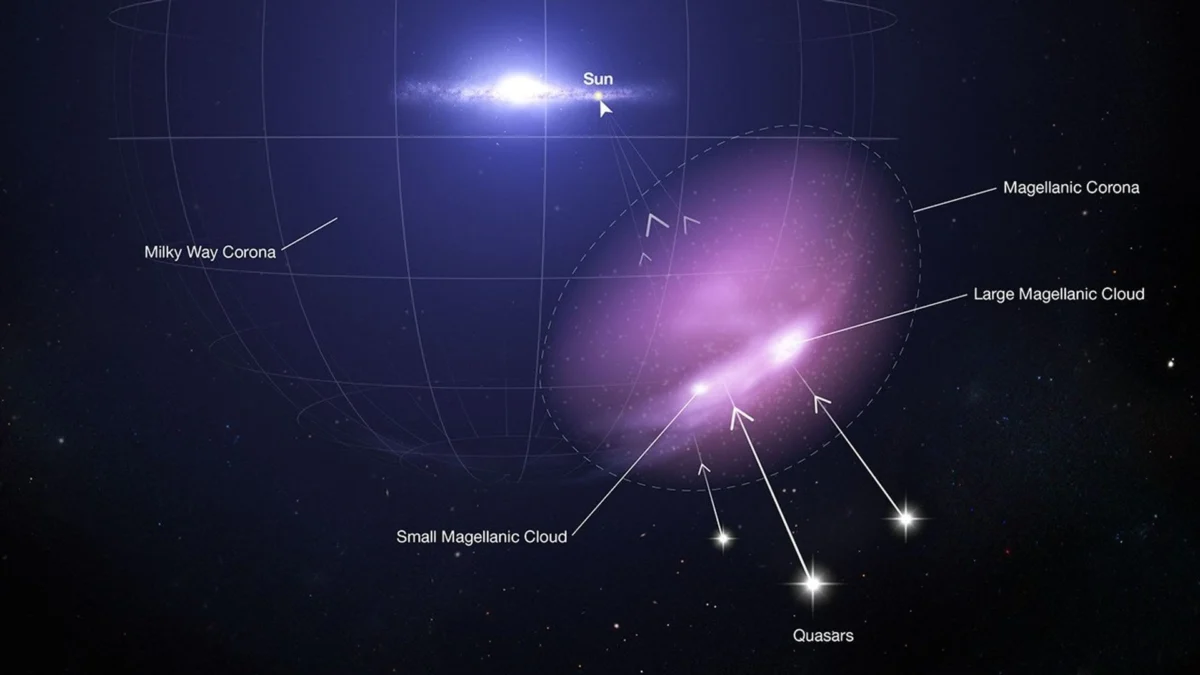
The Large Magellanic Cloud (LMC), a sprawling satellite galaxy located approximately 163,000 light-years from Earth, has become the focal point of a sophisticated astronomical dispute that carries profound implications for our understanding of galactic evolution. For years, the astrophysics community has been divided over a fundamental question: Is the LMC currently making its first-ever close approach to the Milky Way, or is it on a return journey, having completed a "second pass" billions of years ago? A comprehensive new research initiative led by Scott Lucchini, Jiwon Jesse Han, Sapna Mishra, and Andrew J. Fox, recently detailed in two papers available on the arXiv pre-print server, claims to provide definitive evidence supporting the "first-pass" hypothesis. By utilizing advanced hydrodynamic simulations and spectroscopic data, the team argues that the presence of a substantial gaseous corona around the LMC is incompatible with a history of multiple encounters with the Milky Way.
The Evolution of a Cosmic Debate
To appreciate the weight of this new evidence, one must look at the shifting paradigms of the last two decades. Historically, the LMC and its smaller companion, the Small Magellanic Cloud (SMC), were assumed to be long-term satellites that had orbited the Milky Way for billions of years. However, this view was challenged in the early 2000s when high-precision measurements from the Hubble Space Telescope revealed that the LMC was moving much faster than previously estimated—nearly 327 kilometers per second. Such high velocities suggested that the LMC might not be bound to the Milky Way in a traditional closed orbit, but was instead a "first-time visitor" just passing through.
The debate took a complex turn in early 2024 when physicist Eugene Vasiliev published a paper that revitalized the "second-pass" theory. Using data from the Gaia mission and sophisticated collisionless N-body dynamics models—which track the gravitational interactions of stars without accounting for gas—Vasiliev proposed that the LMC could have first encountered the Milky Way between 6 and 8 billion years ago. He argued that if the Milky Way’s dark matter halo was anisotropic—meaning the velocities of dark matter particles are distributed unevenly—the LMC’s current position and velocity could be explained by a previous passage at a distance of roughly 100 kiloparsecs (kpc). This would mean the LMC is a much older component of our local environment than the first-pass theory suggests.
Testing the Trajectories of Hypervelocity Stars
The research team led by Lucchini initially attempted to settle the dispute by examining "hypervelocity stars." These are stellar objects that have been ejected at extreme speeds from the center of the LMC, likely due to interactions with its central black hole. The logic was that if the LMC had passed the Milky Way before, the trajectories of these ejected stars would bear the gravitational scars of that previous encounter.
However, the results of this first study proved inconclusive. After tracing the paths of these fast-moving stars, the researchers found that their current distributions could be explained by both the first-pass and second-pass models. The stellar dynamics alone did not provide the "smoking gun" needed to confirm one theory over the other. This prompted the team to pivot from stellar dynamics to hydrodynamics—the study of gas in motion.
Hydrodynamics and the Galactic Corona
The breakthrough in the Lucchini study came from focusing on the LMC’s "corona"—a massive, invisible halo of warm, ionized gas that surrounds the galaxy. Unlike stars, which are largely unaffected by the thin gas of the Milky Way’s own halo, the LMC’s gas is subject to "ram pressure stripping." As the LMC moves through the Milky Way’s circumgalactic medium (CGM), the pressure acts like a wind, blowing away the LMC’s gas.
Using a software simulation package known as GIZMO, the researchers combined rigid analytical dark matter models with "live" gas particles. They simulated both a first-pass scenario and a second-pass scenario to see how the LMC’s corona would react over billions of years. To verify their simulations, they used a secondary software tool called Trident to generate synthetic ultraviolet (UV) spectroscopic data. This allowed them to compare their virtual results directly with real-world observations from background quasars.
By analyzing the absorption of Carbon IV and Hydrogen II—elements that serve as tracers for ionized gas—the team found a striking discrepancy. The first-pass model produced a massive, robust corona that perfectly matched the column density profiles observed by modern telescopes. In contrast, the second-pass model showed that the LMC would have lost the majority of its corona during its initial encounter 6 to 8 billion years ago. In the second-pass scenario, the LMC’s corona was far too small and depleted to match the current observational data.
Supporting Data and Technical Nuances
The simulation data provided a clear visual and mathematical distinction between the two theories. In the first-pass model, the LMC retains a significant portion of its original gas reservoir because it has only recently begun to feel the effects of the Milky Way’s ram pressure. In the second-pass model, the "time spent swimming" through the Milky Way’s dense inner halo results in a stripped, emaciated corona that contradicts the high-density gas detected by UV spectroscopy.
Despite the strength of these findings, the authors acknowledged certain simplifications made to manage the immense computational power required for such simulations. Notably, the Small Magellanic Cloud (SMC) was excluded from the models. The SMC is a critical player because it is gravitationally bound to the LMC and contributes the majority of the neutral gas found in the "Magellanic Stream"—a long tail of gas trailing behind the two galaxies. Furthermore, the researchers used a simplified single-phase model for the corona, whereas the actual circumgalactic medium is likely a complex, multi-phase environment consisting of gas at varying temperatures and densities.
The Subaru Hyper Suprime-Cam and Conflicting Evidence
The debate remains far from settled because other independent teams have produced data that favor the second-pass model. Only weeks before Lucchini’s papers were released, a team utilizing the Subaru Hyper Suprime-Cam published findings regarding tidal debris in the Milky Way’s outer halo. They identified a population of stars located approximately 30 kpc away that appear to be "stellar crumbs" left behind by a previous interaction with the LMC.
Proponents of the second-pass theory argue that these tidal features are difficult to explain if the LMC is only just arriving. They suggest that the LMC must have been close enough to the Milky Way in the distant past to have its outer stars stripped away by galactic tides. This creates a scientific tension: the gas (hydrodynamics) suggests a first pass, while some stellar debris (dynamics) suggests a second pass.
Broader Implications for Galactic Evolution
The resolution of this debate is not merely an academic exercise; it has significant consequences for the calculated mass of the Milky Way and the LMC. If the LMC is on its first pass, it implies that the galaxy is much more massive than previously thought—perhaps as much as 10% to 20% of the Milky Way’s total mass. Such a massive "intruder" would significantly warp the Milky Way’s disk and shift the "barycenter" (the center of mass) of our local galactic group.
Furthermore, the LMC’s orbital history dictates the future of our galaxy. A first-pass trajectory suggests that the LMC is currently at its closest point (perigalacticon) and will eventually be consumed by the Milky Way in a massive merger roughly 2 to 4 billion years from now. This collision would trigger a burst of star formation and potentially wake up the Milky Way’s dormant central black hole, Sagittarius A*.
Future Missions and Observations
The scientific community is now looking toward upcoming space missions to provide the tie-breaking data. NASA’s Aspera mission, a SmallSat designed to observe the extreme ultraviolet emission from hot gas, is expected to play a pivotal role. By directly mapping the morphology and distribution of the Magellanic gas, Aspera will allow researchers to see the "shock fronts" where the LMC’s corona meets the Milky Way’s halo.
Additionally, deeper surveys from the Vera C. Rubin Observatory (LSST) will provide a more detailed map of the stellar debris in the Milky Way’s outskirts. If more tidal streams are found that align with the LMC’s path, the pressure on the first-pass model will increase. Conversely, if no further evidence of an ancient encounter is found, the hydrodynamic evidence presented by Lucchini and his colleagues may become the accepted standard.
For now, the Large Magellanic Cloud remains an enigmatic neighbor. Whether it is a long-lost relative returning home or a brand-new visitor shaking up our galactic neighborhood, its presence continues to challenge the limits of modern computational astrophysics and observational technology. The ongoing dialogue in academic journals reflects a vibrant period of discovery, as humanity continues to refine its understanding of the dynamic, ever-changing universe.